
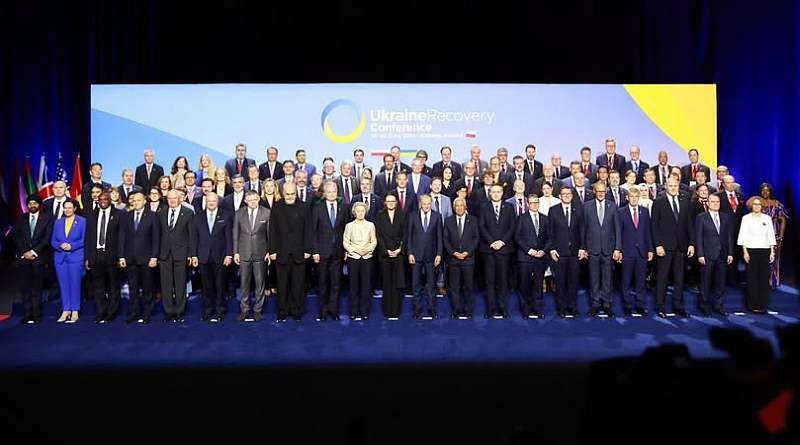
There’s currently a warming in relations between Poland and Ukraine in Gdańsk — the Fifth International Conference on the Reconstruction of Ukraine (URC 2026). Delegations from almost 70 countries, businesses, institutions. But that’s not the main thing.
How does this summit differ from those in Lugano, London, or Berlin? In every way. Illusions have been dispelled. There will be no purely civilian post-war reconstruction anymore. The Poles have pushed through a new reality — officially integrating the fifth dimension into the framework: security and defense.
Europe finally understands. Investing billions in civilian infrastructure without protection from air defense systems, aviation, interceptor drones, and electronic warfare is money thrown away. Yes, reconstruction must start now. Not waiting for winter. Or any mythical ceasefires. We expect the signing of about 160–200 specific economic agreements. The lion’s share — defense. Volumes around 10–12 billion dollars. In my opinion, very good.
Financial Circulatory System
Ursula von der Leyen laid out the foundation. Ukraine’s security is now the foundation of all European security. Period. What about the money?
A package of 90 billion over the next two years has been confirmed. These inflows are critically necessary. This is our macroeconomic stability. Energy sourcing. Army financing. And major repairs of what remains of our energy system after Russian strikes. Plus, they granted a tranche of 2.3 billion. Because cash gaps need closing here and now.
These 90 billion in macro-finance and an additional 6 billion targeted for drones (more on this later) are not just aid, but a clear market marker. Such budget inflows are guaranteed to accelerate European defense. Shares of European corporations, which are now entering joint ventures with Ukraine, will get a nice boost. This is no longer just politics; it is a new European security market, where the smartest money is going and where the real big game begins.
A very important marker was highlighted separately — SEPA. From the beginning of 2026, we are in the Single Euro Payments Area. For logistics and the defense industry, it is just what the doctor ordered — transaction costs drop radically. Seamless payments. Banking compliance is minimized, gray schemes shrink, and the procurement of critical components in Europe accelerates.
Judging by the fact that we are purchasing the same engines for “Ruta” missiles in the EU and the count has exceeded a thousand units — this is a super important moment that accelerates many things.

Evolution of the Military-Industrial Complex: From Donorship to Joint Assembly Line
Here’s the biggest piece of news. The rhetoric has changed completely. No longer “give us ready weapons,” but “let’s build factories together.”
Europe is pouring six billion euros purely into scaling up drones. Direct government investments in asymmetrical warfare. The focus on innovations dictated by the battlefield: interceptor drones, mid-strikes, crewless boats, and electronic warfare. Our developers have unique expertise here right now. There’s a window of opportunity for a few months – they’re right to increase investments.
The paradox of Harvard professor Joseph Henrich’s fish is in full swing: it’s not the smartest individual that survives and wins, but the system capable of rapidly accumulating collective experience. Our military innovations are not ingenious drawings from peaceful design bureaus. It’s the cumulative experience of thousands of calculations, paid for with blood and countless mistakes in real battles.
European capital is now buying into this evolutionary leap, so its armies don’t have to start from scratch and with bloody sacrifices.
Next are ground drones. There’s a great case of merging European capital and our combat experience. German Quantum Tencore Industries signed with Ukrainian Tencore. Ground robotics is the next stage in the evolution of warfare. Last mile logistics. Anyone who worked at the evacuation stage knows very well what zero looks like now. Extracting and stabilizing a severely wounded person under continuous FPV swarm drops and fiber optic arrivals is often a one-way ticket for the medic themselves. Ground drones that pull stretchers from the red zone offer a chance to return the wounded to duty without disability. Plus, mining, fire support, supplying isolated garrisons.
Europe perfectly understands: robotizing evacuation is the only way to preserve specialists when the sky is swarming with enemy drones. I think rich countries are very interested in the idea of covering the Suwalki corridor or forests on the border with Belarus with ground drones. Because they clearly have no desire to receive massive coffins of their voters.

And, of course, important are the distributed supply chains. The production of specialized fuel for Flamingo rockets is being developed in Denmark, despite scandals with Mindich. This is classic risk hedging. The most explosive critical components are made deep in the European rear. Missiles don’t reach there. This ensures uninterrupted final assembly. Fuel, warheads, guidance systems, engines — the EU is the ideal place to scale all this. They get battle-tested technologies without teething problems and production lines. And we get investments and protection from bombings.
Politics and European Integration
The political framework was created by Donald Tusk. He called Gdansk a living symbol of reconstruction. And emphasized that the foundation of a successful future and integration is historical truth and the sincere ability of nations to reconcile. This is a good sign. Moving away from disputes about what is worse — the division named after UPA heroes (an organization not recognized as criminal by allies or the USSR at Nuremberg) or the monument to Piłsudski in Warsaw, who pacified Ukrainians with bloody methods. These are past matters. They do not affect the current situation at all.

Svyrydenko reminded of another much-needed step — last week the first negotiation cluster for EU accession was officially opened. The signal from the European Commission is clear: maintain the current pace of reforms — full membership is a matter of the foreseeable future. We would very much not want to repeat Turkey’s path here. Which always lacks something for membership.
Dry Summary. Briefly
URC 2026 highlights the key point: Europe is transitioning from panicked reactions to crises to systematic long-term planning of the military economy. Hundreds of contracts. Direct billion-dollar investments in drones. Deployment of joint defense production lines. The union is purposefully creating an autonomous military-industrial framework.
In this framework, our practical survival experience and field innovations are now merging with their industrial potential and financial strength. We did not choose this path. But monetizing the fact that Ukraine managed to drive the Black Sea Fleet out of Crimea or take out all oil refineries in the European part of the Russian Federation is the only correct policy.
We no longer ask for protection; we sell our experience and become an integral part of the European military machine. This is a pragmatic symbiosis where Europe pays with money and factories so that tomorrow it doesn’t pay with the blood of its citizens. The war of attrition has reached the level of industries, and in this race, we are finally beginning to play by the rules of the wealthiest and most developed countries in the world.
On the cover: During the Ukraine Recovery Conference 2026 at the European Solidarity Center in Gdansk, Poland, June 25, 2026. Photo: CMU
