
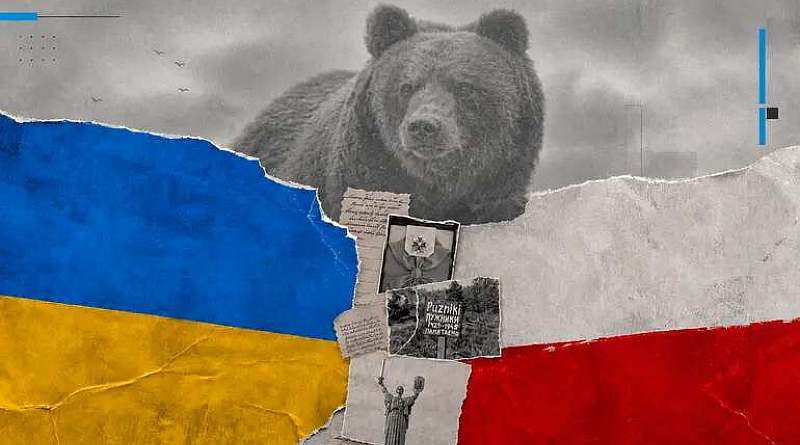
Kostyantyn Yelisieiev / Mirror Weekly
In diplomacy, there is a truth: coalitions formed to counter a major threat rarely collapse due to that threat. On the contrary, a common enemy usually unites. Instead, coalitions break apart due to disputes that at some point begin to overshadow the main issue and gradually push it out of the political agenda. It seems that the relations between Ukraine and Poland are facing such a risk today.
The recent discussions surrounding historical memory, symbols, names, awards, or specific political decisions are certainly important. History always matters. Memory matters. Respect for societal sensitivities also matters. But today, they are not an existential challenge.
The main challenge remains Russian aggression. Period.
This very threat defines the strategic content of Ukrainian-Polish relations as well as our relations with other countries. It created our nations’ natural alliance, breathed new life into strategic partnership. Crucially, it allowed for the resolution of historical memory. It explains the unprecedented level of support Poland has provided Ukraine since the first days of the full-scale war. It remains the reason why Ukraine’s success is a security issue not only for Kyiv but also for Warsaw.
During the war, other important issues do not disappear. They will return once the great threat is gone. Historical discussions do not cease automatically just because there is an external enemy. But responsible state policy is not about ignoring complex issues; it is about prioritizing correctly.
European history knows many examples where states with a difficult historical legacy found the wisdom and restraint not to let the past destroy the future. They did not abandon their memory. They did not renounce their heroes or historical assessments. But they understood that there are moments when security, stability, and a shared future require greater political responsibility than historical disputes.
That is why the current escalation around awards, honors, and symbolic gestures should be treated with responsibility. What is needed now is not escalation, but de-escalation. Not seeking new reasons for mutual grievances, but returning to strategic priorities. Not expanding the conflict agenda, but narrowing it. The more political importance given to such episodes today, the greater the risk of making them a permanent part of Ukrainian-Polish relations tomorrow and in the future.
There is a sense that at a certain point, emotions prevailed in both Kyiv and Warsaw. It happens in politics, and there’s nothing unique about it. Problems arise when emotions start to shape not only news headlines but also state policy.
Ukraine and Poland have significantly more reasons for cooperation than for conflict. We are united by security, the economy, a European and Euro-Atlantic future, a shared border, millions of human contacts, and a joint responsibility for the future of our region.
This is why the main task today is to prevent the ghosts of the past or contemporary emotions from destabilizing the coalition of friendship, support, and unity that has formed between our countries during the toughest years. Our peoples have too many shared interests and challenges to let secondary issues overshadow the main one. Historical discussions will still occur. They won’t disappear. But the future of Ukrainian-Polish relations should be defined not by disputes about the past, but by a shared responsibility for the future.
However, it would be a mistake to assume that the current crisis is merely an emotional episode that will pass on its own. On the contrary, it has already generated several serious challenges that Kyiv and Warsaw will have to address.
The first challenge — Ukraine’s friends in Poland. There are still many of them. But today, many find themselves in an extremely uncomfortable position. Suddenly, all these people find themselves in a toxic environment and, however much they want to help, they cannot escape a political atmosphere divided into “us vs. them.” For these supporters of Ukraine, it is more important to remain among their own than to risk accusations of neglecting Polish interests. This is a serious problem that cannot be ignored.
The second challenge — the Russian factor. Moscow has always been adept at exploiting discord among its opponents. Any complication in relations between Ukraine and Poland is seen there as a strategic gift. The Kremlin has for years tried to find a weak spot in the Ukrainian-Polish partnership. Today’s situation creates opportunities it could only dream of until recently. To provoke such a loud discussion about the relations between two key opponents of Russian aggression is an outcome Moscow certainly won’t overlook.
The third challenge — Poland’s internal politics. It would be naive to think that the current wave of emotions will quickly subside. On the contrary, the topic of Ukrainian-Polish relations is increasingly integrating into Poland’s internal political agenda, especially with the 2027 parliamentary elections already influencing the behavior of major political forces. For President Nawrocki and the political camp supporting him, the Ukrainian issue is gradually becoming part of a broader discussion about historical memory, national identity, and Poland’s role in the region. This means that the issue of Ukrainian-Polish relations will remain in the realm of domestic political contention. And if someone today believes that the current epicenter of emotions will soon be left behind, that could be a mistake. As the 2027 elections approach, the temptation for Polish politicians to mobilize voters around topics of historical memory and relations with Ukraine may grow stronger.
Fourth challenge — communication. The current situation creates a problem that is not yet being discussed sufficiently. Ukraine is catastrophically losing the circle of people capable of effectively explaining the Ukrainian position in Poland and at the same time maintaining trust within the Polish political, expert, and social environment. Many who have been sincere friends of Ukraine for years now find themselves in a toxic atmosphere of internal debate, where any support for Kyiv can be used by their opponents as an argument against them. As a result, the number of natural communicators between our countries is not increasing but decreasing. This is a dangerous trend because crises between states are overcome not only through official diplomacy but also through a network of personal contacts, trust, and people who can talk to each other even when official positions diverge. That is why Ukraine needs to think about restoring and expanding such a circle of contacts, finding new interlocutors and new formats of dialogue, and possibly a special envoy to work on supporting Ukrainian-Polish communication during a difficult period.
Fifth challenge — European and Euro-Atlantic integration of Ukraine. It’s hard to imagine a less favorable moment for political tension in relations with Poland. Ukraine is at the stage of negotiations to join the European Union and continues its movement towards NATO (however little is said about it). Not so long ago, the prospect of opening new negotiation clusters was quite real and almost settled. Today, the situation no longer seems so obvious. There is a risk of the emergence of new situational coalitions to contain Ukraine, where different Central European capitals — from Budapest to Bratislava, from Warsaw to Prague — may find a common interest. It doesn’t matter much who will be the formal leader of such a coalition. What matters is the result.
That is why today Ukraine and Poland need not a new escalation, but a new stage of responsibility. Because, ultimately, history evaluates statesmen not by how skillfully they exacerbated disputes, but by whether they were able to keep allies when it was most necessary.
Collage: ZN.UA / DALL-E
