
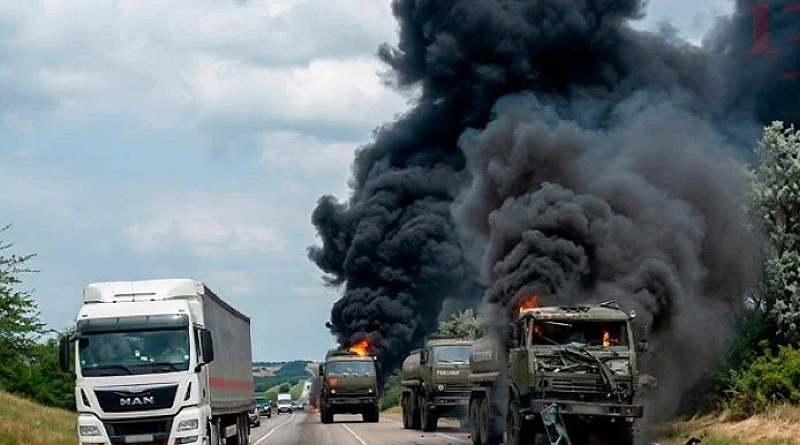
Oil has been and remains the lifeblood of war. Not just an export item and its funding source. What does the enemy group lose, and how do its combat tasks change under the influence of logistical problems? Let’s try to understand with a concrete example.

Across Ukrainian territory north of the Sea of Azov runs the M14 highway. Within our country, this route goes from Kherson to Melitopol — Pryazovske — Prymorsk — Manhush — Mariupol — Novoazovsk. It is a key transport corridor in southern Ukraine, important for the logistics of the Sea of Azov ports. In Melitopol, the route intersects with the M18 highway Kharkiv — Simferopol, which via Novooleksiivka, Chonhar / Dzhankoi leads to Crimea. The occupiers designate the highway from Novoazovsk to Simferopol as the R-280 route. The entire logistics of the enemy in the southern part of the theater of operations is tied to this road, meaning its “Vostok” troop groups in the Oleksandrivka and Huliai Pole directions, “Dnipro” in the Orikhiv and Prydniprovsk directions, and the entire occupation circus in Crimea. Partly, this road supports the “South” enemy grouping, which conducts combat operations near Pokrovsk, but we will not delve into it to form a general idea.
Accounting (we do not have access to intelligence data, so we analyze open sources, where the range of figures is significant, hence we take lower indicators):
UV “Vostok” — consists of the 5th, 35th, 29th, 36th armies, the 90th tank division (transferred from UV “Center”), the 120th marine division, part of the troops of the 68th army corps, three to four territorial regiments/battalions. Considering troop staffing and supply levels at 50–70%, this may comprise at least 35 thousand servicemen, 180 tanks, 450 armored combat vehicles, 250 self-propelled artillery of various types, 25 self-propelled anti-aircraft missile systems, 1500 trucks of general and special purpose.

UV “Dnepr” — 49th, 58th armies, part of the forces of the 18th army, 7th, 76th air assault divisions, 98th, 104th airborne divisions, 45th special forces brigade of the Airborne Forces. Group size — about 40,000 servicemen, 200 tanks, 500 armored fighting vehicles, 300 self-propelled guns of various types, 30 self-propelled anti-aircraft missile systems, 2000 general and special purpose trucks.
In Crimea, the military situation is much more complex, as it is not only an “unsinkable aircraft carrier” but also a refuge for the battered, a training camp, and an operational rear with permanent bases, home airfields, and fleet bases. The situation is as follows: operational-tactical group “Crimea” (remnants of the 18th army, which are scattered in permanent bases for various reasons, remnants of the 810th Marine Brigade), units of the National Guard, FSB, border guards, and territorial troops for internal security and coastal defense. The total number is about 20,000 people, taking into account rotations, air defense, logistics, aviation, and the fleet. The air component is represented by the 27th mixed aviation division based at the Belbek, Dzhankoy, Saky, Gvardiyske, and other airfields, and the 31st air defense division of the 4th Air Force and Air Defense Army. The remnants of the naval component are mostly small boats and auxiliary vessels.
Crimea remains an important rear hub for the entire enemy group in the occupied south of Ukraine.
Thus, at least 95–100 thousand soldiers are fed three times a day; fuel tanks are filled for 380 tanks, 950 armored fighting vehicles, 550 self-propelled guns, 75 air defense systems (in Crimea, an additional 40 self-propelled air defense systems and 15 radars), up to 4000 trucks, 40 combat and about ten transport aircraft. Generators providing electricity to the troops are not counted; they seem impossible to count.

How is the army’s rear organized? A battalion must be autonomous for ten days, meaning it carries part of the military reserve with it. A brigade must lift and maintain a month’s supply for combat operations in the area of the mission. The army/corps must ensure replenishment of the subordinate tactical level’s reserves and maintain a supply for the entire operation.
The struggle against tactical and partly operational level depots was begun by the Defense Forces back in 2023. Over 110,000 trucks were taken out, plus 4,300 special vehicles. This fragmented the system of storing military reserves, complicating the transportation support for the troops. This scenario is common to all front sectors, although donkeys were only noticed in the “Zapad” military group. The Defense Forces have no complaints against the donkeys; the warriors of light love animals.
If the troops are supplied according to norms, without theft or corruption games, the occupying horde consumes 300–350 tons of food daily, 6,000–7,000 tons of water including technical, 330 tons of fuel and lubricants, 50–150 tons of ammunition, and 50–150 tons of military-technical property.
To deliver all this from storage locations to battalion/brigade field depots requires 100 railway cars and 1,500–2,000 trucks daily, needing to make 1,200–1,400 trips, consuming 400–500 tons of fuel. Notice the water and compare it to the fuel need. Interesting, isn’t it?
The Southern Defense Headquarters made similar logical constructions. And intense combat work began.

On the route Novoazovsk — Melitopol — Dzhankoy — Simferopol, there are between 15 to 25 road bridges that are critical for all movement, 25–40 medium-sized and more than 50 road structures, the destruction of which would slow down or stop movement in specific sections.
The unmanned systems forces are currently focused on a key section — at the gates to Crimea: it’s known that two to five objects have been completely destroyed, five to ten seriously damaged, and a significant, though unspecified number of road structures temporarily taken out of normal operation.
Asymmetrically, but beautifully, the Defense Forces have achieved an effect: enemy columns are forced to move along detour routes, which lengthen journeys by 50–150 km, the number of vehicle trips per day has dropped from 1 to 0.5–0.7 (meaning the vehicle doesn’t return to base, it will only be reloaded the next day), the need for trucks has increased by 30–70%, and bottlenecks have appeared all along the route.
Smart Ukrainian planners have clearly identified that the main target of this campaign should not be all the bridges, but rather five to seven nodes that control the throughput capacity of the entire corridor. This has already been demonstrated along the entire M14 highway.
We have already said a few words about the logistical autonomy of the troops: interruptions or complete halts in supplies do not lead to an immediate effect — it is cumulative. Everyone understands that central supply vehicles do not deliver supplies directly to the front-line battalions — everything is delivered to army depots, unloaded, then loaded onto army transport, which goes to brigades, further unloaded, loaded onto brigade transport (motorcycles, civilian cars stolen from the population, quad bikes, if there are any, horses/donkeys/soldiers; in Kharkiv region a camel defected from the enemy and joined the good side), which moves to battalions. Sometimes you have to carry things 50 kilometers or more on foot. Imagine the speed of supply? And all this happens in the killzone, where you can’t just stroll around.
By disrupting logistic transport and creating problems at selected points along the routes, the Defense Forces have at least formed a chronic daily supply deficit for enemy units on the front line. Merely controlling UAVs over the M14 logistic route causes delays in the delivery of 0.5–0.7 thousand tons of cargo daily, each strike on transport infrastructure delays 1.5–3 thousand tons of cargo, and systematic attacks on logistics — 3–4 thousand tons. In five to seven days, the volumes of undelivered military cargo reach tens of thousands of tons.

To understand the scale of the catastrophe, which Ukrainian drone operators are diligently working on, let’s consider the needs of a regular battalion conducting mid-intensity offensive operations in southern Ukraine. For combat operations, it is necessary to deliver to its depot 40–65 tons of cargo daily: 18 tons of water, one and a half tons of food, ten tons of fuel, five tons of ammunition, and up to two tons of military-technical equipment.
We can see that a single attack on enemy logistics deprives 12–13 frontline battalions of timely supplies.
Keep hitting them, guys!
On the cover: Damaged Russian army equipment. Photo: video screenshot
