
The battle for Donbas continues. The enemy’s military groupings “Zapad” (20th and 25th armies), “Yug” (3rd, 8th, and 51st armies), and “Center” (2nd and partially 41st armies) are continuing their Sloviansk-Kramatorsk offensive operation in the Lyman, Sloviansk, Kramatorsk, Druzhkivka, Kostyantynivka, and Dobropillia directions, but this does not mean they have sufficient resources for an operational breakthrough.
The key issue is whether the enemy’s military command in the theater of operations is not only able to maintain the intensity of assaults but also has a combat-ready grouping that can develop an offensive into the depth after breaking through Ukrainian defenses.
Today, the aggressor has resources to continue the offensive, but turning tactical advances into a large-scale operational success remains a complex task for them. This is indicated by three main factors.
Firstly, the enemy command continues to concentrate efforts mainly on the southern flank of the Sloviansk-Kramatorsk agglomeration. In the Dobropillia area, the occupiers are attempting to expand the zone of penetration, create a threat to the logistics routes of the Defense Forces, and lay the groundwork for further advancement on Kramatorsk. On the Kostyantynivka direction, the enemy seeks to establish itself in urban areas and expand its control zone. Meanwhile, the infiltration of separate assault groups into the city does not imply control over it or readiness for further advancement. The enemy is present in only 38% of the urban area, which does not mean control over Kostyantynivka, and their advancement in the Dobropillia area is accompanied by intense fighting.

Secondly, the enemy’s forces are forced to expend resources to maintain the pace of the offensive simultaneously in several directions. This does not allow them to apply a single powerful strike group, as all armies of the three previously formed groups are forced to act in different directions. It is particularly important that the Ukrainian operation “Vivaldi” in the Lyman direction has created an additional problem on the northern flank for the Russian command.
Moscow must consider the risk of further Ukrainian counterattacks, restore lost positions, and respond to threats to its own communications. Accordingly, part of the forces and resources have to be used not for further offensive, but for stabilizing the front.
Thirdly, tactical penetration does not guarantee an operational breakthrough. To develop success, the enemy needs to concentrate a sufficient amount of combat-ready infantry, armored vehicles, artillery, engineering units, and air defense systems, and continuously supply ammunition and fuel.
Even if the occupiers manage to break through a specific section of the defense, further advancement will depend on the ability to deploy fresh forces, expand the breach, and prevent its isolation by Ukrainian counterattacks. However, there are no fresh forces.
As always, there are three scenarios:
• Realistic: continuation of exhausting battles with the gradual advance of Russian forces in certain areas without a rapid collapse of Ukrainian defense;
• Negative for Ukraine: a local breakthrough with the subsequent expansion of the Russian foothold if the Ukrainian command lacks sufficient reserves to promptly close the gap;
• Favorable for Ukraine: further exhaustion of Russian strike groups and disruption of their plans with counterattacks, disruption of logistics, and the need to regroup forces between directions.
The greatest danger lies not so much in a single deep breakthrough, but in the simultaneous deterioration of the situation at several locations. If the Ukrainian command is forced to sequentially transfer reserves from one direction to another, the aggressor will have the opportunity to exploit the weakening of neighboring sectors.
Russia has the potential to continue the offensive, but its ability to turn local advances into an operational breakthrough depends on maintaining momentum, having fresh reserves, and the ability to neutralize Ukrainian counterattacks. That is why the situation near Dobropillia and Kostiantynivka remains dangerous, but talking about an inevitable breakthrough is premature.
Something should be said about Operation “Vivaldi,” whose impact goes far beyond the immediate battles on the Lyman direction. Its main operational effect is complicating the enemy’s plans to encircle the Sloviansk-Kramatorsk agglomeration from the north. The total declared area of restored control by the Defense Forces reached 277 km², and the number of liberated settlements is 16.
Blue-and-yellow flags were raised in the liberated settlements of Lypove, Zelena Dolyna, and Kolodiazy!
Three more settlements were fully de-occupied during the fourth season of Operation “Vivaldi” by the Third Army Corps.
We are not stopping at what has been achieved. The fight continues! https://t.co/aYrLKkOokN
— Third Army Corps (@ab3army) October 15, 2026
Russia’s strategy regarding Sloviansk and Kramatorsk involves not only a frontal assault. A potential way to achieve the goal is to encircle the agglomeration from multiple directions and gradually cut off supply and withdrawal routes of Ukrainian troops. That is, once again, the enemy uses its favorite operational technique, only this time the level of implementation is not just a single settlement, but an entire agglomeration, and among the executors are the troops of seven armies.
The northern flank of this plan is linked to the area of Lyman, the Siverskyi Donets, and the advance towards Sloviansk, forming the northern flank of the encirclement. Success in this area could threaten Ukrainian communications and complicate the defense of the entire agglomeration.
The southern flank is associated with pressure through Kostyantynivka, Dobropillia, and adjacent areas. If forces succeed on both flanks, the enemy command could threaten the operational encirclement of Ukrainian forces in the area of Sloviansk and Kramatorsk. This is why stabilizing the northern flank is of strategic importance.
What changed with Operation “Vivaldi”?
We see three main consequences:
1. The operation complicated the implementation of the Russian plan of encirclement from the north: Ukrainian counterattacks forced the enemy forces to respond to the threat of losing positions and hinder the stable development of the offensive in the Lyman area. The defense forces are advancing towards the Zherebets River northeast of Lyman. The actions of the Defense Forces on this flank complicate the implementation of the broader enemy plan regarding the encirclement of the Fortress Belt;

2. The operation forced the command of “Zapad” to pay more attention to the defense of the southern flank, and the enemy’s command in the theater of operations to the northern flank of the entire group formed for the operation: the enemy command has to consider the risk that the Ukrainian advance poses to its forward units, supply routes, and positions used for preparing offensive actions. This may require the redeployment of troops, strengthening defenses, and adjusting attack plans. However, it’s important to distinguish between a confirmed result and a potential effect: open data indicate that the Russian command is responding to Ukrainian actions, but do not allow for an accurate determination of how many reserves have already been redeployed and which specific offensive operations have had to be postponed as a result;
3. The operation created an opportunity to reduce pressure on Sloviansk from the northern direction: if Ukrainian forces can hold the captured positions, consolidate them, and prevent new breakthroughs by the enemy, it will be more difficult for the opponent to use Lyman as a platform for further advances. This may force the Russian command to rely primarily on advances from the south and southwest, where Ukrainian defenses also create significant difficulties. At the same time, focusing Russian efforts on a different sector does not necessarily imply a reduction in the overall intensity of the offensive. On the contrary, the enemy may try to compensate for setbacks in one direction by increasing pressure in another.
Can “Vivaldi” Disrupt the Russian Offensive on the Agglomeration?
The operation has already created prerequisites that complicate the aggressor’s plans, but the long-term effect will depend on whether the Defense Forces can turn tactical results into a lasting change in the operational situation.
For this, it is necessary to:
• hold the liberated territories;
• ensure supply to Ukrainian units on the achieved lines;
• prevent the enemy from using neighboring areas to bypass Ukrainian forces;
• preserve combat-ready reserves to repel a possible counterattack.
It is also important to note that liberating territory itself does not eliminate the Russian threat. The enemy may regroup, take up defense on certain lines, or try to resume the offensive after replenishing forces.
Therefore, “Vivaldi” is significant as it complicates the enemy’s encirclement of the Sloviansk-Kramatorsk agglomeration from the north. The operation may force the enemy command to change priorities and regroup forces. However, its main result will be measured not by the area of liberated territory but by how long Ukraine can maintain the initiative and prevent the resumption of the Russian offensive.
The resilience of Ukrainian defense will be determined by a combination of three factors: the availability of combat-ready reserves, the ability to maintain logistical routes, and the quality of defensive positions. None can compensate for the failure of another. Even well-prepared fortifications do not guarantee success if units lack personnel and ammunition. Similarly, the presence of reserves does not ensure stable defense if the enemy can bypass fortified positions and cut supply lines.
The First Factor — Reserves and Their Combat Readiness
This is one of the most important factors. Ukrainian command must simultaneously restrain Russian attacks on the Lyman, Sloviansk, Kostiantynivka, and Dobropillia directions. Accordingly, the need for reserves arises not in one place but at different sections of the front.
The problem is that reserves are needed not only to close gaps in the defense. They must also ensure the replacement of units that have lost combat capability, reinforce threatened areas, and conduct counter-attacks. If reserves are used primarily for urgent responses to Russian breakthroughs, the ability of the Ukrainian command to proactively influence the situation decreases.
For such an assessment of the availability of such reserves in the Defense Forces, data is needed on numbers, staffing, losses, training level, and their readiness. All this is a secret that is strictly guarded.
Therefore, it is more correct to talk about risks: the more directions simultaneously require urgent reinforcement, the more difficult it will be to timely deploy reserves into the operation without weakening other sectors.
The Second Factor — Logistics and Supply Routes
The defense of Sloviansk and Kramatorsk depends not only on the situation directly on the approaches to the cities. The routes used to deliver ammunition, fuel, food, evacuate the wounded, and move reserves are of great importance.

If the enemy manages to pose a threat to major transportation routes, Ukrainian forces will have to spend more resources on the same defensive tasks. It is not necessary for the opponent to physically cut the road to disrupt logistics. It is enough to create conditions under which its use becomes dangerous or significantly restricted due to artillery strikes, drones, and other means of attack. That is why the resilience of the defense will also depend on the protection of logistics, dispersal of supplies, availability of alternative routes, and the ability to quickly restore damaged infrastructure.
The third factor — quality of engineering fortifications
Engineering barriers remain a critically important element of defense, especially on the approaches to large cities. However, their effectiveness should be assessed not by the number of trenches or concrete structures, but by how well they are integrated into a unified defense system.
Such a system should ensure:
• protection of personnel from artillery shelling and air strikes;
• prepared reserve lines and positions;
• the possibility of maneuvering between defensive lines;
• interaction between units, artillery, intelligence, and unmanned systems;
• supply and evacuation routes.
The roads near the city of Dobropillia are literally covered with burnt vehicles. During the evacuation, the armored vehicle was attacked several times by Russian drones, the fighters managed to return unharmed. https://t.co/2gVGrdSGqu
— Army Media (@army_tv_ua) October 14, 2026
It is especially important that the engineering fortifications do not turn into isolated strongholds. If the enemy can bypass such positions, disrupt their supplies, or cut them off from neighboring positions, even well-fortified lines may lose effectiveness.
However, the mere presence of engineering structures does not guarantee the resilience of the defense. They are capable of significantly slowing the offensive and increasing the opponent’s losses, but their effectiveness depends on interaction with mobile reserves, intelligence, and the fire damage system.
Fourth Factor — Russian Tactics and Adaptation to Defense Forces Tactics
Russian forces continue to combine small assault groups, infiltration, drone strikes, and artillery attacks. Such tactics can create constant pressure even without a large-scale breakthrough. The enemy forces Ukrainian units to spend resources detecting and destroying small groups, guarding flanks, and protecting logistics.
For the defense of the urban area, this means the need to maintain not only forward positions but also quickly respond to changing situations.
An additional factor is the weather conditions. The autumn-winter period can complicate the movement of equipment and supplies, but at the same time affect observation, camouflaging, and the use of drones. This factor does not automatically advantage either side: its impact depends on specific conditions and the adaptation of the troops.
Fifth Factor — The Ability of the Defense Forces to Maintain Defense Integrity
This is perhaps the most important summarizing indicator. The Slovyansk-Kramatorsk agglomeration is not just a collection of cities and defensive structures. It is a system of interconnected positions, logistic routes, and military formations that hold them.

If Ukrainian forces maintain interaction between all defense sectors, timely reinforce threatened areas, and prevent disruption of key communications, the defense will remain resilient even under significant Russian pressure. However, if local crises arise simultaneously on several fronts and reserves are insufficient to overcome them, the threat is a gradual loss of defense integrity.
In such a scenario, local Russian advances could turn into a much more serious operational problem.
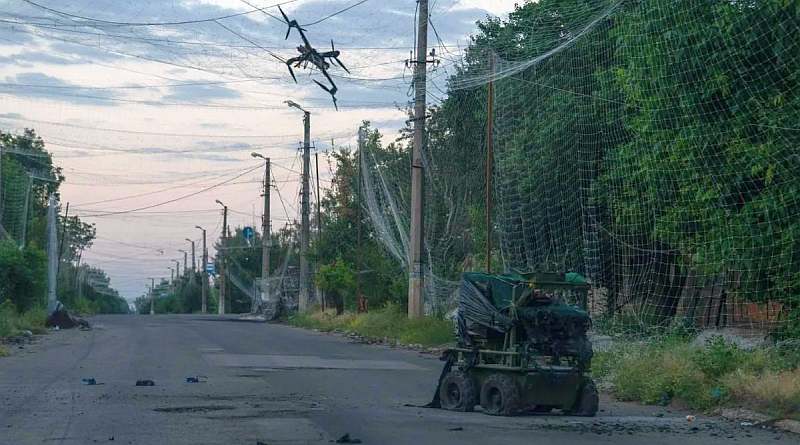
On the cover: Road to Druzhkivka. Photo: 93rd Cold Yar Mechanized Brigade
