
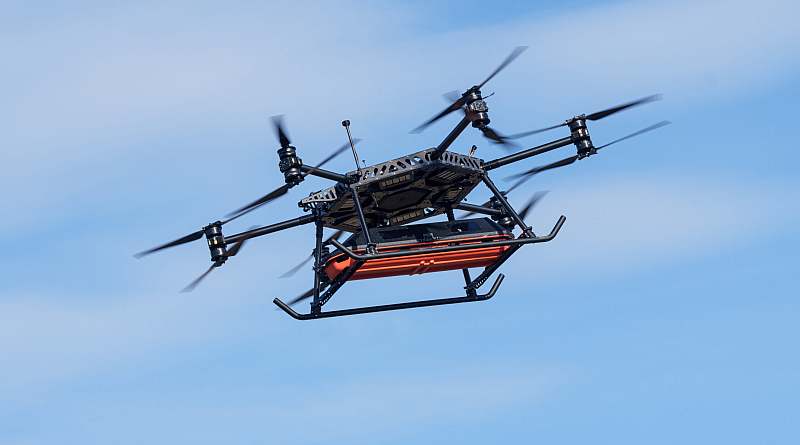
The Ukrainian company SkyFall has developed the heavy drone StarGate for evacuating wounded soldiers from hard-to-reach positions. The device can carry up to 150 kg of cargo over a distance of up to 15 km and has already begun testing on the front line.
This is reported by AP.
How StarGate Will Evacuate the Wounded from the Battlefield
The idea for creating the drone emerged following a request from the military. Last year, the commander of the 475th Separate Assault Regiment Code 9.2, with the call sign Flint, approached the founder of SkyFall with a proposal to develop a safer way to evacuate the wounded from hard-to-reach positions.
In some areas of the front, the kill zone, where drone and artillery attacks constantly threaten, extends 10–15 km and more. Ground robotic platforms typically take two to three hours to reach a position, and mud, craters, broken roads, rivers, and mines can complicate or completely stop their movement.
StarGate can carry up to 150 kg of cargo — enough to evacuate a wounded soldier in body armor and with combat equipment. For this, the device is equipped with a special cabin with stretchers.
The drone’s cruising speed is 65 km/h, and the maximum speed is 105 km/h. The flight range one-way reaches 15 km, and the device can be ready for launch in about 10 minutes.
How the Drone Is Protected Against EW Systems
One of the main tasks of the developers was to ensure StarGate’s operation in conditions where electronic warfare systems disrupt communication or interfere with GPS operation.
The drone uses two communication channels — Starlink and the company’s own L-Link system. It also has artificial intelligence-based functions that help control the device in the absence of GPS, navigation signal spoofing, or radio frequency jamming.
If communication is completely lost, StarGate, according to SkyFall, will be able to independently plot a route to a safe zone. For night missions, the device is equipped with thermal cameras, and its design allows it to operate in rain and snow.
During demonstration trials, developers also tested protection against attacks from other UAVs. When an FPV drone approached StarGate, the device released a net that entangled the target and diverted it off course.
When StarGate Might Enter Production
This week, StarGate began testing on the front line: the device was handed over to a combat brigade to evaluate its capabilities in real combat tasks.
According to SkyFall, the cost of one complex will be at least 50 thousand dollars, depending on the configuration. The company plans to reach production of up to 1,000 such drones per month by the end of 2026.
At the same time, the military emphasizes that it is too early to talk about the effectiveness of the new technology. The commander of unit Code 9.2, with the call sign KVN, noted that his brigade needs at least a month of working with the device before the results of its use can be assessed.
SkyFall is a Ukrainian producer of heavy drones Vampire, known as “Baba Yaga,” and FPV drones Shrike. The company also developed the interceptor drone P1-SUN.
In the image: Evacuation hexacopter StarGate. October 2026. Photo: SkyFall
