
It is important now not to fall into the euphoria that was present before the 2023 offensive. Because talks have already started about how we will filter and whether to destroy the Crimean Bridge.
The fact that we created a fuel crisis and plunged Crimea into a blackout doesn’t mean they will collapse that very second — in the 1990s, queues at gas stations and power outages didn’t help Moldova avoid losing Transnistria. And before “returning Crimea,” it would be good to stabilize the situation along the Plavni-Stepnohirsk line to push away FPV pilots with enhanced batteries and lightweight heads as far from Zaporizhzhia as possible.

The enemy still dominates in aviation production. They produce ballistic missiles that can reach most large Ukrainian cities with precision weapons. They are capable of intercepting long-range “Neptunes” and “Flamingos,” just as we intercept “Kalibrs” and X-101s.
And we do not produce not only delivery systems for missile defenses but also expendable materials for IRIS-T or NASAMS — it’s simply that the Kremlin lacks the capacity to overwhelm Western stocks, which were designed for using air-to-air missile components.
But it’s one chain. That’s why the US is currently negotiating with Europeans to establish joint production of AMRAAM in Europe — to relieve American factories and not steal missiles from aviation for missile defense needs.
Many are surprised that in the result of the latest attacks on the capital ballistic missiles got through. And the fact that for much of the winter there was power for a few hours and warmth wasn’t everywhere (meaning there were strikes on CHP plants and substations in Kyiv), doesn’t surprise anyone?
The availability of interceptors, which were sold to Gulf countries for 6-7 million apiece, is a question not only of production in the US or establishing a solution in Germany but also of budgets, state guarantees, maintenance of those transferred from storage.
Sometimes a batch of Patriot missiles arrives a few days before the strike, and sometimes it doesn’t make it in time. Even if the US ramps up production according to plans, that’s several hundred for all of NATO and the open market for a year — we won’t have enough interceptors for each ballistic missile throughout 2026 and part of 2027.
Therefore, priority is given to dispersal, moving production underground, duplication, shelter, and distributed generation. It shouldn’t be that dozens of aggregators report the takeoff of strategists, missile warfare lasts for several hours across dozens of regions, and dozens are killed and injured in each demolished apartment block.
Confidently, if you asked those who were unlucky whether they are ready to go to the basement every night until the war ends, the answer would be “yes.” But that’s not how it works.
However, this game can be played with both sides. Thanks to the vast spaces and the fact that a couple of firing divisions of the S-300 brigade are stretched to protect the areas between Rostov and Volgograd, with no continuous radar coverage, we can plan routes to reach refineries or military-industrial enterprises. But this doesn’t guarantee 100% hits — cruise missiles are intercepted by aircraft and mobile groups, just like ours.
The fact that we hit Omsk is great because it will exacerbate and spread the crisis to Siberia. The largest refinery in RF, ELOU-AVT-11, is damaged — it’s six months of repairs. Apparently, they tried to lift the Su-57, supported by an AWACS aircraft — their air defense in the sector was sparse. Hitting at a distance of 2,000 km means that modernization is ongoing, new fuel tanks have appeared, and we are using successful developments to increase the long-range radius and improve machine vision.

A full-scale campaign to plunge Crimea into blackout is ongoing — not only both TPPs but also substations, to prevent maneuvers from the mainland.
PS 220 kV “Bakhchisarai” and PS 10/35/10 kV “Zimine” (on the night of July 5): major energy hubs. The occupiers tried to blame it on a technical failure, but in fact, there were massive power outages in Sevastopol, Kacha, Andriivka, and Rozdolne district.
PS 110/35/10 kV “Stary Krym” and PS 110 kV “Saky” (on the nights of July 3 and 7): key power grid nodes of the region. After precise hits, Stary Krym and surrounding villages went into total blackout.
PP-2 “Crimea” (on the night of July 8): main reception point for electricity via the Kuban-Crimea energy bridge.
Gas compressor station — hit alongside the substations, multiplying the damage to generation. Crimean TPPs run on gas. We systematically target Chornomornaftogaz facilities. If the compressor station stops, the pressure in the pipe drops, TPP turbines begin to malfunction or go into emergency stop. This is now our main tactic: not to knock out the TPP, but to choke it by depriving it of fuel/maneuvering units. Not only because a heavy warhead is needed for the machine room, but also because Crimea is mainly supplied by external generation.
Sevastopol, Kerch, and Yevpatoria are without power and water. The peninsula’s switch has literally been turned to off mode. The fuel crisis prevents widespread use of mobile generation and exacerbates the crisis in the service sector — the region is increasingly draining resources instead of being a rear base.
The “TES-Terminal-1” oil terminal in Kerch (a key transshipment point for fuel for the Russian grouping in southern Ukraine) — tanks with oil products and a pumping station were destroyed.
In addition, in the Azov Sea’s waters, drones hit two fuel tankers. Hit the bridges — pilots likely weren’t sure the fire would finish off the vessels, but disabling electronics and navigation means months of repairs. RZD and the “Novorossiya” motorway have exited the chat, leaving only the sea.
To pay two million rubles per contract, the Kremlin needs petrodollars. On the night of July 6, a swarm of drones targeted several strategic facilities over 1000 km away:
Yaroslavl: strike on the “Slavneft-YANOS” refinery — one of Russia’s largest oil refineries producing fuel for the army’s needs. The sixth attack — we prevent repairs and accumulation of component stocks;
Leningrad Region: The “NOVATEK-Ust-Luga” marine terminal and the oil terminal in Vysotsk have been hit. This is a direct blow to the foreign currency export infrastructure via the Baltic Sea;

Kaluga: The local refinery has been confirmed hit. Here we are dealing with not only processing but also storage;
“Luch” CHP (on the nights of July 4 and 7 repeatedly): One of the basic combined heat and power plants in Belgorod. Due to a precise strike and strong fire, a significant part of Belgorod lost electricity, and pumping stations halted — the city was left without water. Plus, the airport was hit, reaching deeply buried kerosene barrels. For a military and logistics hub, this means partial paralysis and additional costs.
Systematic strikes on distribution networks force the opponent to divert resources from the Ministry of Emergency Situations, the National Guard, and engineering troops from defensive fortifications to save their own rear.
Overall, we must continue without being distracted by retaliation for Kyiv, Sumy, Zaporizhzhia, or Dnipro: not allowing the repair of cleaning columns, targeting storage barrels, and finding plants participating in the refinery recovery chain. Naturally, increasing attacks on tankers supplying Crimea, hunting down trucks, hitting bridges, and targeting locomotives and repair trains — keeping the lens on the ant colony.
We must expand the blackout zone from Crimea to the southern regions of Russia, where the fuel situation is most severe — this will affect transshipment, irrigation, and crop collection. And testing Moscow’s air defense supplies: every million-dollar missile against a $150,000 drone is money that won’t reach defensive fortifications.
We cannot physically deprive the Russian army or industry of fuel, but we can push the domino tower — the crisis will amplify the decline in transportation, tourism, services, and altogether impact GDP and regional deficits. The fact that the opponent went into the Sea of Azov with eight tankers without air and air defense cover even on boats is a clear marker of how much Crimea burns for them.
The occupiers’ attempts to close the region in an information vacuum only emphasize the depth of the collapse: they cannot hide that the peninsula, which was supposed to become a foothold, has turned into a burden, severing its own supply arteries.
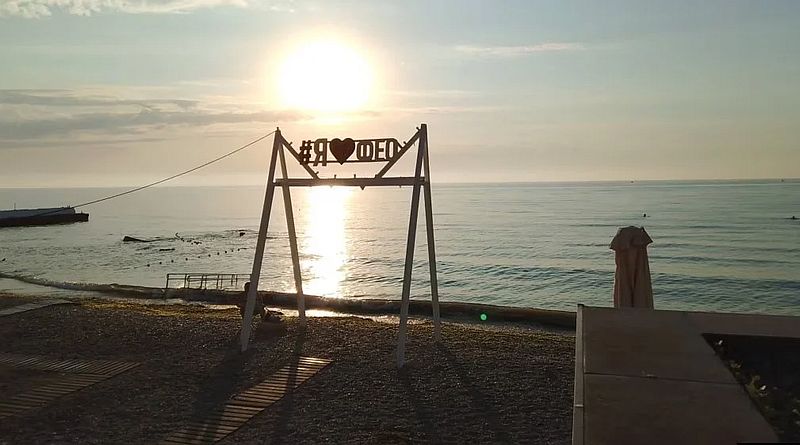
On the cover: Empty beaches of Feodosia, Crimea, early July 2026. Photo: Krym.Realii
Copyright © 2020 RFE/RL, Inc. Reprinted with permission from Krym.Realii (Radio Free Europe/Radio Liberty)
