
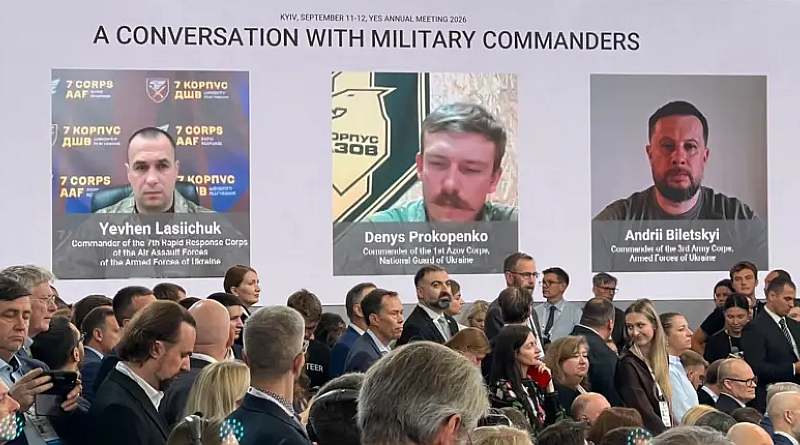
Where is the war heading and what can be expected on the front line in the near future?
Top commanders of the Ukrainian military discussed this at the annual Yalta European Strategy (YES) conference: Andriy Biletsky, Denys Prokopenko, Ihor Obolensky, and Yevhen Lasiichuk.
BBC News Ukraine compiled the main points from their speeches.
The ultimate capture of Donetsk and Luhansk regions is the current strategic goal of the Russian army: the Russian military leadership expects to achieve it by mid-April, and the Russian political elite by the beginning of 2027.
This is according to Andriy Biletsky, a brigadier general and commander of the Third Army Corps, based on data from Ukrainian and Western intelligence.
“If achieved, the Russians would be able to end this war without reputational losses,” he explains.
At the same time, Biletsky emphasizes: it is unlikely that Russia will succeed in implementing this.
“Ukraine has every chance of holding advantageous defensive lines, retaining the so-called fortress-city belt, improving positions in some areas of the Donetsk front. And I think that within a month we will demonstrate these improvements to the whole world, and they will be undeniable,” Biletsky predicts.
He also adds that to achieve its strategic goal on the battlefield, Russia will continue to use the tactic of human wave assaults, although recently it has not yielded the desired effect.
“A year ago, actions with the use of a large number of infantry gave the Russians advantages and even significant success in some parts of the front, but now this tactic has led to Russian losses in manpower greatly exceeding their recruitment into the army,” Biletsky states.
Moreover, according to him, the opponent has not yet devised a new tactic.
About the fact that the advantage in the number of personnel does not provide the desired effect for the Russians, Denys Prokopenko, commander of the 1st Corps of the National Guard of Ukraine “Azov”, also speaks.
“The opponent conducted a summer offensive campaign but had only small tactical successes. And after our offensive actions, they could not even recover the lost positions within a year, from which they had to retreat last summer. And their strategic task – to capture Dobropillia by the end of summer – was not fulfilled,” says Prokopenko.
According to his forecast, by the end of September, the Russians plan to change their tactics on the battlefield, mainly due to changing weather conditions.
“The enemy will be forced to abandon the tactic of small infantry groups, switch to heavy armored vehicles and try, as last winter, to make mechanized breakthroughs,” says Prokopenko.
He also notes that the Russians have learned from previous experiences of such mechanized offensives and are already actively reinforcing their equipment, in particular by adding grills and electronic warfare equipment to it.
Additionally, Russian forces are actively trying to replicate Ukraine’s success in using UAVs on the battlefield, explains Andriy Biletsky.
“This is certainly noticeable, but we have every chance to continue to maintain a significant advantage in the UAV component. Specifically, because we are less constrained and less centralized, which fosters innovation. And the level of human potential is better, as the men and women joining the Armed Forces work better with new technologies than a large number of Russians,” Biletsky emphasizes.
Due to the active use of UAVs and several other reasons, in some parts of the front, the war has already moved underground. This is noted by Ihor Obolensky, commander of the “Khartiya” corps.
“Because the battlefield is becoming increasingly transparent and more dangerous, we are seeking a way out. The [enemy] found it first by going underground. But currently, we are more effective underground, both spiritually and technologically. Western countries do not have such underground flank attack experience as we do. We even use drones underground,” he says.
He adds that this war will become more technological over time.
Currently, Ukraine is a kind of testing ground, says the commander of the 7th Airborne Corps, General Yevhen Lasiichuk.
“Today, Ukraine is the largest testing ground for testing weapons and combat tactics, and our soldiers are shaping the image of a modern army. Our responsibility is to find the most effective model of combat that maximizes technology and minimizes human losses,” he emphasizes.
* * *
On August 27, President Volodymyr Zelensky appointed Andriy Biletsky and Denys Prokopenko responsible for the defense of the Donetsk region.
This reorganization of the troops is taking place during a rather difficult security moment in the Donetsk region.
From late spring to summer 2026, Russia chose this section of the front as a priority for its offensive. This is where the most numerous and combat-ready Russian group is operating.
“Putin’s unchanged primary goal on the front is Kostyantynivka-Slovyansk. The last deadline he gave his generals is to complete the occupation of the Donetsk and Luhansk regions by the end of the year. This is impossible. Such is our response,” President Zelensky told journalists on August 22.
As of August 26, Russian troops have managed to approach about 6 km to the outskirts of Slovyansk and about 8 km to Kramatorsk. The main battles are taking place near the villages of Rai-Oleksandrivka, Mykolaivka, Orikhuvatka, Vasyutynske, and Malynivka.
The leader of the Russian Federation, Vladimir Putin, announced the occupation of the neighboring city of Kostyantynivka on July 3, but the Ukrainian authorities deny the loss of the settlement.
