

November 5. Remember, a couple of weeks ago I suggested that the particularly sensitive disconnect from the news flow until today, so as not to worry needlessly? Well, the complexities of that period are now deeply irrelevant, replaced by new chaos.
1. Starlink was turned off, Starlink was turned on. Who? Musk was made to say it was him.
The nervousness around intelligence data was there, but it’s gone now.
The notorious Russian diesel, with which Trump, assisted by Putin, tried to score points, has already changed course. It will all end with it being sold at a large discount due to its toxicity.
The mirage of the universal importance of Russian refineries dissipated even before the US midterm elections. Since then, attention has been on:
• Novokuybyshevsk Refinery;
• Nizhny Novgorod Lukoil Refinery;
• One of the refineries in Ufa;
• Yaroslavl Refinery;
• Ryazan Refinery.
In the interim, a few incoming after a three-week break were recorded at LPS Samara, which I have repeatedly written about due to its cosmic importance to the Russian oil industry.
Let’s emphasize that the refineries in Nizhny Novgorod, Yaroslavl, and Ryazan are focused on servicing the Moscow region of the Russian Federation. This means that additional efforts to supply Moscow and the region will worsen the situation in the provinces.
2. New challenges are gradually forming for Russia.
Among others – winter diesel, on which cargo transportation and railways depend.
For the production of this fuel, ready aviation kerosene (for mixing with diesel at oil depots) or the kerosene fraction (for production at refineries) is needed. Strikes on refineries affect kerosene too. A domino effect is expected.
The aforementioned plants produce about a third of Russian kerosene. To avoid drowning in details, let’s note – aviation kerosene comes in different grades. In particular, the international standard fuel Jet A-1 is produced by Lukoil plants, including Nizhny Novgorod. Not every country will agree to accept a plane fueled only for domestic Russian flights. It’s not even about quality, but also about formalities, insurance, etc.
And there are special grades T-6 and T-8V for strategic and supersonic aviation. The consumer is the Russian Ministry of Defense. Formally, the locations of their production are classified. The open secret is that such kerosene is made in Omsk, Irkutsk region, and also… in Yaroslavl.
In summary. A potential stretch may arise – between aviation and truckers, which will have to be closed by importing kerosene.
The fact that something is happening with kerosene in Russia is evidenced by the recent order of the Ministry of Energy and the Federal Antimonopoly Service of the Russian Federation: from November 9, they reduce the mandatory norm for vertically integrated companies to sell aviation kerosene on the exchange from 11% to 5% of production volume. Previously, a similar decision was extended for gasoline.
This is a sign that the authorities want to strengthen control over the distribution of scarce fuel. Such measures are not taken from a good life.
For comparison: in January – July 2025, about 983,000 tons of aviation kerosene were sold through the exchange. And for the same period in 2026 – only 581,000 tons (a decrease of 41%). The most striking contrast is in July – a five-fold decrease in exchange sales. Then the statistics were closed for safety.
So the cancellation of flights at Moscow airports due to various obstacles is even somewhat positive in the context of aviation fuel difficulties.
And this is not the only similar case in recent weeks.
Thus, from November 6, a ban on exporting outside the EAEU a number of chemical products: coal tar and oil benzoles, toluene, orthoxylene, paraxylene, and phenol, is introduced. They are used, in particular, in the production of coatings for the automotive, aviation, shipbuilding, and railway industries, in food packaging, insulation production, and the medical industry.
Literally on the eve, a whole series of Russian chemical plants were subjected to active pinging. Coincidence? And since July, failures have plagued the petrochemical giant Sibur.
This is to say that irritants change, and nerve cells require careful handling. Abu Dhabi, then China, then some other calamity…
Take care of yourself.
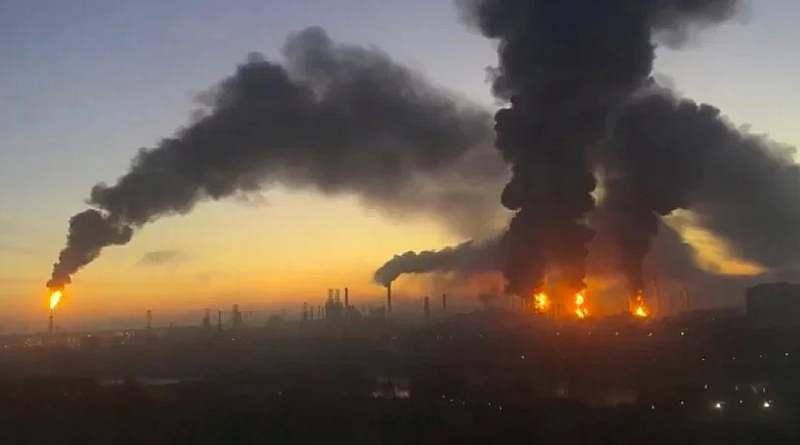
In the cover image: Fire at a refinery in Moscow after a strike by Ukrainian drones, September 20, 2026. Illustrative photo: social media
