
Oleksandr Kovalenko / Obozrevatel
Amid the increasingly frequent strikes by Russia on Ukrainian territory, new speculations have emerged suggesting that the aggressor, in order to achieve its goals, might resort to using nuclear weapons. Intimidating statements have been made for years, with Russia threatening nuclear weapons to the whole world, likely via various propagandists. But how realistic is this, and what objectives could nuclear weapons currently solve in the war?
I’ll cut to the chase and state that I have never supported the notion that Russia would use nuclear weapons against Ukraine in a conventional war, a stance I have held since 2022. This is due to a range of factors, both internal deterrents regarding the use of such weapons and external geopolitical mechanisms that limit their use.
However, to understand why using nuclear weapons is impossible for Russia simply out of whim and why it wouldn’t have a decisive impact on the battlefield, each aspect should be examined separately.
Rational Approach on the Battlefield
Let’s consider the scenario of using nuclear weapons on the battlefield – it frequently surfaces in the information space as the most likely.
It is clear that when discussing tactical nuclear weapons (TNWs) with limited power up to a kiloton or slightly more, many imagine a strike on the battlefield aimed at destroying enemy positions and breaking through defenses. However, this is a misconception.
The factor of using TNWs during combat lost its significance back in the late 1970s to early 1980s when dense, concentrated military structures like divisions and even armies became obsolete, and the primary combat unit on the battlefield increasingly became the battalion tactical group.
Thus, using nuclear weapons on the battlefield to… neutralize a battalion? It sounds at least irrational.
Currently, combat operations are conducted exclusively at the company and platoon levels, and at times, for kilometers along the contact line, there are no traces of enemy presence. Even at the level of the battalion tactical group, there are no troop concentrations that would justify the use of tactical nuclear weapons; it would be comparable to shooting a cannon at sparrows.
But equally important are the consequences and effects for any offensive operation.
Radiation Breach
A nuclear strike leads to contamination of the surrounding area. And in the event of the need for offensive actions, the dilemma of contaminated zones always arises. In those zones, not only is it impossible to secure a position, but even passing through them threatens the combat effectiveness of the troops entering the radiation exposure area.
The destruction of enemy forces, defensive lines, and positions with a single strike always seemed tempting but only at an amateur level. In practice, scorched territories could not be utilized for a long time.
For example, even if one imagines the destruction of a fortified area and the rapid passage of troops through contaminated territory, which in any case receive a certain dose of radiation exposure and over time lose combat effectiveness, the question arose: what next? Then the troops faced the next line of defense and were forced to engage in battle without reinforcements behind them, only a contaminated zone.
Therefore, combat on the battlefield using tactical nuclear weapons is unjustified both in terms of the degree of strike potential and the subsequent effect, which gives absolutely no advantage in the combat zone. Especially in the context of modern high-dynamic warfare, with small forces on large territories.
To use a nuclear bomb to erase a platoon control zone and then have no opportunity to secure it? A highly questionable decision.
Nuclear Terror
One scenario of a nuclear weapon strike is also an act of intimidation – terror – against a city, regional center, or capital to force Ukraine to capitulate or to achieve certain breakthroughs on the front.
For example, the Russian side has repeatedly emphasized the need for the complete destruction of Slovyansk or Kramatorsk to take full control, including through the use of tactical nuclear weapons. Indeed, the Slovyansk-Kramatorsk agglomeration poses a real challenge for the Russian army, as the battles for it can stretch for months or even years.
But again, in the event of a strike on the same Slovyansk with tactical nuclear weapons, the Russian Armed Forces would receive a radiation-contaminated city that would be unusable for further offensive campaigns as a support zone.
Moreover, such cities would rather become an obstacle to the advancement of troops than a factor accelerating the offensive process.

Similarly, a strike with tactical nuclear weapons to remove the state leadership or destroy certain decision-making centers loses its meaning, as they are often located in protected underground facilities capable of withstanding such strikes. Overall, troop management is long decentralized, and such a strike would have no impact on the situation at the front other than emotional and psychological.
Therefore, a nuclear weapon strike can only have a terrorist, intimidating character, forcing capitulation, but here the deterrent factors and reactions of the international community come into play.
Restraining Factors
The use of nuclear weapons in a conventional war will have unprecedented consequences for Russia – and it’s not even about the hypothetical intervention of other countries in the war and retaliatory strikes against the Russian Federation. It concerns the extremely negative attitude of countries that have partner relations with Russia, not only towards the idea of using tactical nuclear weapons, but fundamentally towards nuclear rhetoric.
In particular, China adheres to a consistent position on the inadmissibility of using nuclear threat rhetoric by officials, which the Chinese Foreign Ministry regularly responds to. Beijing is interested in maintaining the global “status quo” – and they are not alone. India and Pakistan hold a similar position, and their reaction to Russia’s use of tactical nuclear weapons could lead to the severing of bilateral relations, and for Russia itself, it would close the doors to virtually all international institutions that Moscow still uses to spread its narratives and propaganda, primarily the UN.
Russia will become a pariah even among those who were considered its partners. And these consequences will have a far more devastating effect than any, even the most dubious, benefit from the use of tactical nuclear weapons.
However, as effective as external factors is the internal restraining factor, which is a complex mechanism for executing such a destructive order.
It’s not just about the sequence of executing such an order through the command hierarchy, but also about the mechanisms for preventing its execution, which exist in all nuclear club countries.
The sequence itself in time can last up to a day, and it cannot be carried out unnoticed. This means that practically all representatives of the nuclear club and beyond would know about preparations for the strike, leading to their direct intervention (diplomatic and other types) to prevent it.
Conclusions
The potential use of tactical nuclear weapons by Russia remains a popular topic in the media and on discussion platforms, especially considering the threats from Russian officials and insane propagandists.
But the truth is, in the current conditions of high-dynamic and highly adaptive wars, tactical nuclear weapons are not just senseless; on the battlefield, they will harm the side that uses them more than solve its tasks.
In the area of tactical nuclear weapon use, it will be impossible to conduct combat operations, secure positions, or use the territory for further advancement for a long time.
The use in large cities for the purpose of terror and coercion to capitulate will isolate Russia, depriving it of even the support it currently has, and possibly lead to an international operation to restrain the dangerously insane.
However, probably the most effective are the mechanisms of internal and external influence and the response of the nuclear club countries that prevent reckless use of tactical nuclear weapons.
Since 2022, I have never changed my position, especially regarding the threat of a nuclear strike by Russia on Ukrainian territory – there are numerous reasons why this will not happen, rather than the opposite.
The material was published as part of a joint project between OBOZ.UA and the group “Information Resistance.”
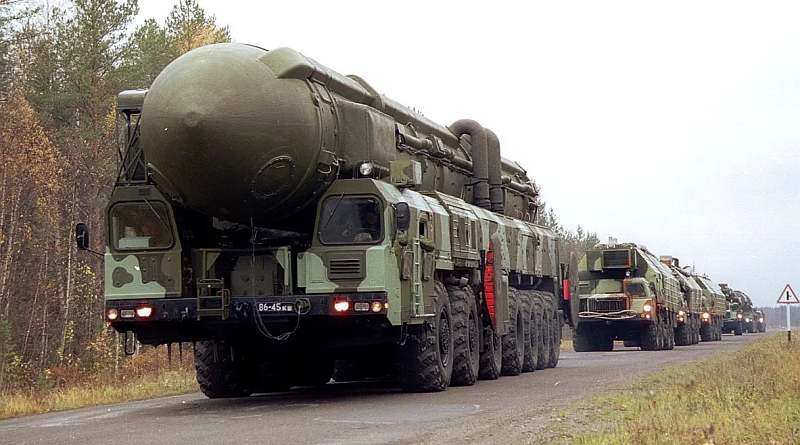
In the image: Self-propelled missile launcher “Topol-M”. Photo: Occupants’ Ministry of Defense
