
Phillips P. OBrien / Translation by iPress
Ukraine’s campaign against Russia’s oil infrastructure should be a priority
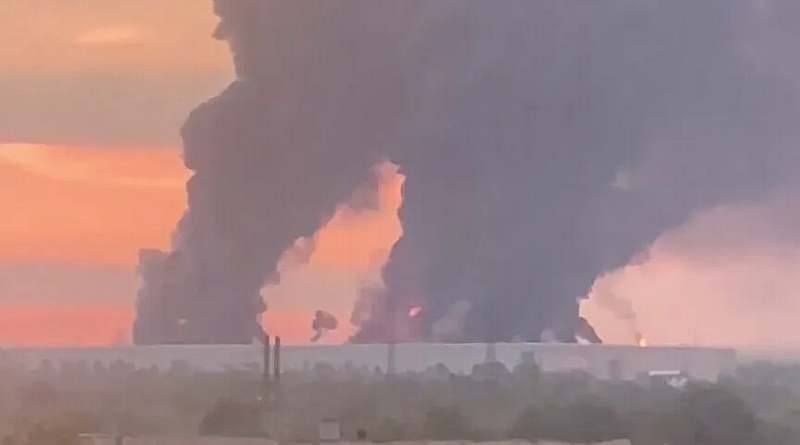
On August 21-22, Ukrainians struck the Russian Novokuibyshevsk oil refinery in the Samara region (pictured on the cover). This facility is located about 1600 km from Ukraine. The attack happened just a day after the Ukrainians attacked another large refinery in Perm, also located about 1600 km from Ukraine.
This indicates a recent renewal and intensification of strikes on refineries—a trend sometimes overlooked in discussions about the campaign against Wildberries and others.
However, as events of the past week have shown, it’s not so much these attacks themselves, but other data emerging recently, that indicate the campaign against Russia’s oil infrastructure is starting to have a strategic effect. If Ukraine can maintain this pace, expand the campaign, and repeatedly hit the same targets, either preventing repairs or negating quick fixes, Russia’s oil system may begin to collapse.
Almost two and a half years ago—has it really been that long?—I summarized both the advantages and challenges of such a campaign against Russia’s fuel system. I emphasized that the key importance lies not in spectacular one-time attacks but in repeated strikes that hinder repair and recovery.
Here’s how I summarized it in that material:
“In other words, don’t let dramatic photos mislead you. The petroleum production system can be repaired, and temporary losses in some places can be offset by reserve capacities in others. That’s why I emphasize reserves above. For this to work, Ukraine must continue the campaign for a while and attack, and re-attack, multiple targets. It’s not easy”.
The problem Ukraine has faced since then is not delivering consistent and repeated strikes on the same refineries to put them out of operation for good. Ukraine either increased the campaign’s intensity or reduced it, targeted new refineries, and then, most distressingly, seemed to forget about other plants attacked earlier.
Finally, over the last few months, Ukrainians have started doing what’s needed. Here’s a chart based on Bloomberg data.

The current intensity of attacks is still not perfect. In the spring of 2026, the number of refinery strikes sharply and regrettably decreased over two months. However, the focus on the entire oil infrastructure system has become more apparent, and strikes on refineries, pipelines, and ports are beginning to shake the whole system.
As for refineries, as I tried to explain a few years ago, repeated strikes are finally undermining Russia’s ability to repair these facilities. Here’s a chart I compiled of attacks on the 11 largest Russian refineries this year. I verified the data, but some information comes only from Ukrainian sources – they have been reliable so far, but I wanted to note this separately.
Eleven largest refineries and what happened to them
The largest Russian refineries under attack, 2026

CDU is a crude oil distillation unit; if you want to know more about why targeting certain critical nodes of refineries is important, this article, written almost two years ago, explains everything. It may serve as a useful reminder.
It seems that Russia’s ability to continuously repair these facilities is finally beginning to weaken. Mikhail Khodorkovsky, who ran Russia’s largest oil company before Putin ousted him from business, published an extremely interesting thread about what might be happening with Russia’s fuel system and what problems arise with repairs. In short, the Russians are trying to keep the system afloat through constant short-term repairs—effectively patches. But this can only work up to a certain limit, after which the system will start to fail. When that happens, the consequences will be quite dramatic.
The current intensification of attacks is once again causing a fuel rationing crisis in Russia. Here’s how it has developed over the past few months, judging by the number of Russian regions where various restrictions have been introduced.
Fuel rationing has spread from a few regions to most of the country
Geographical spread of fuel restrictions, 2026

Here’s a Meduza article with the latest data and examples of how these restrictions are spreading.
Now it’s hitting Russian revenues, and the situation could significantly worsen. Due to the shutdown of refineries, Russia has had to switch to exporting crude oil—all oil products need to be kept for domestic consumption and even purchase ready-made fuel on the world market and import it to Russia.
Thus, Russia exports less profitable crude oil and at the same time is forced to spend much-needed capital on importing fuel. Trump’s war with Iran created a certain margin of strength for Putin by maintaining very high oil prices, so countries like India and China buy everything Russia is able to sell. However, if the campaign against the refineries is complemented by an equally effective campaign against ports (keeping in mind that the US is pressuring Ukraine to keep oil going out of Russian ports), even this will not work, and Russia’s financial crisis could spiral into a deadly downturn. It will have to import expensive ready-made fuel while simultaneously exporting significantly less crude oil.
That’s why this campaign is so important. Not because of its impact on Russian morale or everyday inconveniences, but because ultimately it’s the best way to deprive any war machine of what it cannot exist without—money. Russia, unable to earn from exporting oil and oil products, is neither a great power nor even a medium economic force. It’s an economic ruin.
This is why the fuel system should be the main priority of the campaign.
Note: This doesn’t mean it should be the only target; it just always has to be the top priority. Next, I would prioritize communications, arms production, and strategic transport. However, a detailed review of all this would require a separate article.
Trump’s Scheme Reaches Its Inevitable Conclusion—More Time for Putin
Imagine: After all this anticipation, it turned out that Trump decided not to help Ukraine and did not press Elon Musk to provide Ukrainians with access to Starlink for strikes on strategic targets in Russia. Last week, FT published an article about it, which was also recapped by other publications.
This was the second part of Trump’s scheme, which lasted all summer.
The first part, which fell apart a few weeks ago, involved a promise to grant Ukraine a license to produce Patriot interceptors. All this was part of a stream of highly misleading reports that flooded the press in late July, claiming that Trump was being more “favorably disposed” to Ukraine, that Ukrainian resilience had impressed him so much he intended to help, and that he would finally take on Putin.
Of course, none of this was ever true, and the press moved on to other topics, embarrassed by writing consistently identical and false stories. And here we are almost two months after the start of this scheme, and absolutely nothing has changed. No Starlink aid for Ukraine, no licenses for Patriot, no new major deliveries of Patriot interceptors—and no prospect that Ukraine will get any of this.
For Putin, this scheme turned out to be extremely effective. Ukrainians genuinely believed there was a real possibility of getting both Starlink access and Patriot interceptors from Trump, as well as a license for their production. They spent a long time preparing their proposals, making contingency plans for success, and invested a lot of emotional and political energy into these efforts.
And now, nearly two months have passed, nothing has happened, and it should be clear by now that this was never going to happen. Ukrainians were just being misled—as has been done for 19 months.
The Russians benefited from this. We got two more months of smoke and mirrors while everyone wondered if Trump would help the Ukrainians, meanwhile Russia could bomb an almost defenseless Ukraine. Last week, for example, it was reported that Ukraine’s “Patriot interceptors” were ‘exhausted’.
The consequences of being defenseless against Russian and North Korean ballistic missiles are now fully evident, and the situation worsens every week. The number of civilian casualties in Ukraine is steadily increasing as the Russians can launch massive attacks, knowing that some of their missiles will inevitably penetrate, while other means of attack take advantage of the overloaded Ukrainian air defense. This is how the Ukrainian Foreign Minister summarized the situation in July 2026:
“In July alone, Russia killed at least 437 civilians and injured 2610 people across Ukraine – this is the highest monthly civilian casualty figure since May 2022. Seventeen children were killed, and another 166 were injured – this is the highest monthly child casualty figure since April 2022.”
Buying more time for this is Putin’s main goal, and this is why this scam is so destructive. Most importantly for the Russians, Putin wants to bomb a defenseless Ukraine throughout the winter of 2026-2027 – so that the horrific strikes of last winter, with heat and electricity supply disruptions, will seem moderate in comparison. Ukrainians now acknowledge this as well. This week, Serhiy Kyslytsia, the First Deputy Head of the Office of the President of Ukraine, said:
“Putin currently has no desire to sit down at the negotiating table, and after the onset of winter and until its end, that is at least until mid-March, he will have even less motivation. Because he believes that Ukrainians as a nation are not strong enough to survive this winter.”
This is why it is vital to call what we have seen and are seeing the Trump “scam.” This is why I have been trying to communicate for months: the entire story boils down to leaving Ukraine as open and vulnerable as possible before winter. Ukrainians now publicly acknowledge this themselves. And this is why two days after the announcement of the Patriot license scam, I wrote that Ukraine is actually being prepared to be brutally beaten this winter. Here’s a quote from that material:
“The fact that Russia seems to be increasing the intensity of its strikes—three attacks on Kyiv in six days just when it becomes clear that Ukraine is running out of Patriot interceptors—shows that the Russians realize the kind of help Trump has already provided and will continue to provide them. For at least a year, and possibly longer, they will be able to cause enormous damage with ballistic missiles, knowing that the Ukrainians have few options to intercept them. This is a colossal strategic gift that the USA has given to Russia. Trump has given Putin at least one more full winter, possibly two or three (the Japanese, after many years of licensed production, manufacture only 30 Patriot PAC-3 interceptors a year—the very ones Ukraine needs), so he can attack whatever he wants.”
In other words, pretending that Trump can help Ukraine is not innocent optimism but falling into the trap of a deadly, pro-Putin maneuver that is already causing and will increasingly cause suffering to Ukrainians.
Furthermore, it is preventing Ukraine from doing what it must and is restraining Europeans from actions they could undertake. Last week, we saw one example. One of the reasons Ukrainians desperately wanted to gain access to Starlink from Trump was the intention to attack the new Russian satellite system, which is soon to be launched and could significantly increase the accuracy of Russian strikes on Ukraine—where Russians do not have Starlink. Ukrainians believed that they needed Starlink for an effective attack.
In fact, they may have been mistaken. A week ago, probably already realizing that American aid would not come, the Ukrainians attacked and seemingly seriously damaged an object prepared for the deployment of this new Russian system.

The Ukrainians need to stop pinning their hopes on Trump’s support and expending efforts to obtain it. They need to stop falling for this ruse, and the Western press should at least stop pretending that this ruse doesn’t exist to help them make this choice.
Fedorov Calls for Elections in Ukraine
The situation involving Mykhailo Fedorov, the former and very successful Minister of Defense of Ukraine, seems to have stabilized. The Ukrainian parliament, the Verkhovna Rada, approved Yevhen Khmara as his successor. Thus, a successor has been legally appointed, and at the moment Zelensky seems determined not to allow Fedorov’s return to power. This is unlikely to change in the near future.
Fedorov, evidently disappointed, made a bold and probably ill-considered political move last week when the parliament approved his successor. In a YouTube video, he called for new elections in Ukraine.
I can understand his disappointment, yet from what I hear from trusted Ukrainians, this was a serious mistake. Elections will not happen now, at least because Ukraine cannot protect itself from Russian missiles, thus any election campaign could become a deadly trap. Moreover, Ukrainians do not want elections until hostilities cease for a sufficient period to allow a full-fledged campaign. Therefore, even some of Fedorov’s supporters were surprised that he took such a step.
Thus, both statements can be true. Fedorov can continue to be an excellent Minister of Defense, and Ukraine would benefit from him remaining in office, but his call for elections can still be a major mistake.
The main practical conclusion is that for now, this issue is resolved. He will not return.
