
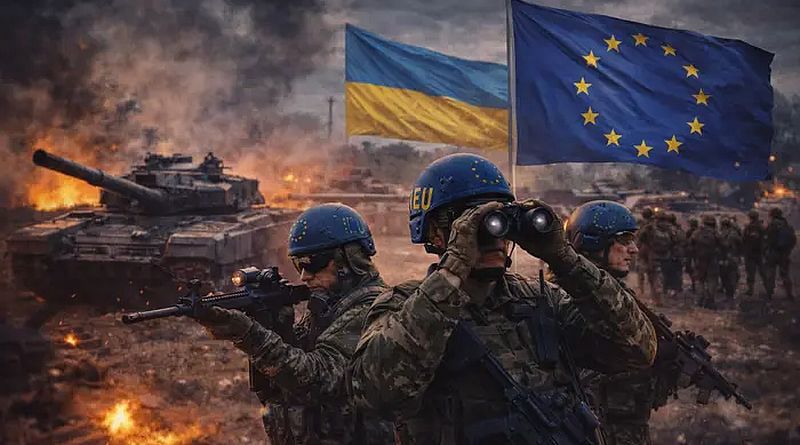
Elena Davlikanova and Arne Bård Dalhaug, CEPA / Translation iPress
Retired Lieutenant General of the Royal Norwegian Army, President of the Norwegian Defense Association, and Senior Advisor of the Norwegian Atlantic Committee, Arne Bård Dalhaug, along with Senior Fellow at the Center for European Policy Analysis (CEPA) and the Sagaydachny Security Center, Elena Davlikanova, advocate a simple yet radical thesis: any new European security system without Ukraine at its center will be incomplete. They emphasize that among all the armies on the continent, the Ukrainian army has gained unique experience in large-scale warfare against Russia, making it an indispensable asset for deterring future aggression. Against the backdrop of discussions on NATO reform, the EU Defense Union, and various coalitions of willing states, the authors insist that integrating Ukraine into Europe’s defense planning cannot wait for EU or NATO membership. It should begin immediately through shared structures, industry, and staff work. Russia will remain a threat regardless of who is in the Kremlin. Therefore, Europe must build its defensive potential with the only ally that already knows how to fight Russia and defeat it.
The great war in Europe offers many lessons, but one is fundamental. Ukraine repeatedly, more convincingly, proves that Russia knows how to strike but not how to withstand strikes. Ukraine’s will and ingenuity, its ability to fight and defeat Russia, demonstrate the country’s unique value for democratic allies.
If you have doubts about Ukraine’s military power and long-range capabilities, recall the extraordinary events of recent weeks. Putin and his circle have inflicted countless strikes on Kyiv and other cities, yet the massive Ukrainian response hitting targets in Moscow, St. Petersburg, and other places shocked a regime that thought it could conduct an aggressive war without consequences. Meanwhile, Crimea is under pressure from Ukrainian drone forces.
Pro-Russian so-called “military bloggers” now openly display something between pain and rage over the fact that an enemy they consider inferior can bring the country to its knees in this way. President Trump is reportedly “extremely impressed and captivated” by the Ukrainian long-range strike campaign.
All of this has again shown the emptiness of the so-called Kremlin “red lines.” As they continue to blur, European governments gain greater political space to affirm their resolve and rethink their approach to relations with Russia.
Across the continent, discussions about a new security architecture are gaining momentum. Proposals range from a multi-tiered NATO to strengthening the role of the EU’s mutual defense provision under Article 42.7 of the EU Treaty as a substitute for a reduced U.S. presence.
The most comprehensive vision is reflected in three alternatives outlined in a May report by European think tanks led by former Finnish President Sauli Niinistö. “More Europe in Defense – Three Paths” describes the first option as “Euro-Atlanticization” of NATO – a gradual shift of military, political, and operational responsibilities from the US to European allies while maintaining the alliance as the main framework for collective defense.
The second option is “New European Multilateralism”: the formation of a coalition of interested states with decision-making coordinated by a European Security Council and its own military structures capable of acting even when NATO becomes politically blocked or incapacitated.
The third option is deeper defense integration under the leadership of the EU, using the bloc’s financial, industrial, and regulatory tools to accelerate capacity development, strengthen the European defense-industrial base, and partner with Ukraine, the United Kingdom, and Norway in joint defense projects.
Although the report states that deeper integration will happen gradually, the EU Commissioner for Defense and Space, Andrius Kubilius, promotes an ambitious vision of a European Defense Union, previously voiced by Ursula von der Leyen. This union would be built around five leading countries – France, Germany, Italy, Poland, and the United Kingdom – and could foresee the integration of Ukraine and Norway through a new intergovernmental agreement based on Article 42(7) of the Treaty on European Union.
This idea is already being discussed. Earlier this year, a concept of the North Atlantic Defense Union (NAFF) was presented as a de facto security community of states ready to respond to challenges. In its broadest interpretation, this group includes the Nordic and Baltic countries (the so-called Nordic-Baltic Eight), Poland, Germany, the Netherlands, France, the United Kingdom, Canada, and Ukraine, as well as close Indo-Pacific partners – Japan, South Korea, Australia, and New Zealand.
The challenge facing Europe is not a lack of ideas but the need to simultaneously overcome several strategic vulnerabilities. Europeans must safeguard against growing uncertainty regarding long-term US security commitments – a challenge that may persist regardless of who is in the White House, as global power becomes increasingly diffuse.
They must reduce dependence on American nuclear deterrence, intelligence, satellite reconnaissance, command and control systems, logistics, strategic transportation, missile defense, electronic warfare, and other critical capabilities while simultaneously restoring military capabilities that have degraded over decades. According to the Kiel Institute, this will cost about 500 billion euros (567 billion dollars) over ten years.
At the same time, Europe must acknowledge reality: Russia will remain a security threat regardless of whether Putin stays in power and regardless of how the war ends. The threat from Russia may persist even under a new dictator in Moscow. Even in the event of a defeat, Russia will nurture imperial ambitions that could one day ignite a new war. The war against Ukraine showed that Moscow does not act alone but enjoys financial and other support from other members of the so-called CRIP bloc—China, Russia, Iran, and North Korea. Therefore, Europe must prepare not only for prolonged confrontation with Russia but also for strategic competition with a broader coalition of authoritarian states, including a strengthened Iran.
Meanwhile, after 12 years of war on the EU’s border, Europe still has not developed a unified perception of the threat. For countries on NATO’s eastern flank, Russia is the primary existential threat. For others, migration, instability in North Africa, climate change, or economic competition with China often rank higher in priority. Building a new security architecture without a common understanding of the threat will be extremely difficult.
These challenges are exacerbated by political and economic constraints. Many European leaders are reluctant to advocate a significant increase in defense spending amid sluggish economic growth, fiscal pressure, and competing domestic priorities. The prospect of a truce in Ukraine could further weaken the sense of urgency.
At the same time, competition for defense investments, industrial contracts, production capacities, and political leadership risks fragmenting rather than strengthening the European response.
Against this backdrop, any future security system in Europe must be capable of acting swiftly, decisively, and on a large scale. Institutions alone cannot compensate for the lack of a shared threat perception, political will, military capabilities, or understanding of new doctrines adapted to high-intensity technological warfare.
Regular exercises and operational assessments have revealed weaknesses in European armed forces when faced with battlefields saturated with unmanned systems, electromagnetic countermeasures, and relentless high-intensity warfare. Many European armies remain optimized for expeditionary operations rather than prolonged continental defense. Ukraine has already adapted to the realities of next-generation warfare.
This is why Ukraine’s role is so important. Any structure intended to deter Russia will be weaker if it excludes the only European country with current experience in large-scale combat operations against the Russian army, possessing some of the largest armed forces on the continent, a dynamically growing defense-industrial base, and unparalleled operational experience in modern warfare. Is it even sensible to begin thinking about continental defense and security systems without Ukraine at the center of this conversation?
Practically speaking, involving Ukraine in the new system means supporting well-funded Ukrainian armed forces integrated into Europe’s defense planning; expanding initiatives like the Drone Pact and joint defense-industrial projects; developing a joint Euro-Ukrainian air defense system; and intensifying a joint missile defense initiative.
Ukrainian officers, planners, and innovators must be integrated into all European institutions—not only as advisors, but as participants in the development of forces and strategic planning. Europe must also institutionalize Ukraine’s participation in military education, training, and threat assessment, so that future defense planning reflects combat realities rather than assumptions.
A new European defense alliance will give Europe the opportunity to begin Ukraine’s defense integration earlier than its accession to the EU or NATO. Its goals should include territorial defense, a joint defense market, joint capability development, and eventually—common structures capable of acting independently when needed.
Today, there are only two armies on the continent with extensive experience in modern large-scale warfare: the Russian and Ukrainian. One embodies the threat. The other—the response to it.
Collage: glavcom.ua, AI-generated
