
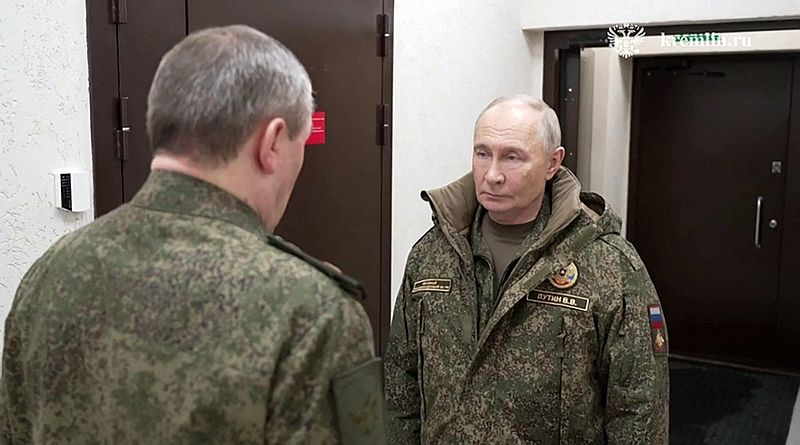
Illia Barabanov, Illia Abishev / BBC
Vladimir Putin continues to insist that the Russian army is “advancing on all fronts.” In an interview with Kremlin pool correspondent Pavel Zarubin, he claimed nearly complete capture of Kostyantynivka and Lyman, encirclement of Ukrainian forces “near the Stary Oskol river” (evidently confusing it with Oskol), and a successful advance on the city of Sumy, which, according to the Russian president, is “about 10.5 km away.”
Putin’s statements about Russian military advancement contradict independent observers’ data. Fighting continues in Kostyantynivka, Lyman remains under Ukrainian control, the frontline towards Sumy hasn’t changed since April, and there are no encirclements near the Oskol river.
Vladimir Putin has exaggerated Russian army achievements in capturing Ukrainian territories before. He now admits that Russian troops do not control Kupiansk, though he claimed twice late last year that this city was taken.
On June 12, the Russian leader asserted that Russian troops were “approaching Zaporizhzhia.”
However, documents from the 58th army and independent researchers’ data suggest that maps from the Russian general staff in this direction may diverge from reality by tens of kilometers, with potentially deadly consequences for Russian servicemen operating in the area.
The Russian BBC service examined staff documents and found out how the army fights when its understanding of the front does not match reality.
Mythical Reports
On Russia Day, June 12, after awarding labor heroes and handing state prizes, Russian President Vladimir Putin met with Russian army assault troops. With one of them, the president had a conversation:
“With this chevron from our battalion, last year we took the settlements of Kamyanske and Stepove in the Zaporizhzhia region, and we consider this a small gift for you,” stated Lieutenant Sergey Chuvashov, commander of the assault platoon of the 247th Air Assault Regiment, presenting the chevron to the president.
“This is the ‘Dnieper’ group, right?” clarified Putin.
“Yes, exactly!”
“Gradually approaching Zaporizhzhia?”
“Yes, exactly!”
“Success to you.”
This statement puzzled everyone—from independent military experts to the authors of z-channels—since the Russian army is nowhere near approaching Zaporizhzhia.
To this regional center, which Vladimir Putin officially included in Russia in October 2022 (after which the mention of the Zaporizhzhia region even appeared in the Russian Constitution), the Russian army has yet to reach by the fifth year of the invasion.
Rather, on the contrary, the Russian forces’ offensive in this sector of the front has stalled some months ago, with Ukrainian forces regaining control over Stepnohirsk—a settlement just north of Kamyanske and Stepove, and liberating some territories at the boundary between Dnipropetrovsk and Zaporizhzhia regions.
However, staff documents related to the actions of the 58th and 5th armies, which are part of the “Dnieper” group and operate in this direction, provide an answer to the question of where Vladimir Putin derives his confidence that the Russian army “confidently advances forward every day on all operational directions.”
“Assaults” on Credit
This is a section of the front in the Zaporizhzhia region — according to the American Institute for the Study of War as of June 13, 2026. The same settlements, Kamianske and Stepove, which last year, according to Lieutenant Chuvashov, who spoke with Putin, were stormed by his battalion, are noted on it. This section almost exactly matches the map of the Ukrainian project Deepstate, which often (with some delay) reflects changes on the line of contact.
However, according to staff maps and accompanying documents of the 58th army, Russian troops allegedly left this territory long ago, having advanced 16-20 km deep into Ukrainian territory northward on April 9.
Official statements from the Russian side coincide with staff maps, which directly guide army actions — all of which strongly diverge from reality.
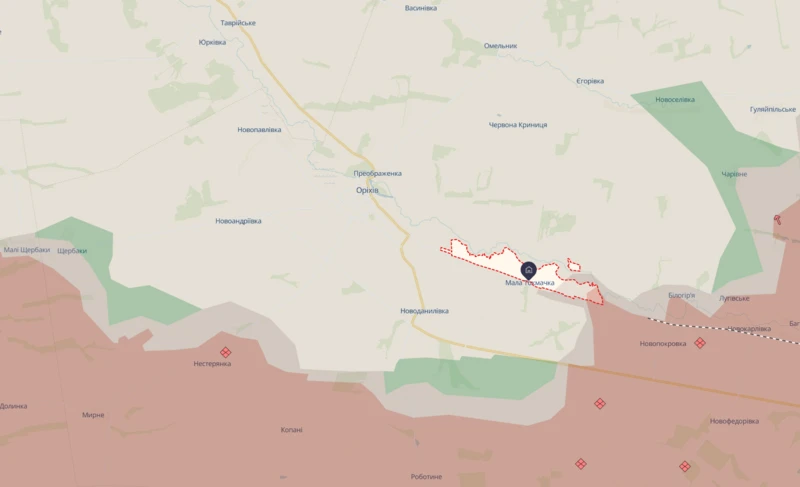
Thus, according to Russian generals, the settlements of Richne — “taken” on January 30, Prymorske — with its capture Andrei Belousov congratulated the servicemen of the 108th regiment on February 15, 2026; the same day “Zapadne” and Magdalinivka were “taken.”
With the capture of Veselyanka, Belousov congratulated the 247th regiment troops on March 4. As for the capture of Mala Tokmachka, a small village in the Zaporizhzhia region that has turned into a cultural phenomenon, Russian Defense Minister Andrei Belousov congratulated the 42nd motorized rifle division as early as November 17, 2025. However, according to independent military researchers and satellite images, it is clear that by June 2026, Russian forces had not captured this village.
The latest statement from the Russian Ministry of Defense regarding the capture of a settlement in the Zaporizhzhia region was dated June 4, when the agency announced the capture of the village Huliaipilske (named in the report as the old Soviet name “Komsomolske”).
On the staff map from April 9, the front is marked as passing by the edge of this village, located north of the still-uncaptured Mala Tokmachka. Thus, this section of the Russian staff map is already “colored in.”
“Zakras” (coloring in) is a slang term for marking territories on military maps as occupied or liberated before reliable confirmation of control over them appears. Even pro-war bloggers often accuse Russian generals of being overly fond of this method.
Something similar happened in the case of the Zaporizhzhia region: maps from the American Institute for the Study of War and the Ukrainian project Deepstate show that all these settlements located north of the abandoned Russian troops from Stepnohorsk are deep in the rear of the Ukrainian Armed Forces. Russian troops have not yet approached them.
The difference between what the Ministry of Defense “took” in its reports and “painted over” on staff maps as territories controlled by Russia and the actual front line in various places can range from 10 to 20 kilometers.
“Paint-overs and Advances”
“Paint-overs” (color filling – Ed.) in the Russian high command is managed not only by the leadership of the “Dnieper” grouping. For instance, z-military correspondent Vladimir Romanov wrote on June 14 that a similar discrepancy between the real front line and the lines on staff maps was recently discovered on the Kostiantynivka front section.
“The inspectors actually went to the LBS (line of contact – BBC), soldiers from the section express their respect to those two colonels,” he wrote. “As a result, they found a mismatch between the real and declared LBS – up to 17 kilometers deep. Do you know what the local command did after such a debriefing? They sent 40 people (including UAV operators) to storm the ‘painted over’ area. All 40 people died in 2 hours.”
“Preliminary reports and ‘paint-overs’ are unlikely to be beneficial to the advancing Russian troops,” warned Mikhail Zvinchuk, the author of the large pro-war channel “Rybar,” on June 8. “‘Credit’ lines in other directions have repeatedly led to erroneous assessments of the situation and, as a result, sources of problems.”
The most famous “paint-over” in the history of the Russian invasion of Ukraine was made by the commander of the “West” grouping, General Sergey Kuzovlyov. At the end of 2025, he reported to Vladimir Putin that the military of his grouping had completed the assault on Kupiansk and completely took it under control, for which he received the title of Hero of Russia. In reality, Kupiansk was, on the contrary, cleared of Russian troops by the military of the Armed Forces of Ukraine, and all maps of objective control of the front line show that the ruins of the city are under the control of the Armed Forces of Ukraine.
“We have Zaporizhzhia region – there are advances by kilometers every day. A kilometer two hundred, a kilometer three hundred, 800 meters. The same in depth along the front,” said Vladimir Putin on June 4 in St. Petersburg at an international economic forum. And the same z-military correspondent Romanov commented on his words as follows: “Zaporizhzhia region is pulling ahead of the grp. ‘West’ in ‘paint-overs’ and advances! About Stepnohorsk, they probably decided to remain silent to the president.”
At that moment, Russian troops had already retreated from Stepnohorsk.

Endless Offensive
In the fall of 2022, after the severe defeat of the Russian army east of Kharkiv, British historian and military expert Chris Owen noted that officers of the Russian army often lie to their superiors about the real state of affairs and the condition of their unit.
“The consequences of this lying were likely very severe for the Russian military. Command decisions – where and when to attack and defend – were clearly based on false information. This led to numerous unnecessary casualties and military failures,” wrote Owen, providing many confirmations of this.
Daily reports from the official representative of the Russian Ministry of Defense, General Konashenkov, literally turned into memes by 2022.
For example, on June 26, 2022, Konashenkov reported the destruction of Ukrainian military equipment exceeding its quantity at the beginning of the war – even accounting for possible supplies.
Konashenkov no longer appears on TV screens, but the understanding of the higher Russian leadership about the situation on the front line has fundamentally not changed.
Studying the staff documents of the 58th and 5th armies shows that the military bureaucracy has not only not disappeared but has become even more demanding regarding reports of achievements.
Russian servicemen must report on every shell fired – justify the necessity of the shot and report its results. It can be assumed that no one wants to write in the report honestly – missed or don’t know where it hit. In most relevant columns, the mark: target suppressed/hit/destroyed is indicated. Such reports summarize all directions, and the final report lands on the table of senior command.
At the same time, reports on the use of UAVs look much more modest: the mark “target hit” is rarely placed, more often – “UAV shot down/suppressed by enemy electronic warfare/lost communication,” etc. Apparently, in the case of drones, Russian military command does not believe in a word – visual confirmation is needed.
“Flag insertion” (military slang for a geolocated photo or video recording of penetrating the enemy’s rear and raising a flag) is just one way of visually confirming success.
Even though such success may be questionable or temporary, footage demonstrating the flag serves as documentary evidence of the advancement of assault groups and is used as reports on the basis of which maps are redrawn.
“Coloring” maps for the sake of reports provides a distorted picture of the situation on the battlefield. Supposedly (as many Russian military write), there are different maps in the headquarters of the fighting units — for reports and with the real line of contact. But this alone does not solve the issue.
There are also other consequences for the Russian army:
- Coordination of actions is disrupted. For example, aviation command has valid reasons to refuse strikes on “its own” territory, i.e., marked on maps as under Russian control. Meanwhile, ground units newly deployed to a hot spot and not yet familiar with the real positioning of forces on the battlefield risk unexpectedly encountering the enemy;
- Claims of capturing settlements “on credit” provide the Armed Forces of Ukraine with information on the directions where Russian troops will focus their penetration efforts;
- A general atmosphere of distrust intensifies within the Russian army. As the well-known pro-war channel “Two Majors” writes, due to the high command’s ignorance of the real situation, “some individuals try to fight not the enemy, but their information resources.” In turn, knowledgeable military personnel and z-bloggers increasingly doubt the adequacy of the high command.
It seems the current state of affairs satisfies the Russian military bureaucracy. In any case, absurd “flags” and false “colorings” in the Russian army are rarely punished (if at all). However, rewards for reports of the latest “capture” of a settlement occur regularly.
