
Crimea is obviously becoming one of the main focus points of our summer campaign.
While continuing to hold positions in the east, we focused on systematic attacks on logistics with mid-strikes along the entire route from Rostov-on-Don to Simferopol. The Defense Forces of Ukraine continue to target bridges in Crimea from Chongar and Armyansk and have significantly intensified their impact on the peninsula, including the crucial bottleneck in Kerch.
The goal of this phase is broader than mere isolation: we are forcing the Russian General Staff to make a painful choice between holding the front on the mainland and maintaining their “sacred” base. Every destroyed radar in Crimea does not travel to Vovchansk or Chasiv Yar to cover troops on the front line.

“The showcase of the Russian world” is now turning into a black hole for resources. There is no longer a guarantee that military or commercial vehicles will reach their destination via the infamous “Novorossiya route” (R-280). The land corridor is not elastic. Trains only go to Kerch, beyond which a scarce locomotive might be lost.
The bridges over Perekop are not completely destroyed, but they are regularly penetrated, damaging the roadway – earthen embankments cannot be built quickly, and the heavy equipment and engineering units arriving for repairs may also fall victim to our drones.
All this creates classic bottlenecks – multi-kilometer queues, nighttime truck stops, delays at pontoons that our drones use freely. Tankers are stuck in Chaplynka and Armyansk, with not a day passing without several burned trucks. Logistics functions in Russian roulette mode – trying to guess what will make it through when needed yesterday.
Numerous restrictions on municipal transport, street lighting, reduced shopping center hours, a complete stop in civilian gasoline sales, a halt in tourist bookings and accommodations, cancellation of ferry services, regular power outages, and outage schedules in Sevastopol – these are not temporary inconveniences; they are markers of a severe structural crisis. Our main task is not so much to make life unbearable for the occupiers on the peninsula (although that’s a nice bonus) but to divert their resources as much as possible from the frontline and force them to carry this burden as long and as expensive as possible.
“Artek” is over for now, children are banned from being transported for vacations – the occupying administration will have to either burn scarce resources at their own expense for the illusion of peaceful life or pay aid. Trains are currently not running, and airports in the south have long been out of operation – all this is the real cost of war. Power outages mean catastrophic losses in HoReCa: spoiled tons of food in refrigerators, canceled bookings, a dead season.
I am confident that against the backdrop of strict gasoline rationing and buses running on the hour in the rear, the Russian garrisons near Stepnohirsk and Mala Tokmachka are also no longer swimming in resources. Especially after the strike on the bridge in Vasylivka. Numerous repairs of burned fuel tanks, power plants, gas storages, and ferries are all massively draining money, building materials, and qualified man-hours from frontline priorities.

The huge queues of tourists and those who naively thought that the cheerful expeditionary war would never affect them, but now decided to urgently return to Russia, severely block the Crimean Bridge. All railway ferries are out of order, and now the Defense Forces have turned to the vehicle ones. We cleverly used the paranoia of the Russians with Putin’s favorite toy to our advantage: after successful sabotage, a strict ban is still in place on the movement of trucks and liquid bulk trains across the bridge. The occupiers are panic-stricken by the possibility of fuel car detonation right on the spans. Therefore, gasoline and cargo were transported exclusively by sea.
Now even this fairly narrow stream of resources is drying up. The damaged ferries (including “Panagia”) and the halt in truck transfers undeniably and 100% guarantee the deepening of the crisis in a few weeks. This means a forced increase in the supply distance by at least 500 km around the Sea of Azov. This results in the wear of thousands of trucks, additional pressure on mobile fire units and air defense along the route, ongoing vehicle repairs, and losses of people and vehicles just on the road.
Simultaneously, the Ukrainian Armed Forces successfully struck four gas compressor stations (GCS) in Zhuravlivka, Aromatne, Klyuchi, and Lokhivka. Large fires and smoke are reported there. Why? The logic is simple: the Tavriyska TPP operates on gas and uses diesel as a reserve emergency fuel. Diesel in Crimea is now in very short supply, so we targeted the gas. On the night of June 20, the Simferopol TPP itself was hit – the fuel storage tank was destroyed, with several direct hits on key buildings. Burning the machine hall or the turbine itself would be incredibly satisfying. At one time, Russia imported these Siemens turbines through grey schemes. Their repair under strict sanctions is exceedingly expensive and can take years. And if the basic generation falls, all military bases, headquarters, and factories switch to diesel generators, burning through the remaining fuel at double speed. A perfect closed loop.
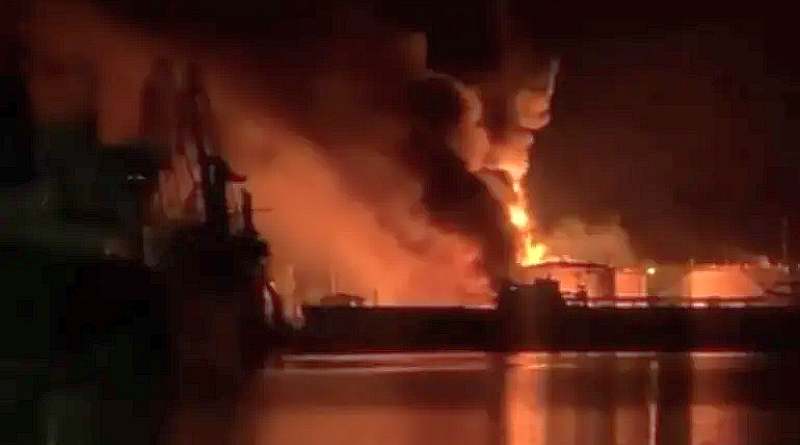
By the way, about fuel: in Kerch, the “TES-1” oil terminal burned brightly – the main hub where trains unloaded fuel oil and refined oil products to then distribute them across the peninsula. At least four out of seven storage tanks have been completely disabled (we will assess the exact scale of destruction via satellites once the fire and smoke subside). Even four full tanks amount to about 20 million dollars in pure loss just from the lost oil products, not to mention the cost of rebuilding the infrastructure from scratch. The village of Chushka and the oil terminal at the Caucasus port were also targeted. The TPP’s network of refueling stations on the peninsula now operates solely to supply fuel for special transport.

Of course, there were purely military targets in the priority target bank: radar systems for long-range SAM complexes (“Nebo-U”, “Kasta-2E2”), “Pantsirs”, the FSB headquarters in Armyansk, and the location of the railway battalion (military unit 98546) in Kerch. Strikes on the latter are a strategic move. This engineering unit is responsible for repairing tracks after strikes. When the battalion is not combat-ready, the next hit on the railway will have a greater impact on logistics. Regarding air defense, the loss of radars (over 350 million dollars in hardware) completely blinds the enemy and prevents them from maneuvering forces. The air defense group is now constrained by the task of protecting only itself, airfields, and command posts, leaving gaps in the sky over infrastructure.
Summary: we are witnessing a man-made logistical collapse and the rapid degradation of Crimea as the main rear of the invading army. All these numerous repair facilities, warehouses, and auto-battalions, under conditions of power outages, will draw additional fuel. The damaged bridge to the “Crimean Titan” plant in Armyansk, the plant itself recently received a dozen warheads, and the constantly targeted bridges from the Perikop side.
In essence, now the Defense Forces are methodically breaking the peninsula into isolated clusters, which we eliminate one by one, overloading their air defense and focusing drone sorties either on “eyes” (radars), firepower (SAM), or critical infrastructure.
This is the main strategic plan of the summer campaign. Crimea is no longer a military asset for the occupiers – it has turned into a toxic liability with negative return. Politically, the Kremlin cannot surrender it, and logistically it can no longer fully support it.
Every ton of diesel that is now burned by generators in the de-energized military units in Sevastopol is a ton of fuel that the armored vehicles in the Zaporizhzhia direction will not receive. Every engineer from the shattered battalion in Kerch currently repairing tracks and tanks is a loss of skilled hands for building fortifications on the mainland. Billions of rubles and thousands of man-hours are now literally burning in attempts to simply maintain the basic functionality of the base.
Thus, Crimea transforms from a mythical “unsinkable aircraft carrier” into a logistical noose. We are causing a man-made disaster for the occupiers and have imposed a war of attrition on them, where the cost of maintaining the rear exceeds the cost of maintaining the front itself. And the longer they try to carry this suitcase without a handle, the faster their operational resilience in the south will crumble.
