
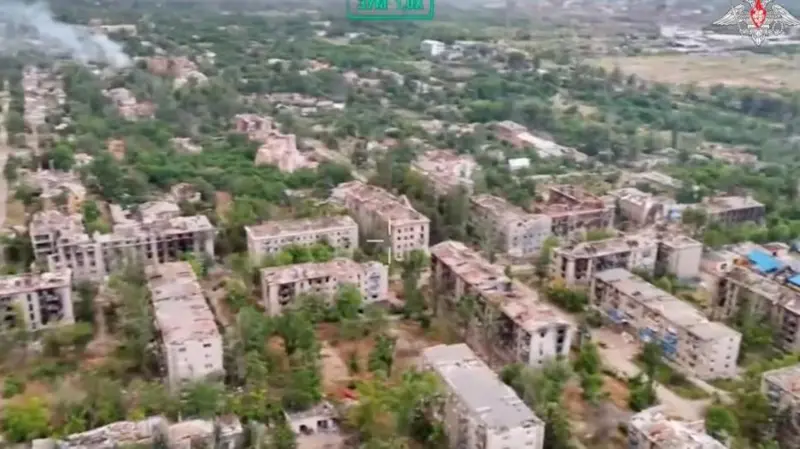
Russian troops have infiltrated Kostyantynivka, and fierce battles are ongoing in various parts of the city. According to Ukrainian military personnel interviewed by the BBC, the entire city has effectively become a “grey zone” – an area not fully controlled by either side.
The Russian Ministry of Defense claims that its forces are actively advancing in the southwestern part of Kostyantynivka, where they allegedly surrounded several units of Ukrainian brigades.
Moscow also asserts that Russian forces have captured the villages of Rubizhne and Dovga Balka to the west of the city and are now trying to flank Kostyantynivka to reach the direction of Druzhkivka and cut off the communication routes with Kramatorsk, a key logistical center for Ukrainian forces in Donbas.
In a written comment to the BBC, Commander of the 19th Corps of the Armed Forces of Ukraine, Brigadier General Oleksandr Bakulin, who coordinates the defense of this area, categorically denied the information about the encirclement of Ukrainian units.
According to him, “the situation in the area remains under control,” and “the enemy is not succeeding.” Meanwhile, the general acknowledged that about 130 Russian soldiers are in the city itself.
Kostyantynivka serves as a kind of gateway to that part of Donbas still under Ukrainian control. Its loss would effectively mean the start of the battle for the last major Ukrainian strongholds in the region – Kramatorsk and Sloviansk.
“All of Kostyantynivka today is a ‘grey zone’”
The BBC spoke to three Ukrainian military personnel whose units are defending the Kostyantynivka area.
According to them, the actual situation in the city is not as catastrophic as described by the Russian side, but significantly more complex than what emerges from official Ukrainian command statements. At their request, we do not disclose their names and personal details.
The military personnel report that Russian infantry advancing from the south and east have already been recorded on the northern outskirts of the city – near the exit to Druzhkivka.
“They are penetrating to the rear, and we have to exhaust all forces to drive them out of shelters and catch them. In urban conditions, this is much more difficult,” says a drone operator.
However, he emphasizes that the mere presence of Russian infantry in different parts of the city does not yet mean its capture.
“The fact that the infantry passed through half of Kostyantynivka does not mean they control it. We are destroying them. This is what is called a ‘grey zone.’ And it can be said that all of Kostyantynivka is in such a zone today.”
However, all interlocutors of the BBC note: Russian troops continue to infiltrate the city and accumulate forces in new positions.
Tactics of small groups
In conditions where drones control almost all movement on the front line and quickly attack any detected target in the so-called “kill zone,” Russian military forces are increasingly using the tactics of small groups.
Thus, they force the Armed Forces of Ukraine to spend even more resources on holding back such offensive operations.
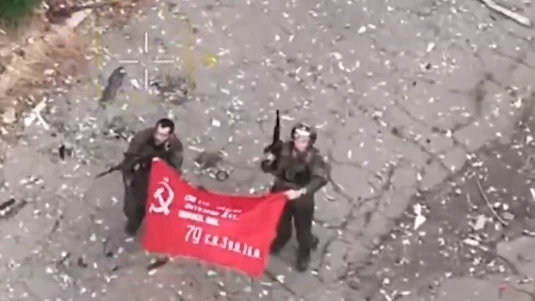
“They go in one by one or in pairs, occupy shelters, and then the main thing for them is not to give themselves away,” explains an officer of the unit defending the Kostyantynivka area. “From the shelters, they report on the movement of the enemy.”
This very tactic allowed Russian assault troops to reach the greenhouse area on the southern outskirts of Kostyantynivka and gradually infiltrate deeper.
The intensity of the assaults sharply increased since late spring. The foliage on trees helped Russian assault troops hide from drones. Once reaching the city limits, they can hide in building basements, from where it is very difficult for Ukrainian drone crews to dislodge them.
However, the pace of advancement remains very slow.
“They can advance less than a hundred meters in a day. Sometimes they literally crawl from one building to another. There were cases when they tried to move along the riverbed – we called them ‘divers’,” says an officer.
Within the city limits, Russian soldiers move exclusively on foot. According to Ukrainian military personnel, the level of their equipment varies greatly.
“You can encounter an infantryman without a bulletproof vest, helmet, or even a weapon. And there are those fully equipped, with a backpack and all gear,” says a drone operator.
Hunting for Drone Operators
According to BBC sources, Ukrainian assault groups, infantry, and drone crews remain in Kostyantynivka. However, their positions are increasingly being detected and attacked.
The main target for Russian drone operators today has become Ukrainian UAV crews.
“Enemy crews do not search and destroy infantry as we do. Their artillery, MLRS (multiple launch rocket systems), and aviation handle that,” explains an operator.
For Ukrainian drone operators, the primary task remains holding back the breakthroughs of Russian infantry and assault troops.
“In the morning, intelligence reports enemy movements. Throughout the day, we conduct 20-30 flights,” he says.
He mentions that often only three to four hours of sleep are possible per day.
Due to a lack of resources, including manpower, Ukrainian UAV groups cannot systematically hunt Russian drone operators. As a result, they can operate freely, detect Ukrainian crew positions, and strike them.
The videos published by the Russian Ministry of Defense also acknowledge that command points and launch sites of Ukrainian drones are priority targets for them.
Due to the high flight intensity—Ukrainian operators often have to launch drones every half hour—warehouses, antennas, command points, and drone launch sites are usually located close to each other. Once one of these sites is detected, Russian forces often strike nearby buildings, using guided bombs (KAB) and FPV drones, among other things.
According to Ukrainian military personnel, this gives Russian infantry more opportunities to move unnoticed.
The closer Russian drone operators can approach the front line, the deeper their assault groups can penetrate into the rear.
“We pay very little attention to enemy pilots. They constantly advance, detect our positions, and we have to retreat. We can’t hold the front,” says the drone operator.
In such conditions, supplying the units has become an extremely difficult task.
There are almost no ground routes left for supply, and large drones like Vampire, used for delivering cargo to the frontline, are often intercepted in the air.
As a result, says the military personnel, his unit is forced to use FPV drones even to deliver provisions and essential items to infantrymen at their positions.
At the same time, Ukraine continues to strike at Russian logistics. Recent medium-range attacks have significantly complicated fuel supply to occupied Crimea.
Since June 21, the sale of fuel at gas stations in occupied Crimea has been stopped for everyone except state services that ensure the life and safety of the peninsula. This was announced by the occupying authorities of Crimea.
Strikes on refineries and other facilities located thousands of kilometers from the frontline create serious problems for the Russian authorities and worsen the overall information landscape.
In such conditions, successes on the front and the capture of such an important city as Kostyantynivka could be a way for the Kremlin to shift attention to military achievements.
However, Ukrainian military personnel defending Kostyantynivka say that strikes on Russian logistics — particularly on routes leading from Mariupol to Crimea — have not yet had a noticeable impact on the situation directly on their front section.
The battle for the key city of Donbas
To capture Kostyantynivka, Russia employs familiar tactics previously used in Pokrovsk, Bakhmut, Avdiivka, and other Donbas cities. Its goal is to encircle the city from the flanks, surround it, and cut off logistical routes.
Without supplies, Ukrainian units may be forced to retreat with heavy losses.
Analysts from the Ukrainian project DeepState believe that the fall of Kostyantynivka is only a matter of time. In their assessment, after this, the logistics of the Defense Forces in the area will change dramatically, any movement will become significantly more difficult, and even being in Kramatorsk will be associated with increased risks due to the work of Russian drone operators.
One of the soldiers defending the city also told the BBC about a serious shortage of personnel. According to him, commanders do not always report the loss of positions, as they might receive an order to immediately reclaim them.
“We already lack enough people to hold what we control. Assaults are out of the question,” he says.
Because of this, command has to transfer fighters from other units, including from rear positions.
According to the source, reinforcements are arriving more slowly than the brigade is suffering losses. Other military personnel interviewed by the BBC also speak of a severe shortage of personnel.
However, the drone operator is confident that the situation can still be stabilized if Kostyantynivka receives the necessary reinforcements.
“If we don’t change our approach and start destroying their logistics and their drone operators, they will continue to advance,” he says.
Cover photo: General Staff of the Armed Forces of Ukraine
