
Has the negotiation process related to ending the Russian-Ukrainian war really been revived? Could the brief peace in Oleshky become a precedent for new humanitarian operations? And can the Russian, Ukrainian, and American delegations agree on anything, should they meet in Abu Dhabi?
If we chronologically arrange the events of recent weeks, we can observe a masterfully crafted Russian special operation aimed at proving the effectiveness of U.S. President Donald Trump’s peacekeeping efforts ahead of the midterm elections to the American Congress.
So, October 9. The Ukrainian delegation in Washington conducts negotiations with American intermediaries in the presence of Europeans. It then becomes known about a phone conversation between Trump and Putin, during which the presidents agree on supplying Russian diesel to the States and temporarily lifting sanctions against Russian oil. Volodymyr Zelensky calls this “investments in war,” and reports emerge of problems with intelligence sharing and the speed of Starlinks. The U.S. president announces an “energy truce,” unknown to either Kyiv or Moscow. However, the diplomatic process continues. On October 19 in Oslo, the leaders of Ukraine, Norway, and Finland meet with Steve Witkoff to develop joint proposals, which the American intermediary presents to the Russian president on October 21 during hours-long negotiations in St. Petersburg. Following this meeting, they agree to hold consultations between the Russian, Ukrainian, and American delegations. Russian presidential aide Yuri Ushakov clarifies that such negotiations may take place after November 4 — that is, after the American elections.
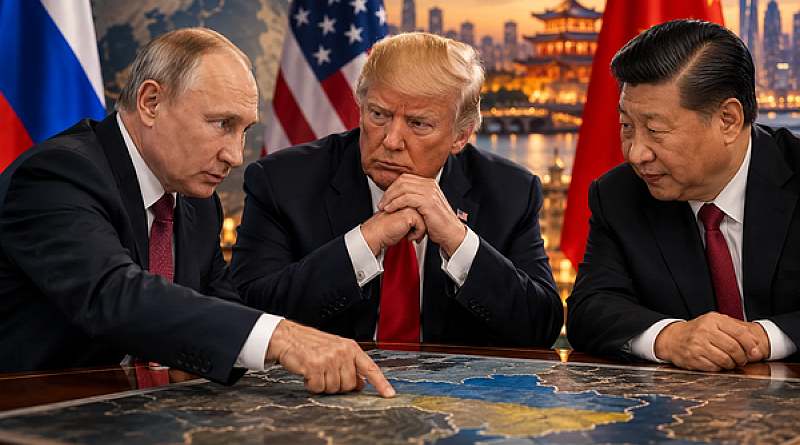
Meanwhile, the Kremlin proposes a November meeting of the leaders of the USA, China, and Russia at the APEC summit in Shenzhen to negotiate the war without Ukraine’s participation. Trump confirmed his willingness for such a meeting with Putin and Xi Jinping but said it could concern global security and denuclearization. On October 25, Ushakov confirms that preparations for such a meeting have already begun. And on October 27, Finnish President Stubb and Norwegian Prime Minister Støre — participants in the Oslo negotiations — call Putin.
On October 23, the White House reported that, through Melania Trump’s mediation, a ceasefire would be established in the strife-torn Oleshky in Kherson region, and President Trump emphasized that his wife had handled this better than professional diplomats. On October 27, the local truce took effect, allowing for the evacuation of some people and providing humanitarian aid to those remaining. At the same time, media reports raise concerns that the Russians might use the truce to advance on Kherson.
On October 28, Yuri Ushakov emphasized that there is no specific date for the delegation meetings, and their occurrence will depend on the battlefield situation. The next day, the Russian presidential aide insisted that if there are “mass-scale bombings” or drone attacks from Ukraine, it would drastically affect Moscow’s mood, and the meeting’s occurrence would be questioned. Meanwhile, Russia continued attacking Ukraine.
On November 1, German President Frank-Walter Steinmeier, meeting in Beijing with the head of the PRC, noted with some surprise that Xi Jinping knew nothing about preparations for a meeting of the three leaders to discuss the Ukrainian issue. The head of the PRC, with feigned naivety, asked his interlocutor where such rumors originated. A potential meeting of Trump, Putin, and Xi in Shenzhen on November 18-19 is still possible, but the Ukraine issue will not be discussed there. The PRC head told the German president that the war in Ukraine is a European conflict, so Europeans should be at the negotiating table, which completely contradicts Ushakov’s statements.
Thus, we can say that we are faced with negotiatory scenery constructed by the Kremlin, not without White House participation, to demonstrate diplomatic efforts ahead of the elections. What points to this being just scenery are factors like the absence of any specifics regarding new proposals for negotiations and the Kremlin’s unwillingness to determine dates before the U.S. midterm elections. The truce, which Trump has been advocating since his return to the Oval Office, is replaced by a brief ceasefire on a limited front section for a humanitarian operation. And even before the midterm elections, Moscow begins rejecting the idea of resuming the negotiation process itself. I won’t even mention the bluff of the “summit of three” purportedly planning to divide the world.
Thus, a major achievement would be merely an attempt to revive the negotiation process post-midterm elections — although the chances are slim, and the chances of such a process leading to any real agreements are nil, as the Kremlin does not intend to cease strikes on Ukraine and seemingly believes that destroying infrastructure will push Kyiv to unconditional surrender. Although Trump continues to make undefined optimistic statements, his secretary of state, Marco Rubio, admitted that the success of the negotiation process is not worth counting on, and that Putin is unlikely to be satisfied with just Donbass.
And this candid statement from the American Secretary of State acknowledges the true, not simulated realities of “Operation Oslo.”
