
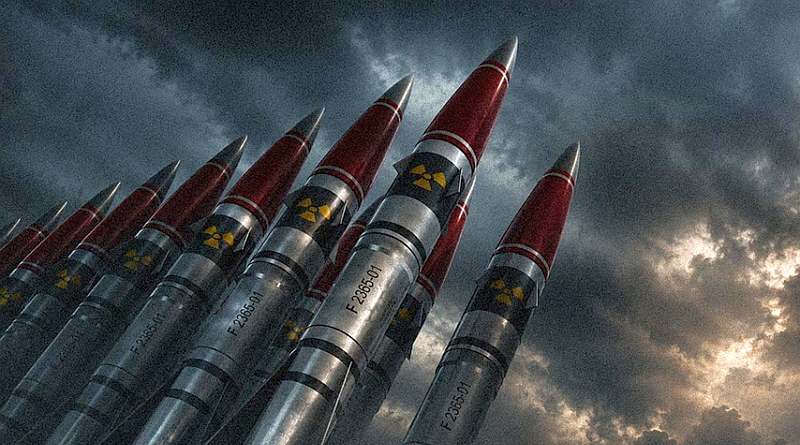
Every few months, Russian propaganda, using Western media, returns to the same threat: the possibility of a nuclear strike. First, it is discussed on Russian channels, then the idea is picked up by foreign commentators, and within a day, the theses about the “inevitability of a nuclear strike” and the “final party on Mount Shchekavytsia” resound in my feed from many people.
So, can Russia really use nuclear weapons against Ukraine? And what will it change on the front? The question is absolutely normal, and it should be answered calmly, without hysteria or unnecessary worries.
When a person hears the words “nuclear weapons,” they imagine a destroyed city and a mushroom cloud over the horizon. A tactical charge works in a similar way. Its main feature is that it is significantly smaller in power. We’re talking about fractions of a kiloton or a few dozen kilotons. The bomb that destroyed Hiroshima was about fifteen kilotons. It turns out that the most powerful tactical charges are approximately equal to that same Hiroshima. And the weakest ones can cover an area of several blocks. Therefore, the word tactical only means one thing—that the military plans to hit not the city. The target becomes a defense node, a mass of equipment, or a river crossing. Therefore, the line between a tactical and a strategic charge is conditional and is drawn not by power, but by the carrier and the task. The same charge is considered tactical if it flies two hundred kilometers at a field ammunition depot. The same charge becomes strategic if the target is an energy facility or the capital of a neighboring state. Therefore, talk about some separate safer category of nuclear weapons is mostly a linguistic game. The physics in both cases remains absolutely the same.
Schrödinger’s Nuclear Arsenal
This is the most important question, and it is usually skipped in public discussions. According to estimates by Western research centers, Russia has about two thousand non-strategic nuclear warheads. The number looks frightening until you ask the next question. Where exactly are these charges physically located right now and in what condition are they? Well, they are not mounted on missiles in operational units but stored in depots throughout Russia. The Soviet, and later Russian system, is built on strict centralization of storage. Warheads are kept at special facilities under the command of the Twelfth Main Directorate of the Ministry of Defense. This is a separate structure with its own security, transport, and transfer procedures. A regular missile brigade does not have nuclear warheads at their depot. To use a charge, it must be physically removed from the central storage, delivered to the deployment area, attached to the carrier, and undergo a long series of verification procedures.
This is where what scares the Russians much more than sanctions begins. All major storage facilities have long been mapped. They are under constant satellite surveillance by the Five Eyes intelligence community, consisting of the United States, the UK, Canada, Australia, and New Zealand (the system’s operation was described in a previous article). This is not about one snapshot a week, but continuous observation in various ranges, from optics to radar. Alongside satellites, electronic intelligence is working, monitoring the control channels of the respective units. Add to this the agent component and logistics analysis, as special trains and aircraft have a very distinctive signature. Therefore, any real movement of charges from storage towards the front will be noticed in advance. This is important because the preparation of a strike doesn’t take minutes or even hours. It takes days, possibly weeks. Thus, the West will have time for a political reaction, a warning, and a demonstration of its readiness. Ukraine will have time to disperse and take additional protection measures for its troops.
This is why previous crises over nuclear threats developed in a similar manner. In the fall of 2022, American officials publicly stated that they saw the rhetoric but did not see the movement of the arsenal. This statement was not diplomatic courtesy but a direct message to Moscow: “We are watching your storage facilities, and we see that you’re doing nothing. A threat without physical preparation remains just words.”
And what will the Russians use to deliver the charges? You won’t see a separate nuclear launcher anywhere. The carriers have long been known and do not stand out among conventional equipment. These are operational tactical complexes like Iskander with a range of up to 500 kilometers, free-fall aviation bombs, sea and air-launched cruise missiles. Nuclear charges were once even made for large-caliber artillery. From the same machine, a regular missile can be launched and a missile with a special warhead. This duality creates a separate and very unpleasant problem for the entire world. Each Iskander launch could theoretically be nuclear, and it is impossible to distinguish it outwardly. The deployment of some carriers on the territory of Belarus, announced in 2023, was precisely about this. This political gesture was meant to blur geography and add uncertainty, not to create a real new military capability.
Who makes decisions and what has changed in the doctrine?
In the fall of 2024, Russia updated its foundations of state policy in the field of nuclear deterrence. Formally, the threshold for use was lowered, including due to the mention of aggression by a non-nuclear state supported by a nuclear one. Propaganda presented this as a historic turn and a direct signal to the West. In reality, the declarative doctrine and the actual decision-making procedure are two different worlds. The doctrine is written for an external audience and physically obligates no one to anything. Actual use requires a chain of technical and organizational actions, which cannot be hidden. The decision of the first person is needed, the involvement of military leadership is needed, the work of the Twelfth Main Directorate is needed, the involvement of dozens of people at different levels is needed. Each link in this chain is a potential leak point and a potential point of refusal.
Chronicle of Threats and Possible Consequences for the World
The peak of nuclear intimidation occurred in the fall of 2022, when the Russian front was crumbling near Kharkiv and Kherson. At that time, the possibility of nuclear use was publicly discussed at the highest levels. Simultaneously, there was a narrative around the Zaporizhzhia nuclear plant, intended to create a separate channel of nuclear fear. There were exercises of non-strategic nuclear forces, statements about changing doctrine, and the demonstrative use of a medium-range ballistic missile on Dnipro in November 2024. Put all these episodes together, and you will see a pattern. Each subsequent threat works worse than the previous one. Blackmail makes sense only as long as the victim believes it. Russia has spent its nuclear credibility on dozens of statements, none of which have been carried out.
But if an attack does occur, what will be the consequences for the world? I consider this section the most important for the European reader. A radioactive trail does not stay within administrative borders and does not stop at the front line. Depending on the weather, it will cover hundreds of kilometers in the form of an elongated stain, and this stain will cross state borders within a few days.
Then begins a chain that cannot be stopped with political declarations. Contaminated groundwater flows into the Dnipro or Siverskyi Donets, and from there to the Black Sea. Ukrainian grain loses markets instantly and forever, as no importer will buy products with suspected radionuclides. Following the grain are the Danube Delta, Moldova, Romania, and Bulgaria, which physically cannot distance themselves from their river. The European Union will face not a political crisis but a sanitary one, with product controls, bans on fish, and panics in supermarkets in Warsaw or Sofia. Separate is the Zaporizhzhia nuclear power plant, under occupation and requiring stable power for cooling. Any nuclear incident in the region creates a second story, much worse than the first. Damaged lines, destroyed logistics, staff unable to reach work. In this scenario, a tactical charge becomes merely the trigger for a civilian-scale disaster.
Now the most interesting question, which somehow hardly arises in public discussion. West and northwest winds prevail over Ukraine, and this is not a matter of opinion but a matter of climatology. An attack on eastern regions means the cloud will go exactly where the missile came from. The Rostov, Belgorod, and Voronezh regions will fall under the nuclear trail within a day or two. History already provides us with a ready illustration, which is extremely uncomfortable for Moscow. After Chernobyl, the most contaminated were not Ukrainian regions, but the south of Belarus and the Bryansk region. Homiel still has relocation zones, and Bryansk forests still produce mushrooms with elevated levels. The reactor stood in Ukraine, but people abroad, who didn’t even understand what was happening to them, paid with their health.
The Earth is truly one, and its atmosphere is also one. Isotopes do not read passports, do not ask about citizenship, and do not consult the map of occupied territories.
A state that uses nuclear weapons 50 kilometers from its own border will cause a nuclear accident to itself. The difference is that this time it will do it consciously and by its own decision.
Next comes a double paradox, and both parts are worth discussing out loud. Russia declared the occupied regions as its own and included them in its constitution. This means that, formally, it would be launching a nuclear strike on its own territory, according to its own law. The legal structure built for annexation turns into a trap for its creator. The second part of the paradox lies in simple tactics. Russian units are situated a few kilometers from any possible strike point, in the same zone as ours. The explosion radius and the depth of their own battle formations roughly coincide. Whoever strikes the front line also hits their own infantry along with the enemy’s.
Put this together and look at the result from the outside. It results in a state using nuclear weapons on land it claims as its own, against a population it calls its own, while also covering its own attack units and border regions. Explaining such a decision to its own society is basically impossible. Explaining it to its own army is even harder.
Soviet Dream of a Nuclear Breakthrough
To understand where the idea of a tactical nuclear strike came from, one must return to the 1950s. In September 1954, at the Totskoye range, the Soviet Union conducted exercises involving an actual nuclear explosion. Troops were moved through the epicenter, practicing an advance into the newly created corridor. Tens of thousands of servicemen received radiation doses, and the event remained classified for decades. The concept appeared logical and even elegant on paper. A nuclear strike creates a corridor in dense defense lines, mechanized columns enter the breach, and the advance develops in depth. The scheme made sense against continuous defenses with a clearly defined rear that could be covered with one strike. The entire Soviet ground doctrine was designed for such a war. But this scheme does not work on a modern front.
Let me explain. Assume for a moment the worst-case scenario and imagine the strike is indeed carried out. Let’s analyze its consequences. Over a distance of 100 or 300 kilometers, the flight lasts mere minutes. Early-warning satellites detect the launch almost immediately, radars pick up the target and calculate the trajectory. But they see the missile, not its payload. This means that the whole world would be in a state of complete uncertainty for a few minutes. What was in the warhead will only be known after the detonation. But would it be effective? The detonation can be either airburst or groundburst.
The military knows that, in the first case, 20 kilotons take out equipment and personnel within a radius of a few kilometers. Add to this the flash of optics, a powerful electromagnetic pulse, and total burnout of unprotected communications. However, infantry in properly equipped shelters can survive even relatively close to the epicenter. A ground detonation yields a different result and adds prolonged contamination of the area. The radioactive cloud will go where the wind takes it, and no one can predict this with kilometer precision. Weather becomes a full-fledged participant in the operation, and the outcome depends on cloud cover, humidity, and wind direction. A military planner receives a weapon whose consequences he controls only approximately.
But will this allow breaking through the front? No, it will not. The modern line of contact is fundamentally different from what Soviet generals imagined. The defense stretches for hundreds of kilometers and does not have a single junction worth a nuclear charge. Command posts are relocated, warehouses dispersed, and units hold positions in small groups. You might use up ordnance and find nothing beneath it but a few empty forest belts. And a continuous drone zone that stretches 20 kilometers deep into the positions of both sides. It will not disappear after a nuclear explosion, as operators sit beyond the radius of damage. Assault groups that are supposed to enter the breach will go through the same drone-affected zone. Only now they will do it over contaminated terrain, wearing protective gear, with limited time on the ground and no proper evacuation for the wounded.
The Price to Pay Beyond the Front
The main opponents of such a scenario are not Washington and not Brussels. The harshest reaction will come from Beijing and Delhi.
- For years, China has repeated the formula about the inadmissibility of the use and even the threat of nuclear weapons. This thesis is needed not for Ukraine, but for its region, where nuclear powers stand nearby and where a precedent would destroy the entire deterrence system.
- India is in a similar position, having a nuclear neighbor across a disputed border. In Samarkand in the fall of 2022, Modi told Putin face-to-face that today is not an era of wars. This short phrase went around the world precisely because it was spoken not at the UN, but at the negotiating table opposite Putin himself.
Both states fully understand the main consequence of the first use. Threshold countries from Iran to South Korea will get a ready-made argument in favor of their own nuclear programs. The non-proliferation regime, which is maintained by habit and fear, will cease to exist within a few years.
This leads to economic consequences that will finally devastate the Russian economy.
China and India are today the main buyers of Russian energy resources and the main channel for bypassing sanctions. Neither of these countries will want to publicly stand next to a state that used nuclear weapons for the first time in 80 years. It’s not about a moral choice, but about reputational and financial risks for their own banks and companies. Secondary sanctions in such a situation will no longer be a subject of negotiation and will become a matter of survival for any counterparty.
It’s also worth recalling the American warning, which was made back in 2022. The response to the use of nuclear weapons will not necessarily be nuclear. The West has enough conventional means to destroy the Russian group in the Black Sea and in the occupied territories. Such a scenario was publicly discussed by former high-ranking officials specifically so that Moscow would hear it.
A nuclear threat is not a miracle weapon that will help the Russians win. It will not break through modern defenses, will not remove the drone zone problem, and will not return the initiative to Russia at the front. It does not solve any operational task that Russians cannot solve by conventional means. But it destroys the last supports on which the Russian economy and Russian diplomacy rest. Russia will turn from a state that blackmails the world with threats into a state of a nuclear terrorist, which once used nuclear weapons against a neighbor, and will have to live with this stigma for centuries.
