
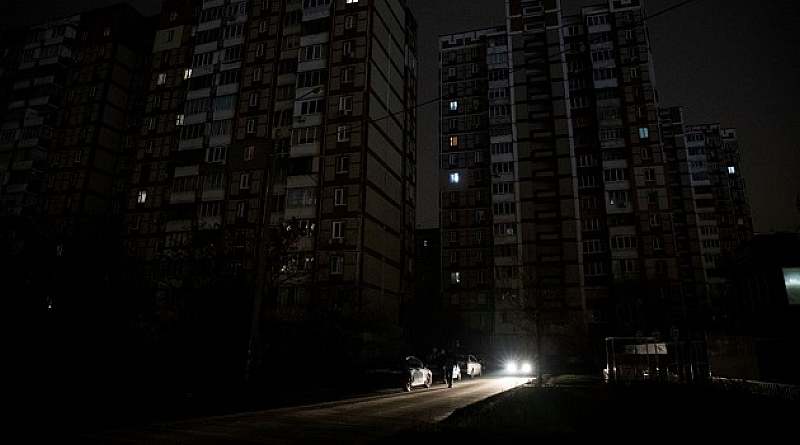
Massive Russian missile and drone attacks have led to significant problems in Kyiv. As of November 5, the capital is experiencing ongoing and increasingly severe issues with power and water supply.
“Kyiv is operating under extremely difficult conditions. The city authorities are doing everything to sustain the capital’s life and are developing different scenarios as the enemy intensifies attacks on energy, heat generation, and water supply systems,” stated Mayor Vitaliy Klychko on Thursday.
He emphasized that the work of air defense is critically important for the protection of infrastructure objects.
“With such an intensity of devastating enemy attacks, without the protection of key objects with air defense systems, the restoration, stable operation, and existence of these objects are in great doubt! Because when several rockets or a swarm of drones hit at once, no protective structures can handle it,” said the mayor.
President Volodymyr Zelensky, in turn, called the situation in Kyiv “especially difficult.”
“The situation in Kyiv is now especially difficult: there are prolonged power and water outages for people and businesses… But, no matter how difficult it is, there must be the most operational and complete work of state structures, regional and local authorities, and every company that provides people with electricity, heat, and water, regardless of the ownership form of such companies,” he stated on November 4.
Water Disruptions
Around 2 PM on Thursday, November 5, city authorities reported power outages at water utility facilities.
Only the day before, on November 4, the public was announced the restoration of water supply after the previous RF attacks.
However, on the afternoon of November 5, water began disappearing again in most districts of the capital.
“Due to emergency power outages at Kyivvodokanal facilities, there are currently disruptions in water supply in all districts of the capital,” stated the announcement from “Kyivvodokanal.”
It mentioned that specialists from “Kyivvodokanal,” together with energy workers, are taking all possible measures to restore water supply as quickly as possible.
“The emergency arose due to an enemy attack on Ukraine’s energy system and damage to energy equipment, which supplies electricity, including to Kyiv,” Klychko noted.

At a briefing, First Deputy Head of the KMDA Petro Panteleyev explained the water issues by noting that the power systems for most districts’ water supply cannot be powered by generators.
The situation is different only in the Obolon district, where there are 300,000 consumers, but a backup power system of 1 MW supports their stable water supply.
“The capacity of most of the water supply and sewage systems in Kyiv is such that, roughly speaking, generators cannot handle it,” stated an official.
According to him, for backup power supply to these facilities, 104 generators were purchased, and several mini power plants with a capacity of 16 MW were built.
By the end of the year, several more stations with a total capacity of 40 MW need to be built.
However, the construction of such stations is ongoing, very lengthy, and costly.
Prime Minister Serhiy Koretsky announced on November 5 that the government will provide Kyiv with an additional 10 generators for water utility facilities.
“People should not be left without water supply every time due to Russian attacks on the energy system. It is critically important to provide the utilities and sewage systems with backup power sources,” the prime minister noted.
Issues with Light, Heat, and Transport
The drop in temperature on November 4-5 (according to the Ukrainian Hydrometeorological Center, it fell to 4-6 degrees and will decrease further in the coming days) led to increased electricity consumption.
“…On November 4, the daily peak consumption was recorded in the evening. It was 4.9% higher than the peak of the previous day – Tuesday, November 3. The reason for the change is the further drop in air temperature, prompting consumers to use electric heaters,” stated the “Ukrenergo” report.
According to the BBC, the increase in energy consumption in Kyiv led to numerous local network failures. Several dozen buildings were disconnected from the power grid. Repair times are very long due to the high workload and shortage of repair crews in the capital.
On the evening of November 4, groups of residents from Obolon and Akademmistechko blocked local roads, demanding attention to lighting issues in their homes. According to the BBC, in some of them, there has been no electricity for almost a week – since October 30.
Kyiv authorities, meanwhile, assure that the energy situation in the capital is “stabilized.”
“We have stabilized the situation after massive shelling of both the country’s and Kyiv’s energy infrastructure,” Deputy Head of the Kyiv City State Administration Panteleyev stated on the morning of November 5 during a briefing.
However, “Ukrenergo” announced emergency outages in the capital and region on Thursday. Stabilization schedules are not in effect.
“Energy workers are working to restore stable electricity supply as soon as possible. Emergency outages will be lifted after the situation in the energy system stabilizes,” said the energy operator’s statement.
In general, emergency outages have been regularly implemented in recent days.

Due to energy problems in the capital, electric transport has suffered.
On the evening of November 3, city authorities announced the “temporary suspension” of trams and trolleybuses.
On certain routes, some tram and trolleybus routes will be duplicated by buses.
The authorities also reported issues with the Kyiv metro due to “voltage fluctuations” in the network.
“Due to the sudden voltage fluctuations from external power sources, there may be temporary disruptions or increased intervals between trains on the metro lines. Once the external power supply system is stabilized, train operations will resume,” said the statement from KMDA.
Serious problems with electricity and heating occurred in Kyiv last winter, but such frequent metro stoppages due to power issues are happening for the first time this year.

Problems with electricity are delaying the launch of heating in Kyiv.
Lack of power and backup generation in certain buildings prevents the activation of circulation pumps for heating supply.
Additionally, missile strikes have damaged the main heat network facilities in the capital.
Petro Panteleyev cited the South Bridge as an example, where a main pipeline was destroyed by a Russian missile strike.
Only on November 4, they managed to lift a new section from a barge and secure it on the bridge in place of the damaged one.
However, Kyiv authorities assure that heating has already started being supplied to residents on November 2, and it’s progressing simultaneously in all districts “as planned.” According to Panteleyev, there are no “critical anomalies” in this process so far.
The heating connection will last about 10 days, until November 12.
“…the decision to start the heating season in the residential sector was made a few days before a sharp drop in temperature. As of today, nearly 45% of the city’s residential buildings are already connected to heating,” Vitali Klitschko reported on November 5.
