
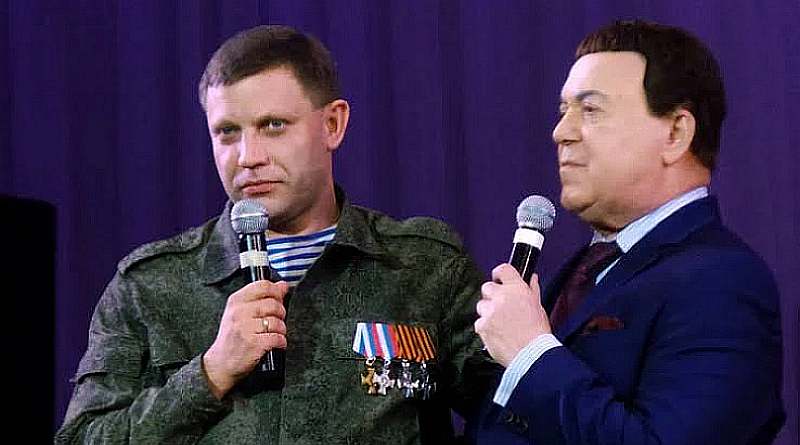
Eight years ago, on the last day of summer, August 31, 2018, in the center of Donetsk, powerful explosives, previously planted in a lamp at the entrance to a café with the symbolic name “Separ,” killed the head of the council of ministers of the occupation formation “DNR” Alexander Zakharchenko. He became the last and most high-profile among a whole cohort of collaborators in Donbas eliminated in a similar manner.

Kobzon’s Concert
This event marked a certain milestone. With Zakharchenko’s death, the “romantic” phase of those influential militant leaders who, since the spring of 2014, not only stood at the origins of Russia’s hybrid war against Ukraine but also directly fought against the Ukrainian army, came to an end. After the second Minsk agreements, they claimed a special role in the further governance of these large, once powerful industrial Ukrainian regions that had turned into bottomless black economic holes, territories of lawlessness and fear. I recall that turbulent day on April 16, 2014, when, without any resistance, the Donetsk city council was seized by armed militants of the “Oplot” organization, and its then-leader Zakharchenko boldly boasted to journalists in the corridors about his Ukrainian passport. As if to say, we are the uprising people of Donbas, local miners, not some incoming Russians. With Zakharchenko’s death and up to the full-scale invasion of Russia in Ukraine and then until the “annexation” of the so-called DNR into Russia, direct Russian governance on the seized lands was less and less camouflaged as some form of self-governance of the people’s republics.
It is notable that none of the Ukrainian special services, neither after Zakharchenko’s elimination nor afterwards, publicly hinted at their involvement in the special operation. All statements from Ukrainian law enforcement and political leaders at the time were limited to sarcastic comments about such a logical end as a result of the fierce struggle for spheres of influence between collaborators and their Russian handlers, particularly concerning the redistribution of shadow revenues in the rebellious pseudo-republics. The elimination of Zakharchenko itself was the result of deep agent infiltration into the close circle of the militant leader and was very symbolic. The terrorist leader came to his death as if attending a memorial dinner for the singer Iosif Kobzon, who died the day before in Moscow, at his own cafe “Separ,” which was carefully guarded and constantly checked because it officially belonged to his guard Alexander Kostenko, nicknamed “Modest.” Since then, the ironic euphemism “to Kobzon’s concert” has been firmly established in Ukrainian public discourse as a definition of the killings of Russian leaders or collaborators.

Interestingly, it was only six years later, in June 2024, during the height of the full-scale, that the Russian Southern District Military Court in Rostov-on-Don handed down official sentences to four individuals accused of murdering Zakharchenko: a certain Alexander Pogorelov received a life sentence, and three of his accomplices received 12 to 17 years in prison. All of them were described by the Russian FSB investigation as agents of the 5th Department of the Counterintelligence Directorate of the SBU, which allegedly organized Zakharchenko’s elimination with the participation of Western intelligence services.
Poetic Justice
There’s no denying it, during the first phase of the war with Russia, which took place from April 2014 in the legal format of the Anti-Terrorist Operation, and from April 2018 — as the Joint Forces Operation, it was indeed the Security Service of Ukraine, along with other Ukrainian special services and law enforcement agencies, that successfully conducted a number of entirely legal lethal special operations against terrorists and their Russian handlers. Agent-combat operations, planned and executed in the occupied territories deep in enemy lines during 2015-2017, sent such notorious criminals known for their brutality as Donetsk commanders of the terrorist battalions Sparta and Somalia, Arsen “Motorola” Pavlov and Mikhail “Givi” Tolstykh, to Kobzon’s concert.


In addition, in a similar manner — with explosives — smaller Luhansk militants were also eliminated: commander of the Cossack regiment named after Platov, Pavlo “Batya” Dremov, and chief of staff of the LNR People’s Militia Mykola Anashchenko, responsible for the downing of a transport plane with Ukrainian paratroopers at Luhansk airport on June 14, 2014. However, a whole series of other lower-caliber separatist field commanders became victims of internecine wars. It was the Russian “Wagner” PMC fighters, who were just gaining strength in Luhansk, who decisively dealt with Oleksandr “Batman” Bednov, Yevhen “Malysh” Ishchenko, and the popular “Ghost” battalion leader Oleksiy Mozgovy in the first half of 2015, who openly refused to obey the official occupation authority. Knowing and using this, the Ukrainian special services have long been, especially after the second Minsk, gaining operational-combat experience specifically in covert sabotage operations against terrorist leaders deep in the rear in occupied territories.
Such targeted eliminations of high-ranking leaders and top commanders of the enemy are an essential component of modern military confrontation and a global practice. Eliminating military leaders of the enemy is something that must be achieved both in traditional conventional wars between states and in counter-terrorism operations by countries against various guerrilla and insurgent movements. Apart from establishing justice and the inevitability of punishment for criminals, such operations instill an atmosphere of fear and panic among the enemy’s leadership, disorganize its combat management system, sever established links between enemy commanders and their subordinates, reduce the efficiency of military unit interactions, decrease combat capability, and deliver a massive psychological and propagandistic blow to the morale of enemy troops, the resilience of its political leadership, and the cohesion of the population.


New scales
With the onset of Russia’s large-scale invasion of Ukraine, the scale of this invisible yet inevitable war has increased. However, it was no longer so secretive. Occasionally, after several such operations, the Ukrainian side itself was the first to release information about them, thereby taking responsibility for the actions.
Partly, this was justified by the psychological motive of needing to intimidate the enemy: they had to know that the wheels of divine justice grind slowly, but inevitably. In other words, the awareness that punishment for the crime of aggression is unavoidable and can strike at any moment is a fairly psychologically destabilizing factor for the adversary. Partly, such openness also pursued an informational goal, as the Ukrainian society, weary from the prolonged war on the frontline and continuous air terror at home, felt a much-desired uplift after each news of enemy destruction.
On December 17, 2024, in the center of Moscow, a bomb in a scooter eliminated Lieutenant General Igor Kirillov, the head of the Radiation, Chemical, and Biological Defense Troops of the Armed Forces of the Russian Federation. He became the highest-ranking Russian military leader — a commander of a separate branch of the aggressor’s army, neutralized as a result of a special operation by the Security Service of Ukraine. It was sources in this special service that informed the media about what exactly led to Kirillov receiving his personal ticket to Kobzon’s concert.


On April 25, 2025, in suburban Balashikha, Lieutenant General Yaroslav Moskalik, Deputy Chief of the Main Operations Directorate of the Russian Army General Staff, was similarly eliminated by an explosion. This time, there were no leaks from intelligence services, but President Zelensky himself wrote on social media three days later: “…the head of the Foreign Intelligence Service reported on the elimination of individuals from the top command of the Russian armed forces. Justice inevitably comes…” The Foreign Intelligence Service of Ukraine, then headed by Oleh Ivashchenko, current head of Ukraine’s Defense Intelligence, demonstrated its high combat and operational capabilities and the ability to conduct highly complex covert operations to eliminate the enemy’s top generals deep in their rear.
The third Russian Lieutenant General in a year, Fanil Sarvarov, head of the Operational Training Directorate of the General Staff of the Russian Armed Forces, was blown up in his car on December 22, 2025, in Moscow. And on February 6, 2026, an attempt was made on the first deputy chief of the Main Directorate of the General Staff of the Russian Armed Forces (GRU), Lieutenant General Volodymyr Alekseev. He was shot three times in the apartment building entrance, but he survived.
In the last two cases, none of the Ukrainian special services took any responsibility, even by hint. But it was already clear that the SBU, GUR, and SZR are successfully conducting large-scale, deep, technological, systematic, and even routine hunting of Russian war criminals in their very lair—beyond the front line, in the near and far rear. Besides the top generals, the prey of our hunters of Ukraine’s enemies included dozens of senior officers of the occupying army, designers and heads of enterprises of the Russian military-industrial complex, Ukrainian traitors, and collaborators involved in crimes against their own people. Of course, not all of these complex and risky operations were successful. Perhaps that is why in 2026, Ukrainian special services consciously chose the tactic of complete silence and do not comment on the results of their secret sabotage work, which is truly impressive.

Statistics only for the summer of 2026:
— June 9, once again near Moscow in Balashikha — Colonel Damir Davydov, head of the Main Rocket and Artillery Directorate of the Russian Ministry of Defense, was killed by a car explosion;
— July 29, Tula — an attempt was made on Andriy Cherezov, director of the Russian Air Transport Laboratory company, which produces drones;
— August 1, central Moscow — a demonstrative assassination attempt in a restaurant on Colonel General Oleksandr Chayka, commander of the Russian Aerospace Forces, during his birthday celebration. He survived, but five people, including the son-in-law of the war criminal Chayka and another Russian Major General Valeriy Plokhotnyuk, died in the explosion;
— August 5, Yekaterinburg — the explosion of the car of Volodymyr Tkachuk, head of the Uraldronezavod enterprise, which produces FPV drones “Upyr”;


— August 13, temporarily occupied Sevastopol — a Ukrainian traitor, captain of the first rank of the Russian Black Sea Fleet Robert Shagiyev was killed by an explosive device planted in a trash can along the path of the target, as reported. He also received a separate comment from President Zelensky the day after his death: “There was also a special services report on the execution of targeted operations against collaborators in the temporarily occupied territory, particularly in Sevastopol, who are involved in Russian attacks against Ukraine and Ukrainians. The responsibility of collaborators is inevitable,” the head of state reported. Shagiyev became the second eliminated senior officer-submariner from such a special hostile military unit as the 4th Submarine Brigade of the Novorossiysk Naval Base of the Black Sea Fleet of the Russian Naval Forces. The first was captain of the second rank Stanislav Rzhytsky — former commander of the submarine division of this brigade, who was shot while jogging in Krasnodar on July 10, 2023. At that time, the Main Intelligence Directorate of the Ministry of Defense was the first to spread information about his involvement in the deadly missile strike on Vinnytsia in July 2022 against the civilian population;
— August 27, St. Petersburg — bombing of a vehicle with Russian pilot lieutenant colonel Serhiy Sechkov from the 332nd Separate Helicopter Regiment of the 6th Air and Air Defense Army. Back in May 2022, Ukraine’s military intelligence published (hyperlink) lists of the personnel of this regiment’s helicopter squadron and reminded of the inevitability of responsibility for crimes against the civilian population.
— On August 29, in temporarily occupied Donetsk, the car of the deputy head of the Olenivka colony, Dmytro Neielov, who is involved in the torture of Ukrainian prisoners, was blown up.
