
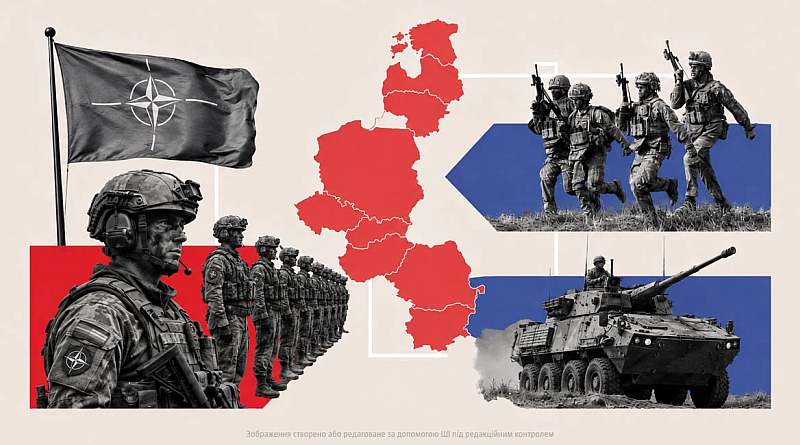
The full-scale Russian invasion of Ukraine in 2022 forced NATO to reconsider its approach to the defense of the eastern flank. Previously, the presence of allies in the Baltic and Central-Eastern European countries primarily served as a political signal and deterrent, but now the Alliance is trying to build a system capable of conducting large-scale warfare from the first day of conflict.
It is no longer just about the number of troops stationed on the eastern flank. NATO is creating regional defense plans, pre-determining the forces to protect specific allies, deploying equipment and ammunition closer to potential theaters of war, expanding command structures, and practicing rapid reinforcement deployment. At the same time, the eastern flank is increasingly perceived as an interconnected system—from the Arctic and the Baltic Sea to the Black Sea.
This is crucial because Russia itself is not static. The war against Ukraine has become a kind of laboratory for the Russian military, where Moscow is changing tactics, increasing weapons production, and learning to circumvent battlefield limitations. Therefore, NATO is effectively in a race: the Alliance must simultaneously build a new defense system and keep up with the adaptation of a potential adversary.
Forces must not only be present — they must be ready to fight
As of June 2026, NATO has nine multinational Forward Land Forces formations in Bulgaria, Estonia, Finland, Hungary, Latvia, Lithuania, Poland, Romania, and Slovakia. They work alongside national forces of the host countries and are to be the first line of response in case of a crisis.
However, NATO does not expect that these forces will be sufficient for a large-scale war. The concept envisages combining forces already on the ground with pre-designated reinforcements. It also involves pre-positioned stocks of weapons and ammunition, integrated air and missile defense, and enhanced command and control. This is what differentiates the current model from the approach of previous years.
British expert on Russia, Ukraine, and European security, Senior Research Fellow at the International Centre for Defence and Security (ICDS) in Tallinn, and Associate Fellow at Chatham House, James Sherr, comments to Tyzhden that the current eastern flank system should be assessed precisely with this change in mind.
“An astonishing number of people who should understand the situation better continue to replay the Crimea/Donbas scenario — ‘little green men,’ ‘unmarked forces’ — as if the situation in eastern Ukraine in 2014 and the eastern NATO allies in 2026 can somehow be compared. In 2014, Ukraine was a country in turmoil, with its local political structures, security, and law enforcement systems undermined. In contrast, the national defense and security systems of the Baltic countries are among the most cohesive and integrated in Europe. Awareness of the situation and knowledge of the local context are exceptionally high, including knowledge about those on our territories whose loyalty and intentions are in doubt. The loyalty of the vast majority of the population and their civic consciousness is beyond question. If the Russians are reckless enough to attempt a Donbas-like scenario, they will find that the ‘current architecture’ and local forces are more than sufficient to counter such a challenge — even before any reinforcements from outside arrive,” he notes.
According to James Sherr, the only attack scenarios worth taking seriously are the ones that cannot be concealed.
“The Russians would have to conduct even a limited war precisely as a war, and preparation for it would be noticeable. On NATO’s side, the capabilities of national intelligence systems and the level of intelligence sharing are significant. The readiness, deployment, and rules of engagement of national reserve forces and Forward Land Forces almost guarantee that Russia will encounter decisive resistance if an attack occurs. From day one, SHAPE (Supreme Headquarters Allied Powers Europe) and other NATO commands will have no doubt about what happened,” he tells Tyzhden.
The British expert also adds that under any scenario, Russia’s military goals would be to disrupt NATO’s cohesion, destroy forces at the immediate theater, and force the Alliance to concede defeat as quickly as possible. If Russia is not confident in achieving these goals, it will not start the war.
Military Mobility: A Problem That Cannot Be Solved in a Few Years
Even the best-planned system won’t work without the ability to quickly move people, equipment, munitions, and fuel. French expert on European defense, defense industry, and military mobility, former senior research fellow at the French Institute of International and Strategic Relations (IRIS) Maxime Corde emphasizes to Tyzhden that military mobility is a long-term policy.
“Military mobility is a 10–15 year policy (considering infrastructure issues), and even if some significant progress has already been made and will be achieved by 2030, I would say that the pre-positioning of European forces (with offensive weaponry, not just defensive, as in the case of changes to British forces in Estonia) on the eastern flank would help Europe respond more effectively to the short-term threat from Russia,” he states.
Meanwhile, James Sherr warns against viewing military mobility solely as an infrastructure issue.
“Military mobility was a challenge of yesterday. The war in Ukraine has changed the way wars are conducted, and these changes are likely to become even more significant in the future. The proliferation, capabilities, and especially adaptability of unmanned systems make visible forces — troops or transport, lightly armored or armored — vulnerable to detection and immediate destruction. Furthermore, the initial period of the war remains extremely important. Yesterday, the challenge was amplified by the insufficiency of forces in the theater of operations, the time required for NATO to make a decision on invoking Article 5, and the additional time needed for force deployment in the east. Today, forces already on the ground have substantial capabilities, and the Forward land forces are likely to ensure NATO allies engage in the fight at the onset of hostilities,” he tells Tyzhnia.
James Sherr also notes that, in addition to the three leading countries in the Baltic states — the United Kingdom, Canada, and Germany — there are currently more than a dozen participating countries, including a Danish mechanized battalion in Latvia and 500 Swedish soldiers in Lithuania.
“In the case of Estonia, the British brigade is a fully integrated component of Estonia’s Defense Forces and reports to the commander of the Estonian division. The Estonian axiom is: ‘In Brussels, you can talk, in Washington, you can talk. Here we fight’,” he adds.
Meanwhile, Russia is also learning from the war. Over the years of war, Moscow has not only suffered great losses but also restructured some of its approaches. IISS notes that Russian forces continue to adapt tactics, and Russia retains the ability to support offensive operations despite significant losses.
James Sherr notes that NATO is currently rebuilding its eastern flank faster than Russia is restoring and modernizing its military capabilities.
“This will continue as long as the war in Ukraine absorbs the lion’s share of Russia’s attention. Russia is already failing to meet its goals for recruiting servicemen for the war in Ukraine. These circumstances will not allow it to form a separate grouping to wage war against NATO. However, the situation could change dramatically if Ukraine is defeated,” he tells Tyzhnia.
According to him, then the redeployment of Russian forces and their recovery could change the dynamics in Russia’s favor — faster than many currently expect.
“Today, tremendous attention is paid to troop readiness, reserve force mobilization, their numbers and capabilities. Estonia, for example, has set a goal to deploy forces numbering 45,000 within 24 hours, increasing them to 200,000 within several weeks. Sudden exercises now play a significant role in preparation. Forward land forces weigh much more than they did a few years ago,” says James Sherr.
One of the main challenges for NATO remains transforming technological lessons into changes in military doctrine and defense production.
“It is becoming increasingly clear that victory now depends on gaining and maintaining an asymmetric advantage in a technologically unstable environment. More painful is the process of aligning changes in the defense industry with the transformation of military doctrine. Finally, it is becoming widely recognized — some accept this with enthusiasm, some reluctantly — that Ukraine is an important participant in European security, not just a consumer of it,” he adds to Tyzhnia.
Collage: Tyzhden
