
Vitaly Portnikov / Vilni Media
The image of the “island of Crimea,” of course, is associated with the famous anti-Soviet dystopia by the Russian writer Vasily Aksyonov, which was actively used during the occupation and annexation of Crimea, when the Ukrainian peninsula almost truly became a “Russian island,” having lost its real connection with the mainland.
I myself noted at the time that the occupation of Crimea seemed absurd because the peninsula had never existed in its long history without a connection to the mainland. And when it began to exist—it marked the beginning of significant historical changes. The decline of the Crimean Khanate, leading to its annexation and liquidation by Catherine II, started precisely when Russian troops managed to establish control over the Crimean state’s territories on the mainland. It was the lack of connection with the mainland, controlled by the Bolshevik army, that led to the final defeat of the White movement in the Russian state. And now, in 2014, the peninsula was again not only without a connection to the mainland but also without water, as control over the canal, which had transformed Crimea in the decades before the occupation, remained in Ukraine’s hands.
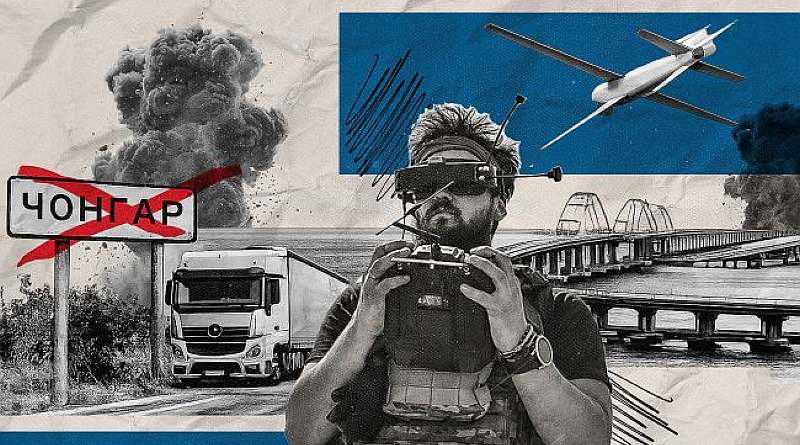
Putin, as expected, drew his conclusions from this “new island” situation—not to relinquish control over the stolen Crimea, but to carve a corridor to Crimea through occupied Ukrainian territory, which became one of the main goals of the 2022 invasion. It might seem that the Crimean issue for Russia was resolved, that Crimea was no longer an island, that it had a connection to the mainland and the occupied territory of Ukraine, and a bridge built during the years of occupation.
The Russian president simply did not foresee that the war with Ukraine could last more than a year and, moreover, change technologically. And now we find ourselves in an amazing situation, where the efforts of the Ukrainian Defense Forces have finally turned Crimea into a true island. There’s a corridor, but it’s under bombs and has essentially ceased functioning as a transport artery. There’s a bridge, but they’re afraid to let fuel trucks cross, lest it lead to the structure’s destruction. Ferries in the Kerch Strait have been destroyed. There’s no fuel on the peninsula—or rather, on the island. Crimea is heading toward a true logistical catastrophe, and Russians who decided to vacation on the stolen land are heading out and can’t leave!
A few years ago, the Kremlin said that the Crimean issue was not up for discussion with Ukraine. Just a year ago, the President of the United States proposed to his Russian counterpart to recognize the Russian status of Crimea. But now the Kremlin might consider what the point of occupied territories is if control over them seems nominal?
Since the early 1990s, Russia has tried to maintain its presence in Crimea, using the Black Sea Fleet and pro-Russian activists. The first and last president of the autonomy, Yuri Meshkov, formed a government and presidential administration of the ARC from Russian citizens who were already preparing the peninsula for annexation. When the Russian operation failed, they began to demand a special status for the Black Sea Fleet and eventually convinced Leonid Kuchma of the need for agreements. When the date for ending the stay of this real occupation contingent in Ukrainian Sevastopol approached, they used Viktor Yanukovych and a band of collaborators posing as the Ukrainian government to extend the term. Then in 2014, they annexed all of Crimea. For what purpose? To use its territory as a platform for occupying the Ukrainian south and destabilizing the situation in the Black Sea.
As a result, the Black Sea Fleet—this eternal symbol of Russian shame and defeats—bolted to Novorossiysk, Crimea is without fuel and electricity, and Russians are already fleeing from foreign land, even though their troops are still there. What, then, is the point of occupying foreign lands today, which you cannot protect? What is the point of Russia in the “island of Crimea”?
During the preparation of this material, it became known that on June 23, units of the Special Operations Forces, in cooperation with underground members of the Resistance Movement of the SOF, successfully destroyed a railway bridge in occupied Crimea. The object was located near the settlement of Rozdolne and crossed the North Crimean Canal.
Collage: RBC-Ukraine
