
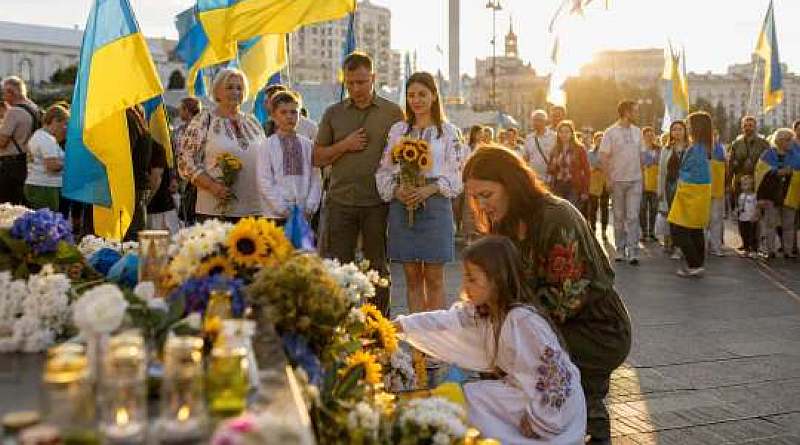
Perhaps for many of our compatriots today, it seems that there has never been an Independence Day with such uncertainty. The Russians continue to attack almost daily, killing people right in their apartments and shopping centers. There is no missile defense. Corruption scandals have engulfed the authorities and are nearing the main offices – at a time when we so desperately need unity and trust in state institutions. What to expect then?
But I remember well the uncertainty before that very first Independence Day. A coup took place in the Soviet Union, which practically meant a definitive rejection of change in the country. Moreover, the isolated president of the USSR, Mikhail Gorbachev, had in previous months rolled back his course on restructuring and the policy of transparency, making the coup by his associates seem like a logical continuation of the prior triumph of reaction.
Now we consider the coup participants doomed. But on August 19, 1991, few could believe that the leaders of the Soviet army, the KGB, and the ministry of internal affairs – the main power players of the Union – would turn out to be political impotents. And what could I have been thinking at 24 years old in the Ukrainian capital?
About yet another failed attempt at change in the Soviet Union, just like in the 1960s. About how this would affect my future work and life overall. Before this, I had conducted a series of interviews with the “Sixtiers,” participants of the previous thaw, and realized that the most active among them lived in true “internal emigration” for 25 years or betrayed their youthful ideals. But I knew I had gone much further than my interlocutors, as I was actively collaborating with Radio Liberty, publishing articles in the first independent newspaper in the USSR, covering the changes in the country in “Youth of Ukraine” – and under new conditions, all these texts would likely be considered “anti-Soviet.” So for me, “internal emigration” would have been the best option. I knew the plotters had already drawn up a list of candidates for internment (I’ve found myself on such documents all my life) and was preparing to meet representatives of the new old regime.
But this uncertainty did not last long. In just a few days, the incapability of the Soviet Union’s power apparatus became evident, the once-powerful Communist Party was banned, Ukraine and other former Soviet republics declared independence. History again took a stunning turn! And I had to wait 23 years for a new – now sanction – list from Moscow.
But then, in August 1991, I realized that for the vast majority of my compatriots, independence was a parliamentary decision behind which lay no personal pain of their own. Yes, our country always had people ready to fight for freedom – and not just freedom but national dignity, however, they did not constitute the majority. I was always on the side of this minority – often called passionate, but to me, they were simply Ukrainians. Yet I did not understand how these people could save the young state from indifference.
The Maidans proved that Ukrainians are ready to struggle and sacrifice for the future of the country. But the real change in national consciousness came with this war. I see nothing positive in this – it would be better if there were no war, people remained alive and at home, and evolution occurred more gradually. But the war was not started by us, but by those who sought to prevent such changes by force.
And now Ukraine has more and more people scorched by war. People whose roots are not just in Ukrainian soil, but in Ukrainian statehood. People who understand that if not themselves, then their children may be forced to renounce their Ukrainian identity if the enemy prevails. People who realize that on the graves of their sons or husbands, not even a flag will be placed or a candle lit if the enemy wins. People who realize they will have to hide with their language and truth if the enemy prevails. People who care about the name of the street, even if it’s unpaved. People who know that prayers in a foreign temple are only heard by a foreign patriarch – and also the devil whom he serves.
There are now so many of these people with their grief, their pain, their losses, and their faith that I am certain – they will not surrender Ukraine, because Ukraine is their only solace. Maybe there are fewer of them than Russians. Maybe there are quite a few in Ukraine itself who would agree to any terms of ending the war just because people “just want to live.” But these people have nothing left to lose but Ukraine. Ukraine is our confidence in tomorrow in times we perceive as an era of complete uncertainty. And therefore, we will win. We, not they.
