
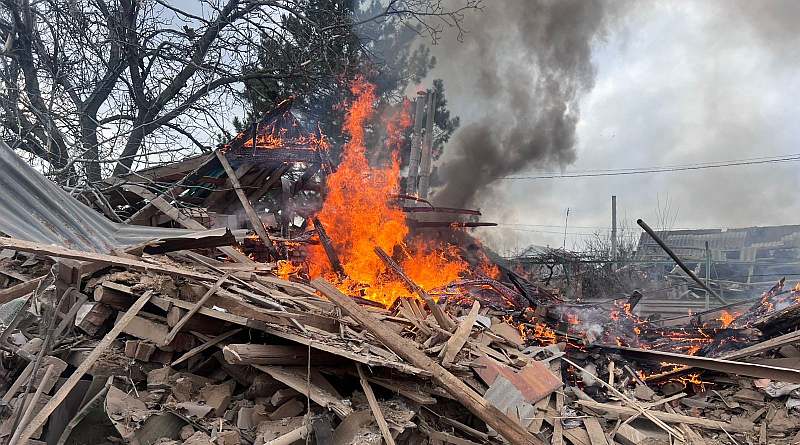
Oleksandr Kovalenko / Obozrevatel
In August, Russian occupiers continued to terrorize the rear areas of Ukraine, delivering both systematic and massive combined attacks on the country’s cities. A significant difference from previous acts of terror is that the ROV adopted a strategy of attrition and significantly enhanced the reactive component for their attacks.
In August, the Air Forces of Ukraine stopped publishing statistics on enemy missile strikes, making the compilation of analytical notes significantly more challenging, if not impossible.
This decision sparked much debate in society, but the fact remains that such measures are dictated by an increased level of secrecy amidst a sharp shortage of anti-missiles in Ukraine to intercept complex targets. Meanwhile, statistics on drones remained open and available for study and systematization.
Drones
In August, Russian occupation forces deployed 5,004 Shahed-136/BM-35 “Italmas” kamikaze drones and “Gerber”/”Parody” decoy drones in Ukraine, out of which 4,307 targets or 86% were intercepted.
Recall that in June, the enemy deployed 5,749 drones (5,289 or 92% intercepted), and in July – 4,515 (4,073 targets or 90% intercepted).
Thus, there was no critical increase in raids, especially in comparison to the record in May when the enemy deployed 8,150 drones (of which 7,642 or 94% were intercepted). However, despite the lack of increase in the overall number of drones for strikes on Ukraine’s rear, the interception rate decreased, due to the enemy’s shift to reactive means of terror.
This information was voiced by the head of the communication department of the Air Forces Command of Ukraine, Yuriy Ihnat, who noted that in August the enemy used about 2,800 reactive drones, which are more difficult to intercept compared to conventional piston models.
Additionally, ROV switched to a protracted terror strategy against Ukrainian cities, especially the capital.
Instead of standard massive, combined one-off attacks, Kyiv experienced continuous raids by single drones, mostly reactive ones, and also ersatz missiles “Banderol”.
The aim of such a tactic is not only the moral and psychological exhaustion of the population but also economic pressure and paralysis of cities, especially those divided by a water boundary – split by a river into two parts (such as the right and left banks of Kyiv).
The enemy also intensified attacks on warehouses, logistics centers, and other civilian infrastructure, including shopping centers and hypermarkets. Overall, this tactic is not surprising, considering a war of attrition. The only problem is that for four and a half years, preparation for inevitable threats and risks to such objects was practically not conducted.
Unfortunately, the incomprehensible ignoring of threats that began to emerge a few years ago has resulted in a low level of readiness to counter them today. Let me remind you that the first jet kamikaze drone was used on Ukrainian territory in January 2024, and the “Banderol” missile in winter 2025. During this time, no effective means of counteraction were developed for either, and solutions for protection against them are only being implemented now.

Threats
In August 2026, the enemy used the 9M723-2 ballistic missile, also known as “Iskander-1000”. At first glance, one might think that this name hides a characteristic of its range – 1,000 km, but in fact, this missile has a range of 550 kilometers. Meanwhile, the Intelligence of the Ministry of Defense disclosed the actual flight range of the standard 9M723 as 390 km, although it was previously believed to be 500 km.
It is evident that the enemy is trying to improve the characteristics of its main terrorist missile, especially on the eve of the heating season, to strike as deeply as possible into the rear of Ukraine. But currently, Russian missile builders are constrained by both physical and technological capabilities in implementing the project of a ground-based ballistic missile with a vertical launch range of 1,000 km. However, this does not mean they are not seeking solutions.
This could become another challenge for us in the future.
Overall, during August, Russia continued to improve the tactics of adaptive distribution of attacks. It was noticeable how in several regions threats emerged that were not previously recorded – KAB. Specifically, these are KAB strikes on Odesa, which Russian aviation had feared to approach to a distance for dropping a glide bomb all these years.
It is not excluded that KAB will become a permanent means of terror in the nomenclature of Russian Armed Forces in the Odesa direction at least until the end of the year.
Apart from already known and mentioned threats above, the terror means “Dan-M”/”Dan-T”, first used in Ukraine in May 2025, has not yet fully revealed itself. It is not excluded that it may augment the “Banderol” component and be used more intensively in the autumn-winter period.
Conclusions
Throughout August, the Russian Armed Forces expanded the selective tactics of terror against various cities and regions of Ukraine, focusing increased attention on the south of the country and the capital. In August, the specifics of distributed adaptive terror became more apparent.
It is clear that in the autumn-winter period, this tactic will be catalyzed during strikes on the energy system. And Ukraine does not have much time left to prepare for both known and yet fully unmanifested challenges.
Russia has chosen the path of transitioning to jet-powered means, even though they are more expensive and energy-intensive to produce. Furthermore, this deepens Russia’s dependency on China. However, the expansion of both existing jet-powered weapons and the emergence of updated, previously familiar ones, combined with missile strikes that are difficult to intercept and a careful, systematic, selective approach to planning terror for each city and region individually, becomes the main challenge for Ukraine in the period from 2026 to 2027.
Ukraine is entering the most difficult autumn since 2022.
The material is published as part of a joint project between OBOZ.UA and the group “Information Resistance.”
Cover photo: National Police of Ukraine
