
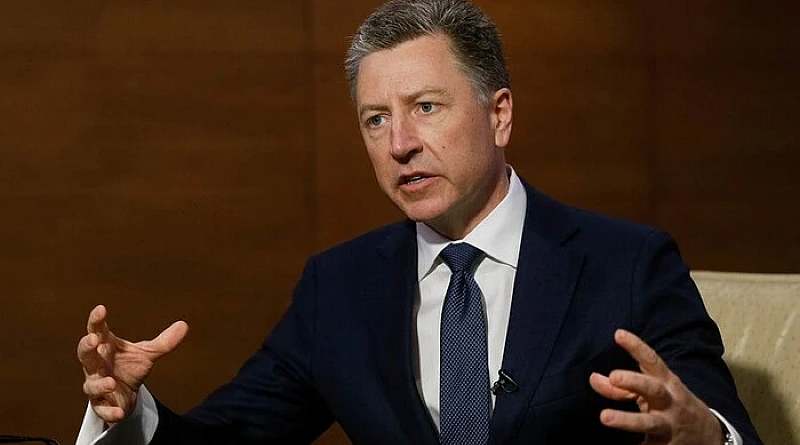
At the margins of the European Forum in Alpbach, Tyzhden spoke with American diplomat, former US Special Representative for Ukraine, Kurt Volker about:
- EU-US relations;
- the current American administration’s view of the Russia-Ukraine war;
- the possibility of Ukraine obtaining a license to manufacture Patriot interceptor missiles.
— During his recent visit to Kyiv, UK Prime Minister Andy Burnham stated that he approved Ukrainian President Volodymyr Zelensky’s request to transfer the technology for the production of Storm Shadow cruise missiles. Of course, it will take years to launch production, but British experts also suggest that this step is somewhat a gesture towards the USA. Previously, President Zelensky discussed with President Trump the issue of transferring the license to produce Patriot interceptor missiles, and particularly during a meeting at the NATO summit in Ankara, President Trump agreed to this, but later changed his mind.
Do you see the possibility for Ukraine to obtain the license to produce Patriot interceptor missiles under the current administration? (After this interview was recorded, Secretary of State Rubio commented that negotiations between Kyiv and Washington are ongoing and he believes they “will yield results” — Ed.)
— Yes, I believe so. But not thanks to Andy Burnham, but thanks to President Trump. I think he heard about this idea. I don’t know how or where exactly. He himself said he didn’t discuss it with either industry representatives or the Pentagon, but considered it a good idea. Currently, we are witnessing a shortage of these missiles worldwide. We, in the USA, need our stockpiles in case of unforeseen circumstances. We do not know how the war with Iran will develop. The Patriot missiles are needed by the Gulf countries, Israel, European allies, and Ukraine. So, it would be a win-win situation for everyone: for Ukraine, which would produce and have them; it would increase global stockpiles; and it would be a win for American companies that would profit from the license. A great idea.
Since President Trump spoke to no one about this, I think no one did anything. Everyone just kept quiet and waited to see what would happen next. And then, when President Zelensky came to the White House and asked about this license, I am sure President Trump was as surprised as everyone else: “Yes, what’s with that license? What’s going on?”
Then, I think he was finally informed and told: “Listen, Mr. President, this is really complicated. There are issues with technology transfer regarding Russia: if this technology is released from US control to Ukraine, the Russians might steal it. There’s also the problem that the factory could become a target: you build it, invest everything, and it blows up [due to Russian attacks — Ed.]. This might mean it needs to be built in a third country, but then where and when would that be. We already have a licensing agreement with Germany, so maybe we don’t need to do anything new. Maybe we should do it there.”
That’s why, in my opinion, President Trump spoke up and said he was unsure [regarding the license transfer — Ed.], because at that moment he was given all this information that no one had provided him before, and suddenly everything seemed complicated. However, it’s essentially a good idea, and I believe President Trump believes in it. So, I think we’ll eventually achieve this.
Most experts will tell you that it will take a lot of time from obtaining the license to when Ukraine can actually produce Patriot missiles and interceptors. I am skeptical that it will take that long. Ukraine already has a fairly developed defense industry. Ukrainians are developing missiles and know how to do it. Primarily, they will need software and components, and in my opinion, everything could happen much faster than people expect. But we haven’t reached that point yet.
As for Andy Burnham, I consider it very positive that the UK has already put forward this initiative. It’s a good thing, with proven missile range, and the Ukrainians have already used it. If there is any signal in this for the US, in my opinion, it’s simple: we can do it, you can too.

— In the context of CIA Director John Ratcliffe’s recent visit to Moscow, the American publication Axios reported that there were again talks of a trilateral summit involving Russia, the USA, and Ukraine. Do you consider this possible? Such ideas have already been proposed in the past, and it seems Russia did not show interest in such a summit?
— Exactly. Just because we propose it doesn’t mean Russia will agree to it. I don’t think Putin has any desire to meet with President Zelensky in any format — bilateral or trilateral. So no, I don’t think it will happen.
I would also note that much of what we read about the CIA director’s trip to Moscow is what they want us to read. I’m not sure that this was the actual purpose of the visit. I believe it’s likely much more related to Iran than to Ukraine. Everything we read about discussions there on Ukraine might well be true: sending Russia a message that it’s losing and should stop, offering trilateral negotiations. I’m sure that’s all true. But, as you say, there’s nothing new in this, and I don’t think these issues are being tackled with any particular energy. I think the real issue is Iran. We have an ongoing unresolved conflict involving Iran. Russia is aiding Iran, and Iran is still trying to control the Strait of Hormuz, which is unacceptable. So, in my opinion, the real purpose was to deliver some direct messages regarding Iran.
— There were earlier rumors that American negotiators Jared Kushner and Steve Witkoff might come to Ukraine on Independence Day, but then the visit was postponed again. Is the reason truly the ‘security situation,’ as they claim?
— In their understanding, possibly. But when you say “security situation,” it means they just need more time to get there and back. We’re talking at least two days for a visit to Kyiv, and they probably don’t want to spend that much time. But I find this unjustified. I can’t imagine negotiating an end to Russia’s war against Ukraine without ever having been to Ukraine. You don’t know what you’re talking about otherwise.
And since they’ve never been to Ukraine, their perception of it will be based on what they hear from Russia, which will, of course, be lies, and from what they see in the media, which exaggerates the destruction in this conflict zone. This is a place where people live. Life goes on. They need to see that Ukraine is a large, developed country with inspiring, talented people fighting for freedom and their future, just as Americans would if we were under threat. And I’m not sure that’s understood by those who don’t know Ukraine.
— Can we finally forget about the 28-point peace plan? Or will it be mentioned again?
— No, I believe it was a useful tool. Russia proposed this absurd 20-point peace plan, which was completely unacceptable. Taking it and reworking it into something acceptable was a useful step. But I don’t think it has any special prospects for the future.
Let me return to the beginning: I don’t believe Vladimir Putin will ever recognize that Ukraine is a sovereign, independent country. He will never acknowledge that President Zelensky is the legitimate president, and he will never admit that there is an international border between Russia and Ukraine. So, he will agree to nothing. As I said, this plan was a useful tool for clarifying issues Russia was trying to manipulate. But in the real world, I think the best we can hope for is a cessation of hostilities and the implementation of a truce.
— Do representatives of the current American administration understand that Vladimir Putin sees Russia’s war against Ukraine in this light?
— I think some people understand this, and some don’t fully grasp it. Some are inclined to believe what Putin says, specifically that he wants peace, that this needs to end, and that he will negotiate a deal. These people want to believe it, but it’s just a lie. It’s enough to watch Putin to understand that he lies to influence us.
— We are sitting in Alpbach during the annual European Forum, and I was struck by this year’s motto: “Europeans, believe in yourselves.” In Ukraine, especially during the Revolution of Dignity, we seemed to believe in Europe more than Europeans themselves. Do you feel that Europe is changing, becoming more self-reliant, especially considering the changed relations between EU countries and the USA?
— First of all, I believe that Europe has recognized certain realities it ignored before 2022, namely that Russia is an aggressive, expansionist state and a threat to Europe. They used to deny this or look the other way, but now it’s an undeniable fact, and they are forced to come to terms with it. This means they will have to put more effort into defense to prepare for potential threats from Russia, provide Ukraine with much more substantial support than before, and acknowledge that Ukraine is actually part of Europe and that it matters to Europe whether Ukraine survives as an independent state. So, in my opinion, they have already realized this. They are still too cautious, slow, and unclear when it comes to taking action; they are not doing everything they could and are still a bit confused about what to do, but the situation is moving in the right direction.
As for the USA, the current problem is that the current administration is quite hostile towards Europe. It does not recognize common values, does not defend these values against aggressors like Putin, and seeks to shift responsibility onto Europe to focus on other matters in the world. This prompts Europeans to say, “We need to be more strategically independent,” which is fair. But they tend to equate this reaction with the USA as a whole when it’s actually about a specific president and administration in power — a temporary phenomenon that does not reflect the overall situation in the country.
Therefore, I believe that the EU is overreacting in its assessments of the USA, while not doing enough to strengthen itself and become a truly independent player.
— In one of your previous interviews, you suggested that NATO could ensure security in the airspace over EU countries, but also deep into Ukrainian territory, about 100–200 km. Polish Foreign Minister Radosław Sikorski has also expressed a similar idea. For the EU, NATO, and Ukraine, this would be an important joint decision. But why is this idea only being talked about? I haven’t seen any actions in this direction.
— I don’t understand why, because there are actually no reasons not to do it. It’s about NATO defense. NATO’s task is to ensure the security of its member countries’ populations. It is in NATO’s interest for Ukraine to be safe, sovereign, and independent, and for the war to end. But it is already NATO’s responsibility to ensure the security of the populations of its member countries.
Therefore, we must collaborate with Ukraine to form a common picture of the air situation and a joint approach — to learn from Ukraine, teach it, and ensure that within a radius of approximately 100–150 kilometers from NATO territory, there is nothing dangerous. This is simply fulfilling our duties, and I see no reason why we should not do this. Russian missiles hit Polish territory, drones attacked residential buildings in Romania, and crossed the Latvian border. We should not consider this a normal situation.
