
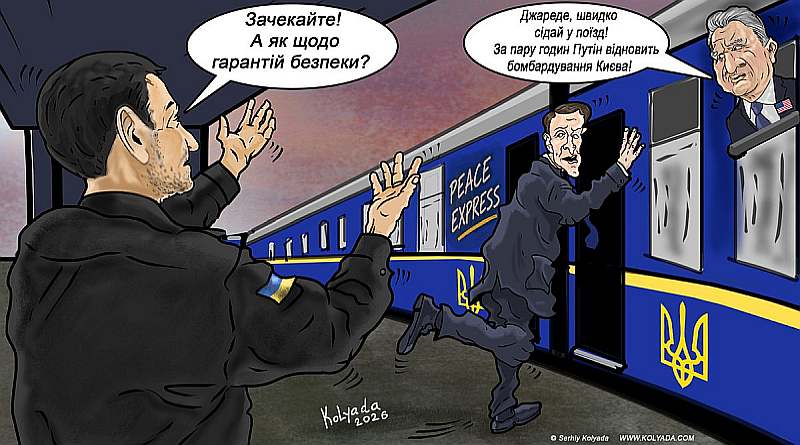
Jared Kushner says that the agreement between Ukraine and Russia is almost ready. The most difficult part remains — the territorial issue. According to him, Ukraine does not agree.
Kirill Dmitriev, a representative of the aggressor state at the talks, praises Kushner. He says he understands the Russian side perhaps the best.
Kushner himself names the Ukrainians he works with in this negotiation track: Kyrylo Budanov, Serhiy Kyslytsia, Rustem Umerov, Davyd Arakhamia.
The Americans speak. The Russians speak. And the Ukrainian side remains silent.
And this is truly dangerous.
Because if you only listen to Kushner and Dmitriev, a very simple picture emerges. Putin allegedly just needs to receive Donbas — and the war will end. The Americans will then help rebuild Ukraine. Peace is almost in the pocket. Just agree on the territory.
Possibly, everything is not like that at all.
But then the Ukrainian authorities are obliged to tell Ukrainians about it.
What does Putin really demand? What exactly are the Americans proposing? What does “territorial issue” mean? Is it only about Donbas? What other Russian demands remain on the table? What security guarantees are offered to Ukraine? Where are the Ukrainian red lines?
I do not call for publishing the negotiation protocols. Diplomacy requires confidentiality. But confidentiality is not silence before your own people. Especially during the war.
Because when Ukrainians are told daily that peace is almost agreed and only “the territorial issues need to be resolved,” they naturally have a question: if everything is almost over, why mobilize? Why join the army? Why prepare the country for a prolonged struggle?
And this is where the problem begins, not diplomatic, but security-related.
Russia fights not only with missiles and drones. It fights for the state of Ukrainian society. For our readiness to resist. For our belief that something depends on us.
Therefore, the information vacuum around negotiations is quickly filled with foreign messages.
Today, Moscow practically tells its version to Ukrainians. Washington tells its own. But where is Kyiv’s version?
The people who fight, pay taxes, bury loved ones, live under bombardments, and must defend this state tomorrow, have the right to know at least the basics: what Russia is bargaining for today and what Ukraine is fighting for.
Therefore, Budanov, Kyslytsia, Umerov, Arakhamia, or the president on whose behalf they conduct these negotiations, must explain to the society what is happening.
Not the details of closed negotiations. But the Ukrainian position. Because silence is also an information policy. And when we are silent, others start to speak for us.

The resonant statement by one of the American intermediaries, Jared Kushner, who just a few days ago heard the aggressor’s “wish list” as well as the Bankova’s position, should not surprise. He simply reiterated the Russian demands, upon which Ukraine would cease to exist as a sovereign country, if not in one step, then in two…
What is surprising is something else: why do American intermediaries have a false impression about the absolutely impossible options for crossing red lines from the Ukrainian negotiators?! Even after clear explanations.
Thus, the Russian leader (as we see, not only him) retains the illusion of possibly achieving his publicly stated (and those not yet stated) goals. As long as this illusion remains, he will not stop the aggression on his own.
Either he must be deprived of illusions, or forced to take steps under pressure. To achieve this, the pressure on him must be critical—concentrated and scalable, not stretched over time.
Until one of these conditions is met, any negotiations will remain merely an imitation of real attempts to achieve a lasting peace, or at least a truce, and a cover for continuing the war.

Bad Ukrainians do not wish to make peace, to surrender the fortresses in Donbas, to open the way for the enemy inside the country. They do not want, such bastards, to voluntarily go to the gas chambers.
For all these years, what has hindered us from organizing Western people more effectively in resisting Russia is the mistaken perception in the Western mindset of Russia as some empire and Ukraine as a colony. It is from these perceptions in the minds of the educated Western public that the mistaken belief is constructed that Ukrainians are “lesser,” and the lesser must yield to the greater simply because they are weaker.
A lot of legal and moral systems are built on such primal rule of power. The closest example is bacha-bazi in wild Afghanistan. Despite official prohibitions, primitive society justifies this phenomenon with the key argument: “the master is rich, he can do as he pleases.”
This psychology works on an international level as well. Especially in the minds of primitive fools like Trump.
Ignoring this primitive thinking around us is a big mistake. Putin knows the nature of people and plays on it. And we don’t know, and then each time we overcome problems created for us by such Trumps with their pet negotiators.
These ideas are nurtured by Le Pen and the German far-right. Because in the Western world, contrary to the established opinion about “impotent liberals,” it is actually full of imperialists and fascists. And they gladly accept superior narratives regarding inferior nations.
Therefore, the idea of the nature of the Russian-Ukrainian war as “colonial,” of Ukraine as a “colony of Russia,” of Russia as an “empire” is what we have to fight against.
Ukraine must achieve the deconstruction of the old image of Russia in the world’s minds. We have already undermined its image of invincibility. But a vacuum has formed: earlier in people’s eyes, it was a Kalashnikov rifle, a parade on Red Square, and tank wedges.
Now there is a search for an answer to the question: what was Russia, if instead of power, it is a stinking pile of tattered rags, which this “mighty force” was turned into by Ukrainian Cossacks?
This is the moment for us to promote our own definition of Russia.
Russia is not a democracy, not a civilization, not an empire (not even “backward” and “medieval”).
Russia is a horde of semi-nomadic tribes.
These tribes, in terms of development, are lower than Africa, the Amazon jungles, and the islands of Polynesia, lacking developed morality, society, legal systems.
Their leaders, like Putin’s advisor Kobyakov, are right now calling for the relocation of these nomads to the occupied territories of Ukraine. This is all a story from a thousand years ago — the period of the Pechenegs and Polovtsians.
The word “empire” was once invented in the West (in the Roman Empire). And it was actively used in the 17th-19th centuries to denote European empires — the British, Spanish, Portuguese, French. Europeans came to the jungles of South America, to Africa, to India, to the islands of Oceania, shot the local tribes, and exterminated them with European diseases (for instance, in some regions, the Canadian Algonquin tribes perished up to 95%), and forced the remnants to buy beads and mirrors for real resources. Often, the newcomers significantly raised these territories in terms of development.
Therefore, Europeans were deluded and transferred their own experience to the Russian horde.
But the British Empire is completely different from a horde of nomads living in rotten huts and defecating in a bucket.
In 1940, occupied France did not become a colony of Nazi Germany. Everyone calls it an occupied territory, not a colony. The same applies to Poland, Norway, Denmark, Belgium, the Netherlands. Because these states, before the occupation, had a developed state apparatus and political nations.
Similarly, Ukraine-Rus, at one time, was a conquered European state that the Golden Horde, and later Moscow, and from the other side Poland, tried to assimilate and eliminate its separate political nation.
American experts believe that nations emerged in the 19th century because that’s when the American nation emerged. To us, this is laughable. In reality, political nations have always existed. And they are born in different periods of history among different peoples.
Even princes and their numerous associates, voivodes, clergy, and various servicemen were this political nation and imagined Rus as a common value and their homeland. Not to mention the Ukrainian elites of the Cossack era, where the presence of a political nation is beyond doubt.
Throughout their history, Ukrainians have dealt with various types of empires – Roman, Byzantine, Ottoman, Mongolian, Russian, Polish, and the Nazi project of Lebensraum. These were not merely typical border wars with neighbors for small territories – involving minor players like Hungarians or Romanians. These were truly wars for survival against opponents who were the most powerful forces of their time.
Therefore, we are not obliged to follow anyone’s opinion, including that of Western political experts or thinkers.
We have a broader experience, making us the experts on this issue, so others should orient themselves to our perspective. We should not rely on Western European formulations but propose our own.
The concept of Lebensraum in Ukraine, with the understanding of Slavs as subhumans, failed precisely because the Nazi German thinkers held backward and erroneous views in their minds.
In fact, few people know – and even less so in the West – that Muscovy was indeed a classical colony of the Ukrainian state of Rus. In the 11th century, newcomers from Kyiv arrived in the stateless jungles of Zalesye, bringing the non-Slavic tribes language, culture, history, religion, the first model of statehood, a bureaucratic apparatus, and a model of military organization. Future Muscovy did not receive the Rus language, Rus law, and its first cities from Swedish Vikings. It was precisely the people from Kyiv, Volhynia, Chernihiv, who, after conquering these lands, began building the first cities there, which still exist today, and elevated the development level of local tribes. Before that, the level of the Moscow tribes was lower than that of the Maya and Aztecs.
This historical fact is undeniably confirmed by sources and archaeology, but it has been concealed for centuries so as not to undermine the great Russian pride and the fashionable imperial status in the eyes of Europeans.
Over the next 800 years, these tribes learned from Kyiv about the first civilization, adopted a strategic western direction from the Golden Horde (“our tanks at the English Channel”), and from the Germans after Peter the First and Catherine – modern Western European imperial frippery. Moreover, after the 17th century, Ukrainian elites, who even headed the imperial academy of sciences and the state apparatus, once again played a huge role in modernizing the backward Moscow state, where, 75 years before the union with Khmelnytskyi, people were still being roasted in pans under Ivan IV.
This is such an “empire”: in 1918, it was burning the Russian nobility in steam engines, in the 1930s-1940s, executing its population by the millions, and in the 1980s, standing in lines.
Amazingly, few pay attention to the crucial fact: even today’s Moscow officially traces its history back to the history of neighboring Kyiv. A Russian Tatar or Mordvin is learning right now under Putin that they originate from Kievan Rus.
This means their colonial consciousness still remains. It’s like the residents of Brazil’s São Paulo, descendants of local indigenous tribes, learning that they are Portuguese.
In reality, there isn’t even a separate self-identity of “Russian.” An imperial nation cannot exist if it has not yet undergone its ethnic and nation-building process.
Under Putin, only the first attempts are being made for Russians to recognize their origin separate from Kyiv. They are developing the Novgorod concept of descent from the Viking Rurik, claiming that Russian history didn’t start from your Kyiv but from Staraya Ladoga. However, this is just another version of colonial origin.
As a result, there is a dissonance in the mind of the “Russian” native, the notion of “their own” as a Russian liberation war. In this war, it is necessary to liberate Kyiv from the fascist Ukrainian invaders, who supposedly crawled either from the Carpathian Mountains or from the evil NATO onto Russian lands and the cradle of the Russian people.
This schizophrenia should not surprise us.
The English are never taught such nonsense in schools, that they originated from New Delhi, India. Because the English nation exists and does not need this.
But the Russian nation does not exist. Because Russia is a multi-tribal horde with a weak common identity.
And even the key leaders of this horde have always understood everything.
The same Lenin ignored the Great Russian identity—he built the identity of the “communist.” And Lenin did not recognize the Russian nation—he divided it into “two cultures”: the imperial identity—tsarism, nobility, intelligentsia (exploiters)—was thoroughly exterminated, but whom he loved was the Russian settled population. Because the ordinary Ivans for the Horde are an illiterate and disenfranchised resource. Lenin even wrote: “Ivans need to be fooled.”
Brezhnev built a Russian-speaking supranational identity “Soviet people.”
And the current Patriarch Gundyaev claims that Russian identity is exclusively religious:
“Our church is a spiritual bond; it is the line of self-identification of our nation, it is the community, destroying which, we destroy our Homeland.”
In translation: without religion, there is no “nation.”
Therefore, Putin is now trying, in front of everyone, to build a modern Russian identity. He does this on an outdated cult of ancestors (“May 9th, when grandfathers…”) and the same outdated cult of strength (“we can repeat”).
This process of quasi-nation-building in the Khan’s stake in the Kremlin tent is viewed precisely as an absolute military goal.
Because we see how, in real-time, right now, subjects of the Moscow regime during our strikes on Wildberries rejoice that they don’t have to go to work tomorrow. The population in Russia does not perceive this as an attack on their state. Muscovites would very much like the Zamkadye to joyfully fight for Neo-Sarai to live wealthier. But due to the lack of national unity, the Khan’s stake in the Kremlin is forced to hire cannon fodder and is unable to unite everyone on free ideas for that whole ZOV.
Today’s Moscow remains a wild nomadic horde.
It is not an empire.
It does not wage a colonial war.
This is a barbaric onslaught on Rome.
This peripheral quasi-state and militarized nomadic society attacks a more developed cultural center from which it once borrowed civilization.
So, no one surrendered Mosul to ISIS. The hordes of savages were dispersed because savages need to be driven out, not speak eloquently about Pushkin and ballet.
Russia is ISIS.
ISIS is defeated by joint forces, not by handing them Slovyansk with Kramatorsk. Because aggressive savages have no place in the modern world.
Convey this to Kushner.
Illustration: Serhiy Kolyadá
Previously published in Kyiv Post
