
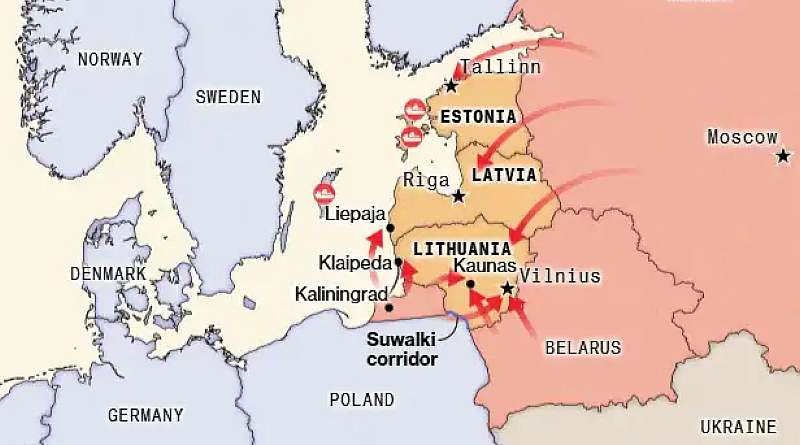

It is often believed that Russia will not be ready to attack a NATO country while the war in Ukraine continues. But that’s not entirely true.
A war against NATO will not mimic the war against Ukraine, and the Kremlin doesn’t necessarily need a million-strong army to start it.
The possibility of a war against Eastern NATO countries directly depends on the allies’ willingness to fight, primarily the USA. There are differing opinions about this, but there is only one reliable way to check it – to carry out a real, “test” attack and study the reaction of member countries.
Over the years, we’ve seen many test attacks on NATO countries: recall the two dozen Russian drones in Poland last September or the periodic appearances of military aircraft and drones over Northern European countries. Clearly, this is needed not only for gathering information about outdated air defense systems but also to determine NATO’s reaction to such incidents.
A hypothetical ground invasion of Russian troops will most likely also begin as a test.
There are countless potential scenarios, but the Estonian border town of Narva is mentioned in almost every one of them. For example, it’s easy for Russia to simulate unrest in Narva. Their actuality doesn’t matter, just as the fabricated “oppression of Russian speakers in Ukraine” wasn’t important before the full-scale invasion. Immediately after, the Kremlin introduces several thousand troops into the city under the pretext of “protecting Russian-speaking residents and stopping the unrest.” This isn’t a full-scale invasion—it’s an operation limited to one city, and the troops don’t advance further.
Obviously, this will become another test of the effectiveness of NATO’s Article 5. Will the USA and EU countries agree to fight for Estonian Narva, especially considering Russia will insist that their countries are not threatened and this is “not an invasion,” but a “special military operation to protect Russian speakers”? Will the allies not quarrel during discussions on the advisability of a military response?
As a result, NATO either starts hostilities or falls apart. Moreover, if hostilities begin, the Russians can quickly withdraw their troops back to the RF, claiming that “the goals of the SVO have been achieved,” and the Russian-speaking population in Narva is no longer threatened.
NATO’s key advantage has so far been that no one has really tested its actual effectiveness. Potentially, it is an alliance of the world’s strongest military with the planet’s most powerful economies. However, the Donald Trump factor combined with the neglected state of most member countries’ armies creates strategic uncertainty about NATO’s ability to defend itself. And to test this, Putin doesn’t need to form a new invasion army: it’s enough to transfer one brigade and one drone unit from the Ukrainian front and see the result.
So it’s not surprising that the US has sent the CIA director to Moscow, as while the probability of such a scenario is not high, it’s certainly above zero.
On the cover: Hypothetical directions of attack by Russia and Belarus on the Baltic countries. Photo: Bloomberg Economics
iPress: What a Russian attack on NATO might look like. The Telegraph named possible scenarios
Meanwhile, European officials are confident that there is no evidence of Russia preparing to attack NATO.
