
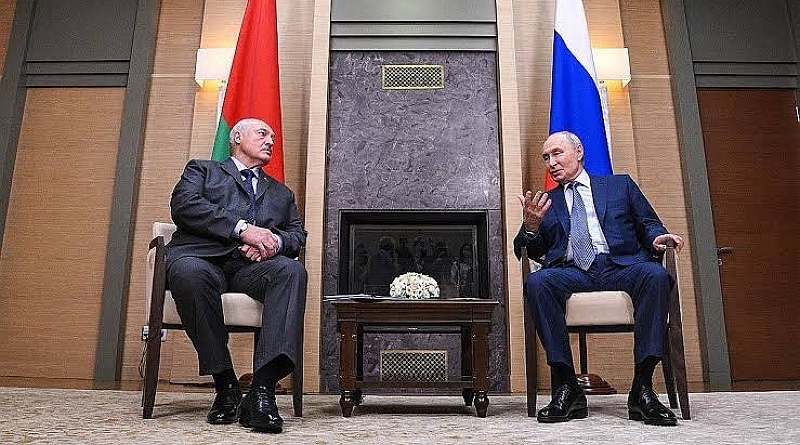

On the eve of his own birthday, the Belarusian leader planned to spend it in a festive setting, but instead of celebratory preparations, Alexander Lukashenko was forced to urgently fly to Moscow at the Kremlin’s summons.
The sudden working visit of the Minsk ruler to the Russian capital underscores the extent of his absolute political and financial dependence on Vladimir Putin, who prefers to personally dictate terms to his only official ally.
Conversations in Novo-Ogaryovo could significantly influence the further escalation of the conflict around Ukraine. Lukashenko’s urgent arrival coincided with the end of the visit of the CIA director to Russia, the results of which Putin decided to personally convey to his Belarusian satellite. The meeting of the two authoritarian regime leaders was preceded by a statement from Vladimir Zelensky’s office, directly pointing to the preparation of a large-scale offensive by Russian troops towards Kyiv and Chernihiv, which effectively means the final entanglement of Belarus in full-scale hostilities.
Washington, through intelligence chief Ratcliffe, tried to define the extreme limits of permissible escalation. The American administration’s representative raised issues of security for Belarus and Armenia, urging Moscow to respect their formally sovereign status, but the Kremlin leadership likely traditionally ignored signals from the US. In Moscow, there is a belief that the White House’s tough rhetoric does not align with its practical actions.
As Donald Trump’s administration rapidly loses stability due to internal political crises, the Russian elite considers it highly irrational to rely on American promises or fear hypothetical Western warnings.
The financial-economic noose around Minsk tightens ever more, turning discussions of sovereignty into pure illusion. The meeting in Moscow between Lukashenko and Russian Prime Minister Mikhail Mishustin clearly demonstrated that the Kremlin regime intends to keep Belarus within its sphere of influence through economic subsidies and providing port infrastructure in the Leningrad region for potassium fertilizer exports.
The geopolitical maneuvering of the Belarusian ruler seems to have reached a dead end. Diplomatic sources note that Moscow’s current hardline position towards Yerevan is partly due to a desire to support Lukashenko in his prolonged personal conflict with Nikol Pashinyan over Karabakh. The Kremlin methodically persuades Minsk to maintain the status quo, insisting on a categoric refusal of any separate proposals from European countries at least in the near term.
The multi-vector strategy developed in Minsk is undergoing the strongest tests. Moscow’s position on maintaining full control over the republic finds silent support in Beijing, leaving Lukashenko without sufficient room for political maneuvering, deeply isolated in the face of growing international pressure.
