
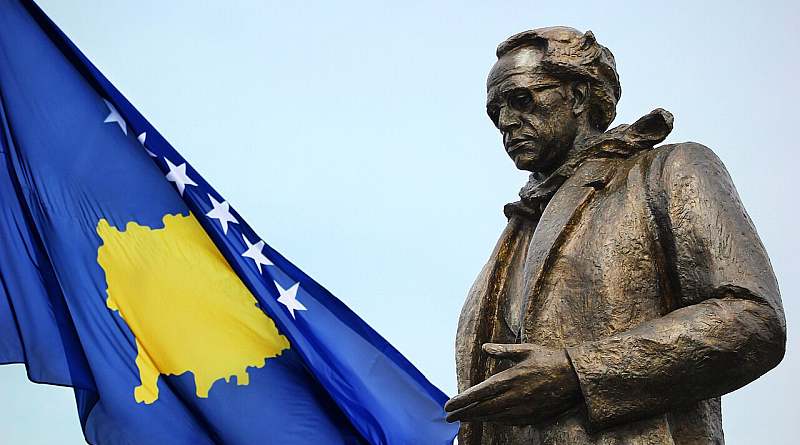
In the summer of 1989, I arrived in Pristina not only to see Kosovo, but also to meet the leader of the Kosovar Albanians, Ibrahim Rugova.
It is now hard to recall how episodic and accidental information was in the times before the internet, especially behind the Soviet “iron curtain,” even during the years of perestroika. I understood the scale of Rugova’s personality and the need to meet him only because I stumbled upon his interview in the Slovenian youth magazine “Mladina” – Slovenia was then almost the only Yugoslav republic that could afford to talk to a dissident from Pristina.
Rugova, an Albanian literary scholar and head of the Kosovo Writers’ Union, reminded me of Ukrainian writers who were already preparing to create the Popular Movement – its first congress would take place literally a few weeks after our meeting in Pristina. We walked around the stadium near the small Writers’ Union house, and Rugova talked about his vision for the future of Kosovo and Albania. At that time, this conversation seemed too romantic to me. Albania was still under a harsh communist regime. In Kosovo, Milosevic’s regime created a real apartheid, separating Serbs and Albanians with invisible borders. Rugova’s confidence in the future was mesmerizing.
But even more amazing was this elegant man’s faith, with his inevitable neckerchief, in the power of nonviolent resistance. In response to Belgrade’s repressions, Rugova created a real parallel state in Kosovo – with its own universities, schools, hospitals, and even maternity hospitals. However, Milosevic did not appreciate this readiness of the Kosovar Albanian leader to avoid using force. Moreover, he intentionally provoked the situation, believing that confrontation only strengthened his power.
It’s not surprising that young Albanians also considered their leader a romantic and did not believe in nonviolent resistance – this is how the Kosovo Liberation Army emerged, and this is how Hashim Thaci emerged, who in his youth passionately supported Rugova’s ideas but later became disenchanted with them. When I met Rugova, Hashim Thaci was as old as I was – a little over twenty. And in ten years, the whole world would talk about him, and Belgrade would declare him the main war criminal and terrorist. Mothers in Serbia would scare their children with the Kosovo Liberation Army, the UÇK (Ushtria Çlirimtare e Kosovës), while avoiding conversations about what the Serbs did to the Albanians – not the fighters of the illegal army, but the completely legal military and police.
The fact that such a protracted conflict, even on a small territory, could not but lead to war crimes on both sides, in my opinion, does not need explanation. However, Kosovars, despite their deep respect for Rugova, will forever remember that it was Thaci who decided to defend them with weapons in hand. And this perception was not affected by the conflicts after the declaration of Kosovo’s independence, when Thaci – who had managed to serve as both prime minister and president of the new state – became an active participant in the ongoing conflicts within the new political elite.
Unlike the leaders of the Bosnian Serbs, who were found only many years after the accusations were made, Kosovo politicians did not hide from the international tribunal. Thaci even resigned from his post as president to defend himself at this tribunal. But he lost the process – which caused incredible anger in Kosovo. And this despite the fact that the West always treated the struggle of the Kosovar Albanians for survival empathetically, and Thaci was a partner and favorite of leading Western politicians.
Rugova – it was felt when talking to him – treated Kosovars like his children. Thaci believed that his compatriots should fight alongside him. Rugova passionately wanted to protect the honor of the Albanians and not stain their hands with blood. When Milosevic decided to expel the Albanians from Kosovo, Rugova went to Belgrade to convince the dictator not to take this fatal step. It was a blow to his reputation – but it seems he was more concerned not with his own reputation, but with the survival of the nation. Thaci saw the path to this survival in resistance, in war. And war is always a dirty business. Of course, it would be desirable to win only in the way Ibrahim Rugova desired. But when they literally try to erase you from the earth, you just have to respond in the way Hashim Thaci did.
The verdict against the former commander of the Kosovo Liberation Army reminded me of the fate of the leaders of the Ukrainian liberation struggles, whose names other mothers still use to scare children. But this is not only the experience of the past, it is also a question of our future: will those who help us today condemn our heroes tomorrow?
In the foreground: Monument to Ibrahim Rugova in the central square in the center of Pristina, Kosovo. Photo: Wikipedia
