
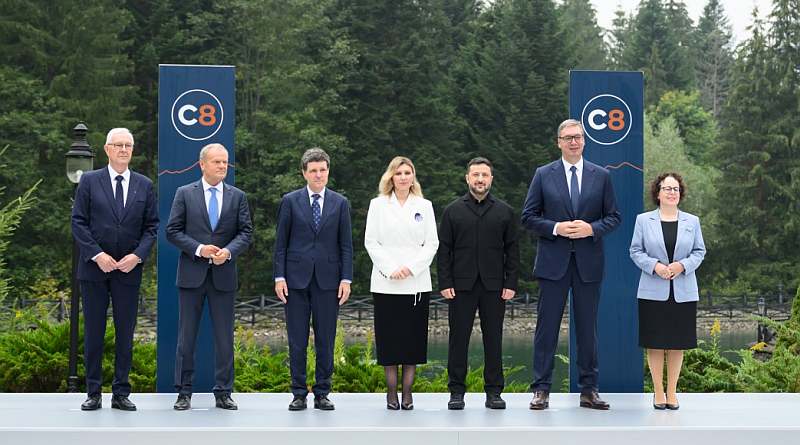

How the “Carpathian Initiative” turned into the Carpathian Eight.
“Today, for the first time here in Ukraine, in our part of the Carpathians, there is a summit that unites all Carpathian states, regions, and communities of our countries. We are launching a new format, C8 – the Carpathian Eight, which unites us and our neighbors in Europe: Romania, Serbia, Poland, Slovakia, the Czech Republic, Austria, Hungary, and, of course, the European Union as a whole. This is a serious start to a movement that aims to bring our countries even closer and create another strong element of interaction at the EU level – security, energy, significant expansion of logistics and cross-border economic cooperation, and substantial support for our communities. Today, in the Ukrainian Carpathians, the first summit uniting all Carpathian states is taking place.” – Volodymyr Zelensky.
* * *
Initiating new formats is wonderful, especially if Ukraine becomes the initiator and, better yet, the leader in such projects of regional unification based on territorial proximity and interests, rather than just a recipient of EU funds.
The main thing is that this format truly moves beyond the “Carpathian Initiative” initiated by Ukraine and which has existed for over 20 years (effective since January 4, 2006). You’ll be surprised, but those… are the same countries. Only Austria, which has joined the Carpathian Eight, is an active participant in another format – the Alpine Convention – a similar international treaty for the Alpine region (the explanation is simple – almost all of Austria’s mountainous territory belongs to the Alps, and only less than 1% to the Carpathians).
It’s important that within this new/old format (under Ukraine’s leadership and with EU support), countries go beyond agreements solely in the realms of ecology, cross-border cooperation, transport corridors, tourism, sustainable development, and community development. Formats and mechanisms for all these directions have long existed and are operational in this cross-border region, particularly with EU support and funding.
Among formats and projects involving the same countries or most of them are the EU Strategy for the Danube Region, the Carpathian Euroregion, the “Carpathian Way (Via Carpatia), etc.
We must also remember the need for Ukraine’s active participation in the Three Seas Initiative, where we have not yet become a full-fledged member of the association, only an associate partner (the possibility of full participation is currently linked with EU membership).
It is almost forgotten that Ukraine has long (since 1996) been a participant in CEI – the Central European Initiative, which includes the same eight “Carpathian” countries, but whose successes have not been heard about for a long time.
We should also not forget about the existence of the Bucharest Nine (B9) on NATO’s eastern flank, consisting of Poland, Romania, Bulgaria, Estonia, Latvia, Lithuania, Slovakia, the Czech Republic, and Hungary (the same five participating countries, excluding Serbia and Austria).
From the perspective of prioritizing security issues, joining this group of countries is currently a more pressing task for Ukraine than attempting to politically reorganize what has already shown the limits of its formats.
Previous experience clearly demonstrates that when uniting countries with such differing goals and actions of political leadership, the effectiveness and dynamics of work can be very low. The “laggards” will inevitably slow down the pace of the leaders of the union or project.
Therefore, doubts that the newly formed Carpathian Eight will become an effective political or even more a security association are legitimate. And security – an undeniable priority for Ukraine. Without security, it’s futile to contemplate investment volumes or even the construction of new transport corridors, let alone ecology.
The meetings in Bukovel, in the beautiful Ukrainian Carpathians, the summit, and “side-events” – are wonderful for all participants. It’s not surprising that not only the Cabinet in almost its entirety but also a large portion of parliamentarians suddenly chose to attend this summit rather than work on finding real mechanisms to fill the state budget, gaps of which are unlikely to be closed by statements about potential specific monetary inflows within the Carpathian Eight. The presence of the delegation led by the President of Ukraine and representatives of local authorities, regional communities, and businesses would have been more than sufficient.
The main thing is that the beautiful echo of Carpathian trembitas does not fade away after the first summit but achieves truly significant results for the country (and hopefully soon) rather than just loud declarations of theoretical possibilities. We have already heard about tens of billions in investments…
Creating new formats is indeed a great diplomatic effort, but effective external and security policy is not shaped merely by holding meetings, summits, and forums. Correctly prioritizing and not dissipating limited resources is also an important task for Ukraine, especially during wartime.
Photo: OPU
