

For culture – continued strict austerity. For the telemarathon and the new presidential “Thousand Spring” – billions.
This is exactly what the priorities of the State budget for 2027 look like.
If you put aside the dozens of tables and percentages, the answer is simple: the state effectively leaves local culture on the shoulders of communities.
The government shows a beautiful figure: total expenditures on culture and art are supposedly increasing by 20.7% – to 36.3 billion UAH. But almost 29 billion UAH of this amount must be provided by local budgets. This is 80% of all cultural funding.
Moreover, over 92% of the planned expenditure growth for 2027 is expected by the government specifically from communities. Not from the State budget. From local budgets, which are not even approved yet.
Will communities have these funds in conditions of war, destruction, falling incomes, the necessity to finance heating, water, shelters, and reconstruction?
There is no answer.
The State budget plans to spend about 7.28 billion UAH on culture and art. Practically the same amount was in 2021 – 7.281 billion.
Six years of war, inflation, rising tariffs, and repair costs – and state cultural funding returns to the same nominal amount.
At the same time, 57% of all cultural expenditures go to libraries, museums, exhibitions, and club institutions. Precisely to the network that works daily in communities and needs heating, repairs, electricity, and staff.
A separate subsidy for cultural institutions and arts education damaged by Russian aggression receives no funds.
The program for the development of institutions of national importance is completely halted.
And now, about the real state priorities.
5.4 billion UAH – for the presidential “Thousand Spring”.
Another 1.62 billion UAH – for the production and broadcasting of programs for state needs, state broadcasting, and the telemarathon.
Together – over 7 billion UAH. Almost as much as the State budget plans to spend on all culture and art.
For one “Thousand Spring” they allocate almost 16 times more than for cultural projects through the Ukrainian Cultural Fund. Moreover, the funding for “Thousand Spring” increases by about 36%. While the entire Ukrainian Cultural Fund – only by 3.5%, i.e., significantly below the projected inflation.
What is “Thousand Spring” for 5.4 billion UAH?
How many products will be created?
Who will produce them?
How will performers be selected?
Who will own the rights?
What are the efficiency indicators?
In the explanatory note to the budget, there are no answers. For 5.4 billion UAH – in fact, one sentence.
The government speaks of culture as the foundation of Ukrainian identity. But the maintenance of libraries, museums, and cultural centers is transferred to communities.
For damaged institutions there is no separate resource. For cultural projects – an increase below inflation.
In contrast, for the telethon and the new presidential media initiative – over 7 billion UAH.
Agree, human sacrifice cannot endlessly replace state policy and proper funding.
This is a survival budget for culture at the expense of communities and further funding of the state media machine.
Shame.

Today at the meeting of the Committee on Humanitarian and Information Policy, we discussed the draft state budget for 2027.
My main thesis is simple: the budget should reflect the strategic priorities of the state. Especially during the war, when culture, information policy, media, and preserving our heritage are directly related to the resilience of the country.
Therefore, I drew the government’s attention to several problems we have been talking about for more than a year.
First of all — the remuneration in our two largest scientific libraries: the Lviv National Scientific Library named after Vasyl Stefanyk and the National Library of Ukraine named after Volodymyr Vernadsky.
Because they are subordinated to the National Academy of Sciences of Ukraine, the salary increase for cultural workers does not actually affect them. In the Stefanyk Library, a librarian’s official salary today is 5463 UAH. Meanwhile, other national libraries can apply additional coefficients to salaries.
This injustice can be corrected normatively: to include the Stefanyk and Vernadsky libraries in the appropriate list or to develop a separate mechanism for them. I asked government representatives to finally do this.
Separately, I raised the problems of the Crimean House. For years, its funding has allowed it only to survive: low salaries, lack of funds for projects, problems with renting premises, and debt that arose due to untimely payments by the Treasury. In the draft budget for 2027, funding is increased to 5.8 million UAH, but it is important to understand whether this is enough to address at least the most critical issues.
To understand the disproportion: the entire annual budget of the “Crimean House” since 2021 has averaged 4.5 million UAH per year — this is for employee salaries, premises rental, and all project activities of the institution.
Meanwhile, according to the ProZorro website data, the State Enterprise “Center for the Protection of Information Space” spent 1.78 million UAH on room rental in Ivano-Frankivsk for the organization of “TyachivWeight” pitching alone, 1.29 million UAH on marketing services, 1.1 million UAH on organizing live broadcasts, and 1.44 million UAH on translation services. And this is far from all the expenses.
In other words, just these four expense items together — over 5.6 million UAH — exceed the annual funding of the “Crimean House.” This is why it’s not only about how much money we allocate to culture but also about the priorities and effectiveness of their distribution.
An entirely separate discussion is needed about “Thousand Spring.” In the draft budget for next year, 5.4 billion UAH have been allocated for the program. Meanwhile, this year alone, 92 projects were selected in the category of feature films and series. This is a lot—during the heyday of Ukrainian cinema, about 50 feature films were produced in Ukraine. In my opinion, before significantly increasing funding, we need to see the results of the first phase, understand the criteria for effectiveness, and have a transparent mechanism for the distribution of funds.
It was also stated that specialized institutions should be more involved in such programs. For example, the State Film Agency, which already has experience in competitive selection and support of Ukrainian cinema and cultural products.
However, there are still many questions about the Budget Project.
Where is the systematic support for Ukrainian media in this budget?
How do we develop Ukrainian international broadcasting and measure its results?
How do we preserve archives and national libraries?
What is the state program for supporting the Ukrainian language?
What is the demographic policy, and what is the state doing to bring Ukrainians back?
How do we integrate Ukrainian film production into the European market and develop co-production with EU countries?
The answers to these questions should compose the humanitarian part of a budget for a country at war. Russia attacks Ukrainian culture, books, history, language, and information space. Therefore, when we discuss the budget, we need to look at it through the prism of these realities and understand what resilience of the state we are building for each spent hryvnia.
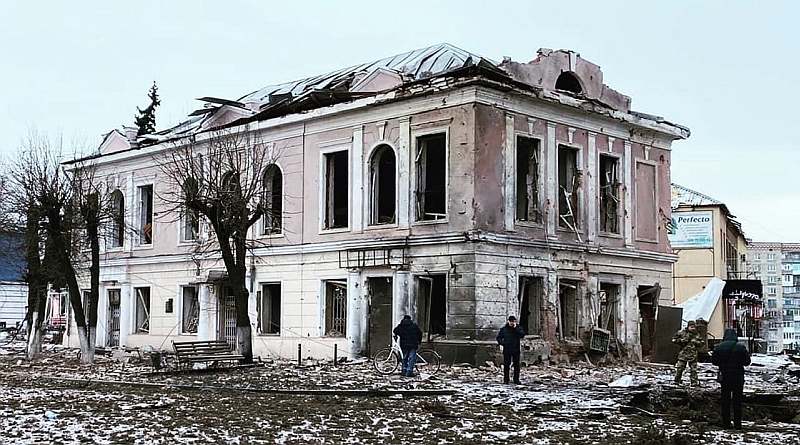
On the cover: The museum of local lore in Okhtyrka, destroyed by shelling from Russian occupiers. Photo from open sources
