
Few will read this post to the end, but it must exist… At least for the sake of historical record – “they warned”. This post is again about the Pantheon.
Judging by the triumphant joy and emphasized determination in the government camp, after the disgraceful mishandling of the NMVК (National Military Memorial Cemetery – Ed.), Bankova has decided to ruin the topic of the Pantheon as well. Consistent. Well, I see no reason to hope that any sobriety or sanity will emerge here. Therefore, I simply state and partially repeat what I have written before.
The report of the head of the UINP (Ukrainian Institute of National Memory – Ed.), that his business trip regarding the reburial of notable Ukrainians was not in vain, suggests that Bankova continues to mix fundamentally different objects:
National Pantheon,
Pantheon of Heroes,
and National Memorial Cemetery.
Already in this initial moment lies a great mistake, because these are ABSOLUTELY different objects and phenomena. In their essence, meanings, spaces, and functionalities. They have only one thing in common – it concerns national memory. But in everything else, these three cases are about different things.
About the territory for…
1. For the National Pantheon, less space is needed than for the Pantheon of Heroes and, of course, than for the Memorial Cemetery. The National Pantheon is 90% a sculptural and architectural ensemble, not a burial place. It may contain 1-3 real burials or a row of cenotaphs, but no more. Instead (and this is extremely important), unlike the Pantheon of Heroes and the Memorial Cemetery, the National Pantheon can ONLY be located in the central part of Kyiv. This is the main protocol location. This place is not just about the great people of the nation; it is ONLY about those who consciously built the nation’s statehood in different historical times.
2. The Pantheon of Heroes requires much more space. It is not a complex of monuments or a memorial with a set of architectural and sculptural solutions (like the Vittoriano, which I previously referenced); the Pantheon of Heroes is a place for the rest of notable WARRIORS of the past. It is not about state figures, cultural, or scientific figures of the nation; it is primarily about those who with arms achieved and defended Statehood. Therefore, the Pantheon of Heroes cannot be within Kyiv – it may turn out that for all the burials that over the years might wish to be moved, there will not be enough space.
It is therefore much more logical to establish the Pantheon of Heroes of the past where contemporary heroes will rest – at the NMVC. This is also logical as a historical bridge and emphasis on continuity.
3. For the Memorial Cemetery as a reburial site for all other distinguished Ukrainians (politicians, scientists, artists…), as well as for future burials of the nation’s prominent figures (Baikove Cemetery 2.0), more space is needed than for the Pantheon of Heroes. This is because it is a memorial cemetery, and the focus should be on the number of prominent/significant Ukrainians buried over the next 100-150 years, rather than on the number of historical figures whose remains are returned to Ukraine.
About meanings, semantic emphases, and functionality
1. The main purpose of the National Pantheon is not to serve as a reburial site for iconic state builders but to visualize and emphasize the depth and antiquity of statehood.
Thus, the concept of the National Pantheon on the shore should focus on visualizations, sculptural and architectural solutions that illustrate the continuity of statehood, refuting Russian narrative and ideological distortions.
Emphasizing that all the efforts of statesmen at all times relied on the sacrifice and deeds of the Warrior, there should be a Tomb of the Unknown Soldier, an eternal flame, and Guard Number One. This tomb can contain the remains of unknown soldiers from different eras.
The main functionality of the National Pantheon is to showcase history. To Ukrainian citizens: “look and do not forget that you are not random, but descendants of the Great, be worthy descendants.” To foreigners: “look closely, we have been here for a long time, we remember everything, we have the right, this is our land and history, it is worthy of respect.”
This is where the newly elected President of Ukraine comes first “to seek blessings from the ages,” where heads of foreign states come to pay their respects to the Nation’s Statesmen.
This is where the honor guard, ceremonial events, and so on are held.
2. The main goal of the Pantheon of Heroes is to gather on native soil those who once gave their lives so that this state could exist, or who made efforts, fought, struggled, but died in foreign lands dreaming of returning. The dream has come true.
The main meaning of the Pantheon of Heroes is to express the gratitude of descendants and unite the fighters for statehood with the land of the State they dreamed about and fought for. This is a place of emphasis: “their deeds were taken up by generations, their goal achieved, they returned home.”
The Pantheon of Heroes is a place of continuity among Warriors of different times. Therefore, it’s important for it to be located at NMVK, wherever it may be. The alley or reburial site of historical figures should be part of the educational influence on the visitors of the complex.
3. The Memorial Cemetery is less about returning the remains of prominent Ukrainians home, and more about providing a burial site for significant people of the country in the future. Like any memorial cemetery, it is partly a resting place and partly a park complex where descendants can come and hear/see who contributed to the achievements of the State in various non-military fields during their lifetime.
About problematic moments
1. The National Pantheon will require a consolidated, approved list (there must be social consensus) of individuals who represent various periods of Statehood.
There cannot be too many representatives of eras, so it will be necessary to decide who is the most outstanding based on their achievements. Quick and simple decisions are disastrous in the end. Those who determine these individuals and justify “why them” must not have politics in mind or a desire to do it swiftly, but rather a subtle understanding and appreciation of the deeds of the historical person.
The National Pantheon requires a thoughtful approach to the stylistics of architectural and sculptural solutions. Categorically NOT LIKE what was done at NMVK! This place is not about the self-expression of urbanists or showcasing trendy approaches in global “monument-building.” It is about deliberate harmony in every smallest element— the National Pantheon should be read like a book. Not a comic, not a storyboard of a series, and not reels-stories in stone— The Book of the Nation. This is such a complex challenge that those who master it will engrave themselves in history. Thus, it should not merely be an architectural-sculptural competition but also a consortium of creators who can use the best ideas from all projects.
For various reasons, we do not have the actual remains of many state builders. Neither from the princely times, nor from the period of the Grand Duchy of Lithuania, nor from the era of the Hetmanate. Therefore, if we are lucky to find Yaroslav the Wise or Bohdan Khmelnytsky and return Symon Petliura… well, maybe a few more names. So WHO is visualized in sculpture, and who, besides that, is also buried— this must be a fundamental and very thoughtful decision.
2. Pantheon of Heroes. For the reburial of soldiers from the First and Second liberation struggles, permissions will need to be obtained from those who care for the burial sites abroad. The state must decide whom exactly and by what criteria it wants to return (regardless of status or only known historical figures, regardless of rank or only senior and higher officers) and make great efforts to convince the current custodians. I am not sure, for example, that Poland would agree to give up the grave of Marko Bezruchko.
The Pantheon of Heroes must have its own approach to aesthetics— are these standardized NMVK tombstones or sculptural compositions? There should be a justified answer, and it should also not be decided by decree, but through open discussion among specialists (!).
3. Memorial Cemetery, perhaps here the biggest problematic question is the place, location, area. Here, the issue with the military memorial cemetery could not be resolved, and now with the civilian one… Architectural-sculptural methods of arranging the burial sites of historical figures already provide space depending on the location, name, and general concept of the complex. Here it is frankly easier than with a military complex.
On Realities
A separate important nuance— security. It must be clearly understood that the National Pantheon becomes a sacred place for the Nation, and therefore the number one target for our main enemy. Especially if there are actual remains of several iconic figures for the nation— the level of protection from terrorist attacks or shelling there should be greater than that of the state leader’s office.
Obviously, Ukraine cannot ensure such a level now. So here is the question of how appropriate it is to try to implement the project according to political whims right now?
Another point— time. It must be clearly understood (this should have been realized even before the processes with NMVK began)— the speed of implementation must be completely excluded from the processes. The creation of the National Pantheon as the main altar for State builders should not be about political dividends, but about thoroughness.
Here it is appropriate to recall— the decision to create the Vittoriano complex in Italy was made in 1878. There were TWO (!) international project competitions. And actual work began in 1885. That is, between the decision and the work— 7 (SEVEN!) years. Construction was completed in 1911. That means it was built for 26 years! And the final completion was in 1935…
Of course, everything is much faster now, but if someone decides to hastily concoct a “gimmick” to gain electoral points, it’s a crime worse than treason, it’s a betrayal of national memory.
Although the practice of substituting essence and shifting focus from the Day of Unification to a strange day of unity, and from Independence Day to an absurd day of statehood, suggests that instead of a Pantheon, they want to create a stylized semblance, stealing the nation’s chance to do everything calmly, thoughtfully, and for eternity.
There will be no optimism…
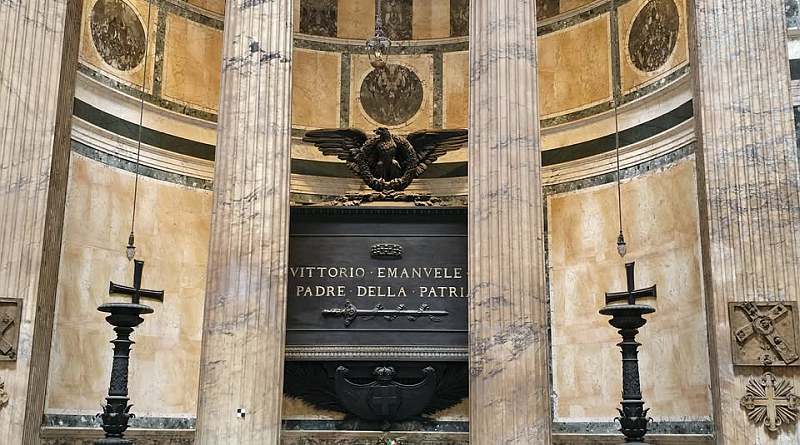
In the photo: the tomb of King Victor Emmanuel II, the founding father of modern united Italy.
