
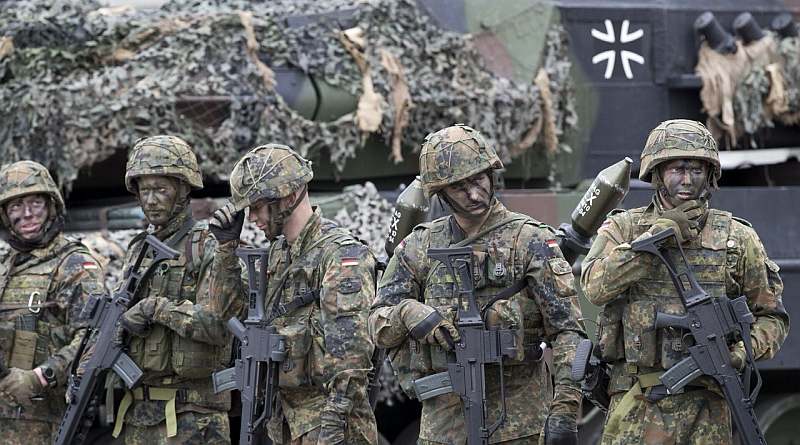

Germany has officially ended the era of “peace dividends.” The adoption of new defense policy guidelines and their accompanying strategies marks a radical shift for Berlin: from participating in peacekeeping operations in Africa or Afghanistan to preparing for full-scale high-tech war in Europe. At the center of this security architecture is one undeniable factor, namely the military threat from Russia.
For the first time since the end of the Cold War, official Berlin is calling things by their names. Previously, German documents referred to “challenges” and “unstable partners,” but the current strategy classifies Russia as “the most serious and long-term threat to security in the Euro-Atlantic region.”
This shift in perception is far from mere rhetoric. German analysts from the Science and Politics Foundation (SWP) and Bundeswehr experts emphasize: Moscow’s aggressive foreign policy and the shift of the Russian economy to a war footing make conflict with NATO a scenario to be prepared for within the next 5-8 years. It is this time frame that determines the pace of the current modernization of the Bundeswehr.
The concept of Zeitenwende (“change of era”), voiced by Olaf Scholz, has become the foundation not only for political decisions but also for the transformation of public consciousness. Russia’s war against Ukraine has shattered the long-standing German dogma of “security with Russia, not against it.”
According to polls by sociology institutes like Infratest dimap, a tectonic shift has occurred in German society: now the majority of citizens support increasing defense spending to 2% of GDP and higher. Simultaneously, discussions about the return of compulsory military service or its modified forms (“Pistorius model”) have ceased to be taboo. Pacifism, which has defined German identity for decades, has given way to the concept of Kriegstüchtigkeit – “capability to wage war.”
To implement the new strategy, Germany is launching mechanisms that seemed impossible just three years ago. The main focus is on three areas.
Firstly, the Special Fund (Sondervermögen): 100 billion euros are being allocated for the purchase of F-35 fighters, Chinook transport helicopters, and Arrow-3 air defense systems.
Secondly, the need for a permanent presence on the Eastern flank. Germany has committed to deploying a fully capable brigade in Lithuania (Brigade 45) by 2027. This is the first instance in the history of the FRG where German troops will be stationed abroad on a permanent basis to protect allies.
Thirdly, the reform of the army structure. The Bundeswehr is transitioning from a complex fragmented structure to a unified operational command capable of making rapid decisions in the context of hybrid and conventional warfare.
The updated Bundeswehr is being created taking into account the experience of combat operations in Ukraine. German strategy now focuses on “multi-domain operations.”
The main innovations include the mass introduction of unmanned systems at all levels of the army and protection against them (electronic warfare means), the creation of a unified information network for real-time troop management. In addition, Germany has realized its role as a “central hub” for the transfer of NATO troops from west to east, which requires the modernization of civilian and military infrastructure.
Berlin no longer tries to “balance” between security interests and economic benefits in relations with Moscow. The new military strategy appears as acknowledgment that peace in Europe is possible only with a powerful deterrent factor. The Bundeswehr is transforming from an “army for foreign missions” into the defense fist of NATO, and Russia is henceforth not a partner but a strategic adversary, defining every step of German military planning.
