
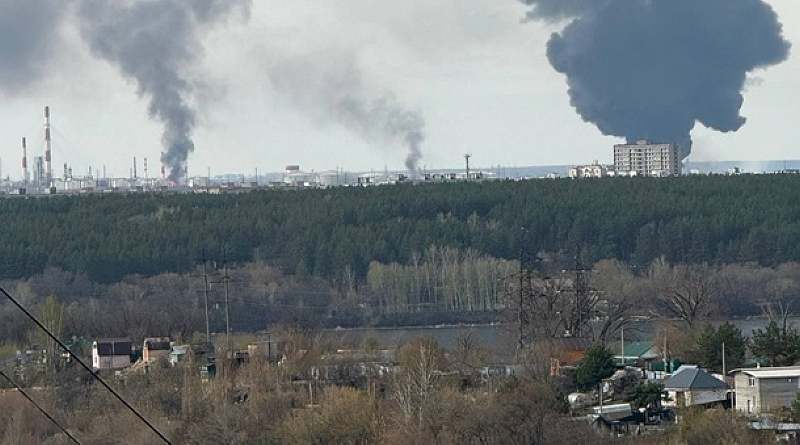

This time, I will not analyze the night strikes on different parts of the Russian oil industry. I want to show what the picture looks like in light of the latest attacks on the marshlands. In other words, what we have done to the Russian oil system over the past two weeks. We’ll examine the recent strikes and see the overall impact that could bring about Russia’s downfall.
LVDS Samara – the hub where Urals is born
On April 21, Alpha SBU drones struck the LPDS Samara in Prosvet. This is not an oil refinery. It is the largest tank park in Europe – 71 tanks, 1.6 million cubic meters of oil, 216 hectares. Here, oil from Siberia, Tatarstan, and Kazakhstan is mixed to create the Urals grade – the main Russian export product.
Result: 5 tanks of 20,000 cubic meters each were damaged. In other words, 100,000 cubic meters of crude oil is either in flames or taken out of circulation. Additionally, logistics for three regional refineries supplied by this station have been disrupted.
The Samara refinery cluster – three plants, all halted.
The Samara region is the only place in Russia where three large Rosneft refineries are concentrated in one region. All three are now either shut down or damaged.
Novokuybyshevsk Refinery
Capacity of 8.3 million tons/year. In 2024, it produced 1.1 million tons of gasoline, 1.64 million tons of diesel. On April 18, both primary processing units were shut down: AVT-11 (18,900 tons/day – 80% capacity) and AVT-9 (4,700 tons/day). The plant is completely halted. On April 23, it was hit again while already stopped, preventing recovery. This is at least the sixth strike in six months: September, October (19th), November (16th and 27th), January 2, 2026, April 18, April 23.
Syzran Refinery
Capacity of 8.5 million tons/year. On April 18, unit AVT-6 was shut down – 71% of the plant’s capacity (17,100 tons/day). Previously halted in December 2025 and August 2025.
In total, these two plants annually produced about 2.5 million tons of diesel and 1.9 million tons of gasoline. Now it’s zero.
| Tuapse – the only refinery on the Black Sea, hit twice on April 16 and 20.
Capacity: 12 million tons/year. 90% of the production was exported through the adjacent marine terminal. The strikes damaged deepwater loading stands, pipeline system, and tank park. The plant is halted. The fire lasted several days, and NASA Worldview recorded a smoke plume over 300 kilometers long, reaching Stavropol. Locals complained about oil rain and recorded videos claiming they aren’t just pedestrians. Local authorities canceled school lessons and are watching an oil slick in the bay. The damaged deepwater stands are particularly noteworthy, as even if the plant resumes processing, it won’t be able to load products onto tankers. Video from Gorsky, and as our correspondent on the scene says: the oil supply has stopped, apparently 😆 |
The NPS Gorky was hit today, on the night of April 23.
This is Kstovo, Nizhny Novgorod region. The Transneft-Upper Volga station. It transports oil along the Surgut–Gorky–Polotsk route, i.e., towards “Druzhba” and “Lukoil” Kstovo. Impact: three tanks, fire covering an area of 20,000 sq.m. This is already the second pipeline hub after LVDS Samara to be hit in a week. We are now striking not only factories but also the transportation system itself.
Feodosia is the eternal Black Sea artery of Crimea.
The sea oil terminal in Feodosia remains the only maritime supply route for oil products to Crimea from the Black Sea, bypassing the Kerch Bridge. October 2025: two strikes, 11 tanks destroyed. On April 8, the fire had already lasted over 3 days.
Today, April 23: at least 5 impacts, a massive fire, smoke visible for tens of kilometers.
Adding the destruction of railway ferry transport (all three are already non-operational, remember Avangard and Slavyanin) and the disabling of the BDK of the Russian Black Sea Fleet – this is a systematic disruption of Crimean fuel logistics.
And now the general picture of Russian losses.
According to Reuters and the IEA: in April, Russia reduced oil production by 300,000–400,000 barrels/day. According to RBC, 38% of Russian refinery capacities are currently idle. According to KSE Institute estimates, from March 23 to April 5 alone, Russia lost $1.76 billion from oil exports. The IEA reduced the forecast for oil supplies from Russia by 120,000 barrels/day by the end of the year.
And all this against the backdrop of the highest prices for Urals since 2013 due to the situation in Iran. Oil is more expensive, but they cannot sell in all ephemeral volumes. Because equipment is burning, enemy equipment is on fire 😆.
This is the strategy. Not one strike, not two. Systematic disruption of the entire chain – from the mixing hub to the sea terminal. And while someone asks “why hit the refineries if they are being repaired,” here’s the answer: they hit them again before they’re repaired. The sixth strike on one plant in half a year. These are no longer attacks. This is a siege.

As the news of the defeat of yet another Russian oil facility pours in like a calculator, a few words about the technical and organizational side.
1. On the night of April 23, 2026, drones from the CSO “A” of the SBU visited the Gorky oil pumping station (OPS) (Meshikha, Nizhny Novgorod region; part of “Transneft-Upper Volga” JSC). The station is sometimes geographically tied to Kstovo (15 km from the site) and the Lukoil-Nizhnevolzhskiy ORGSYNTEZ refinery (10 km).
This OPS was built in 1981. Its main task is to facilitate the transportation of oil through the Surgut-Polozk main oil pipeline, which was established as a result of the All-Union Komsomol construction from 1977-1981. It stretches 3,250 km with a throughput capacity of more than 20 million tons of oil per year. The main consumer is the Novopolotsk refinery in Belarus (up to 12 million tons). The route is served by 34 OPSs.
The Gorky OPS also services the Almetyevsk-Gorky-2, 3 pipelines and directs the oil flow to the Starolikeevo linear pumping station, adjoining the Lukoil refinery in Kstovo.
To ensure transit, 10 tanks were built at the Gorky OPS (6 of them at 50,000 cubic meters each).
To understand the timing, the station has been significantly modernized over the last 10 years. The tank farm was increased, energy modernization was carried out, pumping equipment was updated, and digitalization was implemented.
In 2015-2016, major repairs were made to tank No. 1 (20K).
In 2015-2017, tank No. 5 (50K) was built over two years.
In 2016-2018, “Transneft-Upper Volga” JSC reconstructed tank No. 6 (50K):
“… specialists replaced technological pipelines, external fire extinguishing networks, and two lightning rods, built two rooms with electric drive valves, and performed landscaping works. Individual tests of fire extinguishing engineering systems were conducted, and adjustments of power supply networks were carried out at the site…”.
Two years of work.
From July 2022 to September 2023, another tank (20K) was built (i.e., a year and three months).
In 2023, an automated oil blending (compounding) and quality determination system was introduced.
“The new modern compounding system allows regulating cargo flow automatically based on the quality characteristics of oil coming from the Almetyevsk-Gorky 2, 3 and Surgut-Polozk main pipelines. The goal is to ensure the preservation of the quality characteristics of oil supplied to Russian refineries and for export”…
In total: construction/major repair of a 20K tank takes a year and a half, and a 50K tank takes two years.
According to current information, at least 1 tank with 50K capacity is seriously damaged, and two more are affected (the extent of the damage is unclear).
2. Reminder.
• On February 23, the CSO “A” of the SBU attended to the monstrous LPD “Kaleikino” (Almetyevsk, Tatarstan).
• On March 12, the SBU struck the Tikhoretsk oil hub in the Krasnodar region.
• On April 11, they focused on the LPD “Krymskaya” (Krymsk, Krasnodar region).
• On April 21, it was the LPD “Samara” (damage unknown).
• On April 23, the Gorky OPS (visible damage expected to increase).
The frequency indicates that Russia is unable to protect these facilities (in addition to which, SBU colleagues from other Ukrainian Defense Forces structures are hard at work, as well as ports and refineries).
The calculator is relentless: six months of such activity and Russia’s oil achievements over the past 10 years will be seriously undermined, in some places nullified. They became possible thanks to the “fat 2000s.” Nothing “fat” can be seen for Russia in the foreseeable future.
That is, the SBU not only undermines the Kremlin’s ability to finance the aggressive war at the moment, but also reveals the strategic dead end of the evil old men: they have been consuming 10+ years from Russia in various directions.
Those who intend to inherit this legacy after the old men should seriously consider their behavior.
In the foreground: Fire in the area of the storage tank park of the Syzran Oil Refinery
