
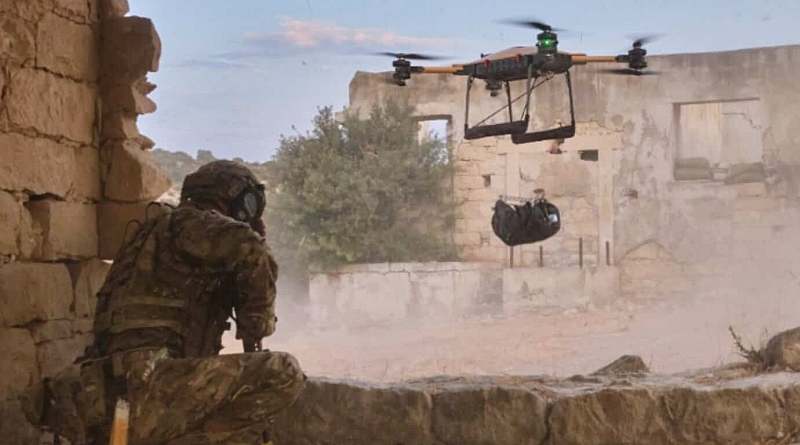
The UK’s Defense Secretary John Healy announced an unprecedented aid package of 752 million pounds (which is almost 940 million dollars) at the meeting of the Ukraine Defense Contact Group in Berlin. The main feature — over the next nine months, we will receive 120,000 drones. If you break this down on a calculator, it’s a fantastic number: more than 13,300 units per month, or about 440 drones per day, which will be continuously sent to the front.
These will not only be strike devices or the usual FPV, but also heavy reconnaissance and logistics platforms. Britain clearly understands the challenges we face: over 1,000 kilometers of LBS, low operational troop density, a chronic shortage of personnel, and critical reliance on artillery and combat UAVs in creating kill boxes (zones of concentrated destruction).
Undeniable focus on flexibility. For example, the twin-engine drone ULTRA — is a machine that can carry up to 150–200 kg of payload within a 2000 km radius and drop it precisely from a special compartment at several control points.
Depending on the need today, this is logistics to a remote garrison, tomorrow a FAB to a Russian aircraft factory or oil refinery, if it’s necessary right here and now to urgently send “gifts” deep into the enemy’s rear, or for mining, or delivering something to saboteurs.
But mainly, of course, it’s about logistics and reconnaissance. The main goal is to maximize the advantage of Western SAUs in accuracy and range and completely nullify losses in the last, bloodiest kilometers to zero. Along with the procurement of 25,000 ground robotic complexes (GRC) in the first half of 2026 alone, our global task is clear: reduce vehicle and driver losses, shifting supply in the red zone to the iron shoulders of the UAVs.
The math here is absolutely clear: after an attack on logistics, it’s much easier for us to remove surviving parts from a damaged drone and order a new unit from London than to evacuate under fire, treat and rehabilitate a wounded driver (when it comes to complex shrapnel fractures, dozens of titanium bolts, and months of difficult recovery) which costs hundreds of thousands of hryvnias, or pay 15 million for a soldier’s death.
The companies selected as general contractors: Tekever, Windracers, and Malloy Aeronautics.
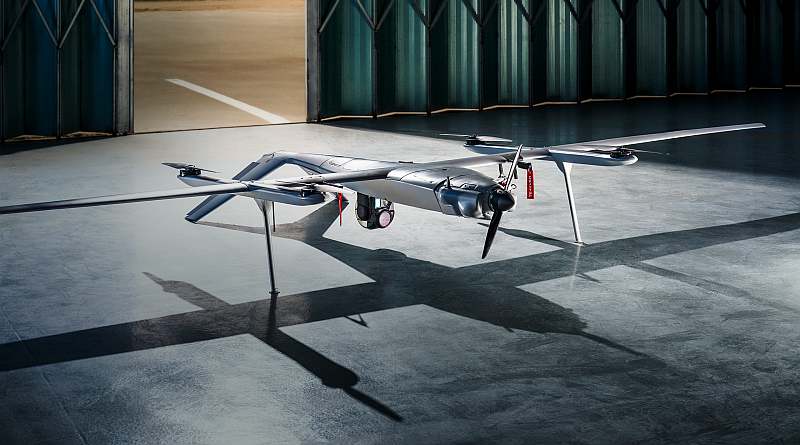
Yes, the TEKEVER AR3 EVO drone has a special VTOL configuration (vertical takeoff and landing), allowing it to operate without a catapult or runway.
Tekever — absolute professionals in deep reconnaissance and targeting (ISR). True eyes for our “Bohdan” and self-propelled guns of five EU manufacturers. The ability to frame with cassettes (DPICM), remotely mine the path of an armored convoy, or precisely hit ATVs with infantry in uniform is invaluable. For us, this company mainly produces the AR3 systems and significantly heavier operational-tactical AR5.
The AR3 is a 25 kg board (payload — 4 kg) which in vertical takeoff versions (VTOL) can hover in the sky for up to eight hours, and when launched by a catapult — all 16. These birds have been in the skies of Ukraine since the spring of 2022, totaling over 10,000 combat hours.
Regarding volumes and timelines: the British government has already invested about 400 million pounds in the Overmatch program, and now Tekever is actively expanding its plant in Britain. It is moving towards serial scaling of the updated AR3 Evolution and AR5 (the latter carries up to 50 kg of payload), to meet our needs within this year’s package. Their main value is that they work as guides for the long arm. Thanks to synthetic aperture radars (SAR), which see through clouds and dense fog, these drones find Russian air defense systems, fuel columns, ammunition depots, and in real-time highlight them for strikes with HIMARS, ATACMS, or the same British Storm Shadow.
Furthermore, they have powerful communication sensors (including SATCOM) — they can function as high-altitude airborne relays for our other drones, effectively extending their range in harsh Russian electronic warfare conditions.
Windracers cover the niche of heavy and long-range frontline logistics with their twin-engine flagship ULTRA (Unmanned Logistics Tracker). This is a large cargo drone of aircraft type (aluminum wing span — 10 meters). The Armed Forces of Ukraine have been testing it since 2023.
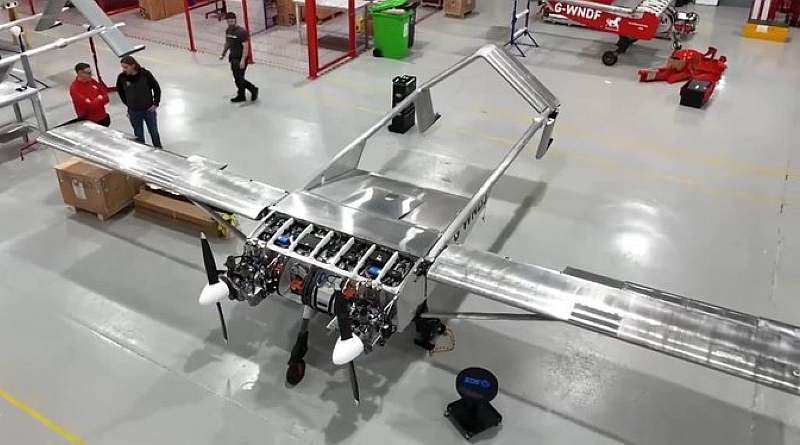
The machine is absolutely unique, and its niche is huge: initially, it carried 100–150 kg of cargo over a thousand kilometers, but literally at the beginning of this year, the British reported that they had doubled the range (to 2000 km) and are already working on increasing the payload to 200 kg. It flies in dense fog, at night (relying on inertial navigation), and performs precise supply drops using parachutes.
Timeline and volumes: the company is currently actively expanding its team of engineers and doubling monthly production. Their goal is to release hundreds of such units over the next two years, with new batches going out right now.
The ability to use short dirt runways (it only needs 150 meters of flat field) and significant range make them extremely resilient suppliers at the operational level. A dozen of such units might arrive and supply an advanced post, which then independently packages gifts for OPs (observation posts) and hiding spots for heavy “Vampires.”
In general, 200 kg over 2000 km means the transfer of EW containers, operational mining behind enemy lines, and uninterrupted supply of sabotage groups deep behind the front lines.
Malloy Aeronautics (now under the wing of giant BAE Systems) are the creators of rugged transport octocopters, primarily the T-150 model and the significantly more powerful T-400. The T-150 has been in service with us since 2022. It’s a fully electric copter that leaves no thermal trace from an internal combustion engine (making it hard for MANPADS missiles to target) and operates almost silently.
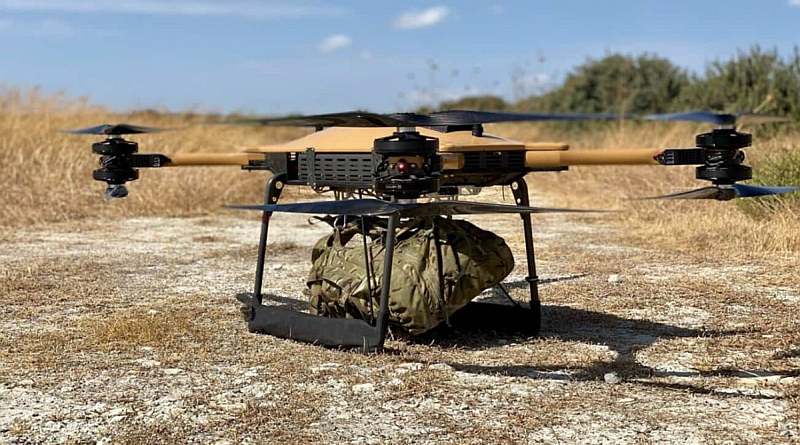
It lifts up to 68 kg of cargo, flies 70 km with continuous hovering time of about 36 minutes. Initially, it was a classic “gazelle” for delivering ammunition, scarce parts, and tactical medicine to the front line by air. It approached at low altitude, dropped off water, fresh batteries, Snickers, and a shotgun ammo — and the bunker continues to function.
But we use them much more widely: for example, recently these drones in 30 night sorties dropped 1.5 tons of explosives (50-kilogram cumulative charges) on bridge supports in the Kherson region and destroyed enemy logistics on the islands. The larger T-400 can carry up to 180 kg. And engineers at BAE Systems are actively testing the launch of APKWS precision-guided rockets from them as hunters for large reconnaissance drones or enemy armored vehicles (where a $25,000 rocket can reliably destroy a $3 million tank).
Ukrainian forces used heavy British Malloy T-150 drones to destroy a bridge over the Konka River last year (in March 2025 in Kherson region)
Their mass production is also firmly embedded in this huge British contract until the end of 2026.
In the end, Ukraine gets a deployed tiered system of unmanned logistics. We completely eliminate driver losses and the distraction of infantry on supply routes in no-man’s land. Pilots remain safe (often tens of kilometers away, in bunkers, and when it comes to ULTRA — generally beyond the Dnipro) and gain invaluable combat experience without a target on their backs.
A large volume of cargo was brought from strategic depth using ULTRA trucks, distributed by heavy copters to a number of supply points where there is no guarantee that transport will reach by land, and where sterility is absent.
And above all this hovers Tekever — a bird that can operate in the sky for 10–16 hours and continuously observe deep behind the front lines (for example, monitoring highways in steppe Crimea or logistical hubs in the south), methodically spotting surface-to-air missile systems or command posts.
What is particularly good about the Western approach is that they closely observe what truly works on the battlefield and scale it up to the level of state finances and the defense industry. The industrial mechanization of the Defense Forces is an opportunity to reduce what is most painful for us: human losses.
On the cover: Malloy T-150 drone. Photo: malloyaeronautics.com
