
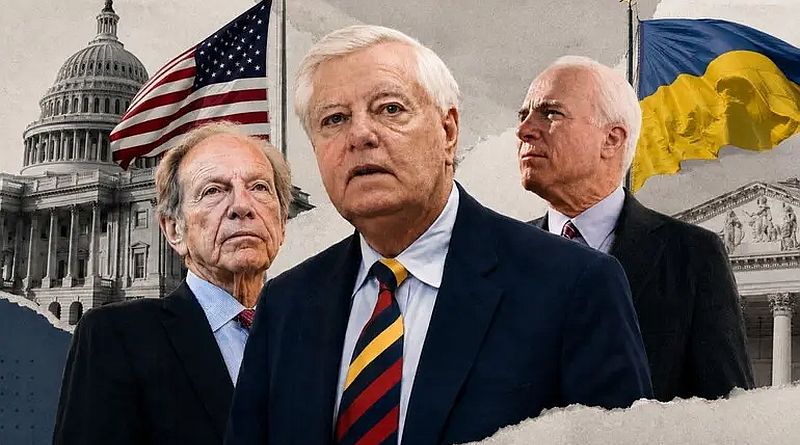
Ukraine has lost one of its most steadfast supporters in the US Congress, an active, and most importantly, an effective partner in countering Russian aggression. It is not surprising that Russian hawks are currently not hiding their joyful emotions, even in the wake of the death of one of the most renowned American politicians of modern times.
Considering his long and illustrious political career, Lindsey Graham can be characterized by various definitions: a “hawk” of American foreign policy; one of Ukraine’s greatest friends in Washington; the main sanctions architect in Congress; a grandmaster of political compromise…
But one definition truly captures his historical role and symbolizes a bridge between eras — “the last of the ‘Three Amigos’.” As is known, for many years, the Senate had an informal alliance of three close friends and political heavyweights — John McCain, Joseph Lieberman, and Lindsey Graham. They traveled together to hotspots and shaped US defense policy. They supported a tough stance in foreign policy and were among the first on Capitol Hill to understand the nature and intentions of the Russian regime, consistently supporting Ukraine in its fight against those rightfully called US adversaries. After the deaths of John McCain (2018) and Joseph Lieberman (2024), Lindsey Graham remained the last bearer of this unique political legacy. As the “last of the Mohicans” of traditional US foreign policy, he used his authority to persuade a new generation of Republicans not to abandon allies, including Ukraine.
Lindsey Graham first visited Ukraine on August 19, 2008, as part of a US Senate Armed Services Committee delegation. The delegation held meetings with the country’s leadership to discuss the consequences of the Russian invasion of Georgia.
He was one of the main initiators and co-authors of the historic “Countering America’s Adversaries Through Sanctions Act” (CAATSA). In 2017, Senator Graham, along with Senator McCain and a group of Democrats and Republicans, developed this bipartisan bill.
Senator Graham was directly involved in promoting and refining initiatives called the Ukraine Support Act back in 2014. The modern comprehensive law with the same name (June 2026), adopted through a petition procedure by the House of Representatives of the US Congress, aims to reinstate the lend-lease program for Ukraine, allocate $8 billion for arms purchases, and impose devastating tariffs on Russian goods. It still requires a decision by the Senate and the signature of the US President to take effect.
Since this document faced opposition from the White House, Lindsey Graham took on the role of chief negotiator in the Senate. Just a few days before his sudden death, during a visit to Kyiv on July 10, 2026, Senator Graham officially announced that he had reached a compromise with the White House regarding the sanctions portion of the bill. He integrated strict secondary sanctions against countries buying Russian oil bypassing the restrictions into the package. This step paved the way for the document to be ultimately approved.
Without Lindsey Graham’s activity and his ability to communicate with the current President Donald Trump’s team and seek compromises in Congress, such plans would now be harder to implement.
Of course, there remain many supporters of Ukraine on Capitol Hill and those who actively push for laws against Russian aggressors. These include Brian Fitzpatrick—co-chair of the Ukraine Caucus in Congress, who became the main public face and lobbyist of the bill from the Republicans in the House of Representatives, as well as Gregory Meeks and Richard Blumenthal, thanks to whom these legislative initiatives gained the necessary bipartisan status.
The role of Lindsey Graham’s allies is also important—Republicans Roger Wicker, who officially became the co-author of the final agreed compromise on strict sanctions against buyers of Russian oil, and Michael McCaul, who, together with Lindsey Graham, exerted constant pressure on the White House administration to convince Donald Trump not to block military aid to Ukraine and agree to transfer licenses for the production of Patriot systems.
However, it’s unlikely that any of them had the unique direct access to Donald Trump that Lindsey Graham did. This allowed him to address issues of supporting Ukraine directly with the White House, far beyond the standard capabilities of the congressional Ukraine Caucus.
Communication between Graham and Trump will go down in U.S. history as one of the most extraordinary political and personal alliances in Washington. Despite Senator Graham calling President Trump a “xenophobe” and a “bigot” in 2016, he later transformed into the so-called Trump-whisperer—a person who has a unique approach to the U.S. president, able to influence, calm him, or translate his chaotic thoughts into language understandable to the establishment.
Golf became the main instrument through which Graham grew closer to Trump and gained his trust. The senator regularly used humor and self-irony to maintain the leader’s favor. He publicly joked that Trump “beat him like a drum” on the course. In March 2025, thanking the president for support in the primaries, Graham wrote on social media: “He’s a great golf partner whom I’ve never been able to beat.” In response, Trump ironically remarked that Graham “was not the best ball-striker, not Tiger Woods, but everyone loved playing with him.”
Trump called Graham “a total workaholic politician.” The senator could call the president dozens of times a day until he achieved his goal.
The effectiveness of supporting Ukraine was also aided by the great activity and courage of Lindsey Graham. Along with John McCain and Amy Klobuchar, the senator visited the front line. This first occurred on December 31, 2016. This visit was historic and had an incredibly strong symbolic message. The senators arrived at a forward command post in the area near Shyrokyne, where Ukrainian marines were defending.
During this visit, Graham delivered his famous speech to the Ukrainian military, stating: “I am impressed that you are fighting for your Homeland. Your struggle is our struggle.” He assured the defenders that the U.S. Congress would do everything to provide Ukraine with lethal weapons. The senator kept his promise.
Gradually emerging from the shadow of Senator McCain, perhaps the harshest and most farsighted critic of the Kremlin in American politics, who saw only three letters in Vladimir Putin’s eyes — K, G, B, and in Russia — “a gas station run by the mafia that possesses nuclear weapons,” Graham effectively adopted a sharp rhetoric against the Russian regime and its leader and also became known for his striking assessments.
“Regarding Putin: We must remember that this is the man who aided in Assad’s regime dropping barrel bombs from helicopters on civilians and deliberately striking hospitals in Syria. The same barbaric behavior is observed in Ukraine. To the Russian people: Putin is leading you into the abyss. Tens of thousands of Russian soldiers are killed and wounded. An economy smaller than Italy’s, and more pressure ahead. Russia is isolated like never before. This does not make Russia great. It turns it into a pariah state. You — the Russian people and military — are capable of more,” he expressed his assessment on the social network X on May 27, 2025.
“He will not stop until someone stops him,” Lindsey Graham warned the “peace doves.” The senator repeatedly called for providing Ukraine with Tomahawk missiles and noted that long-range strikes on Russian infrastructure involved in weapons production and war budget formation were necessary. He was confident that this could change the balance of power and give Ukraine a chance to stand firm and prevent Russia’s victory.
There were even harsher statements. All this usually caused hysterics in the Kremlin, which they did not even try to hide, calling the senator everything: “American hawk,” “rabid Russophobe,” “extremist and terrorist” — these are the terms that can still be quoted in decent publications… It’s not surprising that the Russian regime assessed the senator’s role and influence and officially added Lindsey Graham to the state register of terrorists and extremists, and the Ministry of Internal Affairs of Russia put him on the criminal wanted list.
Graham himself treated such labels and criminal cases with his characteristic humor. When Moscow declared him wanted, he publicly stated that he would wear this order as a sign of honor for his contribution to the defense of freedom.
The day before his death, Senator Graham held a final press conference in Kyiv, where he outlined the strategy for pressuring the Russian leader: “You are not going to win this war solely on the battlefield. But Ukraine exerts tremendous pressure on Russia. My hope is to end this war with diplomacy. And the more leverage we have on Putin, the better.” “The new devastating sanctions law should force Putin to sit at the negotiating table on Ukrainian terms. Putin must pay.”
Lindsey Graham has been twice honored with high state awards from Ukraine for his many years of unwavering support for our country. He received the Order of Prince Yaroslav the Wise, 5th Class, from Ukrainian President Petro Poroshenko and the Order of Prince Yaroslav the Wise, 1st Class, from Ukrainian President Volodymyr Zelensky.
The prominent American senator Lindsey Graham has had, and still has, many enemies in Russia, Iran, North Korea, and other countries that pose a threat to the USA, Ukraine, and the world. But he has even more friends, both in Ukraine and in Georgia, Israel, and European and Asian countries.
The full extent of Senator Lindsey Graham’s personal contribution to the fight against the USA’s adversaries and aggressors who want to destroy the world, as well as to the development of the strategic partnership between Ukraine and the USA, has yet to be properly assessed and commemorated on both sides of the Atlantic Ocean.
Collage: ZN.UA
