

(A country-specific epic for leisurely reading)
1. The first layer of narration.
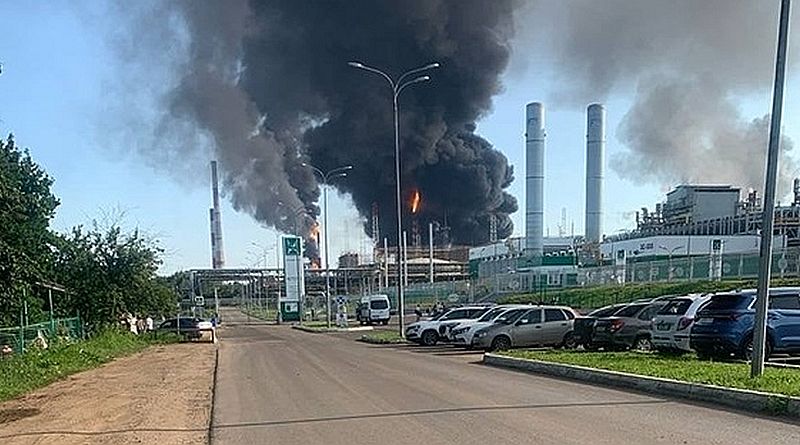
On the night of July 7/8, 2026, drones of the Ukrainian Defense Forces visited Tatarstan. “Smoke” appeared. On July 11, the General Staff of the Armed Forces of Ukraine confirmed information about the impact on several facilities of the “TAIF-NK” oil refinery, which had already taken hits on June 12 (see photo Exilenova+ – Ed.).
This information does not evoke any emotions from us, because in Ukraine they don’t know what “TAIF” is. “Tatneft” is known. “KamAZ” is there. But what is this “TAIF” – no associations. “Lukoil” or “Gazprom” are understandable, but not this.
The situation in Russia is slightly better, but only recently. Because just 5 years ago, the “TAIF” group was considered the largest of the opaque ones. Until the end of 2021, when a deal for the sale of part (!) of this group’s assets to the monstrous “Sibur” holding was completed, “TAIF” was practically unrecognizable outside of Tatarstan. Which always hides some interesting story.
Interim finish of the story: if you go to the global “Forbes” website and search in the list of current billionaires, you find the following:
• Ayrat Shaymiyev, fortune $1.9 billion, co-owner of the “TAIF” group, head of JSC “Tatavtodor”, and others;
• Radik Shaymiyev, fortune $1.8 billion, co-owner of the “TAIF” group;
• Albert Shigabutdinov, $1.8 billion, co-owner and general director of the “TAIF” group for 24 years, member of the board of directors of “Sibur” (as is his son Timur, who headed “TAIF” after his father);
• Rustem Sulteev, fortune $1.8 billion, co-owner of the “TAIF” group…
In this case, the story is quite typical. For someplace like Qatar or the UAE. With small Russian adjustments.
2. Back in 1990 in Kazan, the local council registered a commercial structure called the Foreign Trade Scientific-Production Association “Kazan.” There was nothing scientific-production about it at all, it just sounded grand.
The declared goal was prosaic – supplying citizens with consumer goods.
The main partners in the emerging business were the aforementioned future billionaires Shigabutdinov and Sulteev. They engaged in everything, including immediately diving into the niche of selling tobacco products.
Then there was the classic cycle for hundreds of Soviet-post-Soviet businessmen: trading everything – participating in restoring connections between enterprises after the USSR’s collapse (earning on barter and all the delights of wild capitalism) – participating in privatization – scaling up.
Since the owners of VNPO “Kazan” demonstrated remarkable survival skills and business acumen, in 1995, the authorities of Tatarstan (with Mintimer Shaimiev, a member of the CPSU Central Committee and a longtime regional communist leader, elected as president of the Republic of Tatarstan in 1991) involved them in creating a company with the spectacular name “Tatar-American Investments and Finance” (practically Saudi Aramco). In today’s terms, the group “TAIF” is decoded in a way that is maximally unpatriotic for Russia.
The partners in this consortium were VNPO “Kazan,” the government of the Republic of Tatarstan (which contributed “small packages” of Tatarstan enterprises to the charter capital), and American businessmen Alexander Friedman and Sergey Porovsky (who initially received a third of the company). And off it went.
Mintimer Shaimiev was president until 2010, after which he became the “state advisor of Tatarstan.”
The “TAIF” group gradually turned into a monstrous conglomerate, encompassing major enterprises—oil refineries, thermal power stations, chemical giants “Kazanorgsintez” and “Nizhnekamskneftekhim,” as well as a multitude of real estate and other smaller assets. The ownership structure of the group was as opaque as possible.
Since 2019, Albert Shigabutdinov ceded operational leadership to his son. A TAIF Management Company was created, and something resembling pre-sale preparation was carried out through the simplification of the ownership structure.
Chemical plants (initially accompanied by the generating company JSC “TGC-16,” owning the Kazan CHP-3 and Nizhnekamsk CHP, which later returned to the “TAIF” group) were separated, while the TAIF Management retained the oil refinery, the largest gas station chain in Tatarstan (240+), construction companies, commercial real estate, and much more.
The chemical plants were attempted to be sold several times, finally succeeding only in 2021 after several years of tough negotiations with “Sibur” (main owners—oligarchs Leonid Mikhelson and Gennady Timchenko). In exchange for “Kazanorgsintez” and “Nizhnekamskneftekhim,” the co-owners of “TAIF” received 15% of “Sibur” shares (and another 3% in bonds). Forbes was able to assess them.
This operation was dubbed by business media as the “deal of the year in the Russian Federation,” after which “Sibur” began to be valued at $27 billion. We hardly noticed all this. Although the story is interesting. There are already excerpts from a book about “Sibur” online, describing the plot with the purchase of Tatar chemical plants, the conflict between corporate cultures, and so on. Very curious.
In particular, it is explicitly mentioned that after optimizing the plants’ staff by 40% (because managers at all levels were bringing in relatives, and they brought in more relatives…) those who were let go did not end up on the street, but eagerly went to work at military factories, including in the “Alabuga” zone, where “geraniums” are assembled.
During preparations for the sale to “Sibur,” it unexpectedly became apparent to external observers that a significant share of “TAIF” belonged to… the sons of the former president of Tatarstan, Mintimer Shaimiev—Ayrat and Radik. This means that the republic’s assets were successfully privatized by the most revered family in the region. The sale of part of the assets generated two official dollar billionaires for the Shaimiev family.
Currently, “TAIF” declares that the group includes 21 companies where 9,500 people work…
3. The second layer of the narrative.
Some time ago, the Russian business press began describing the difficulties faced by small oil companies (MNCs). They say that under current conditions, some of them have found themselves in crisis, forced to shut down wells, etc. Since 2022, production in these structures has decreased by 22%.
In Tatarstan, this issue has been examined in detail, particularly using the example of the struggling company LLC “MNKT” – the largest small “independent” oil company in the republic.
Small companies produce about 20% of all oil in Tatarstan – roughly 6.9 million tons. Everything is relative, as Ukraine, in its best times, extracted 4 million tons of oil and gas condensate. Interestingly, Tatarstan’s small oil companies produce 30% of all oil extracted in Russia by such structures.
This is due to the specifics of the emergence of the genre known as MNC in Tatarstan. Former President Shaymiev signed an order in 1997 allowing “Tatneft” to transfer old and not very profitable wells to new companies to increase production.
“Old age” and “unprofitability” are flexible concepts. This led to expected consequences: the owners of small oil companies became top officials of “Tatneft” and various respected people. For example, the family of the former general director of “Tatneft” (1999-2013), Shafagat Takhautdinov, owns a whole array of MNC and oil service structures. The former head of Almetyevsk and former State Duma deputy of the Russian Federation, Foat Komarov, is also the founder of two large MNC.
Mentioned above, LLC “MNKT” is the most illustrative example: 20% belongs to billionaire Airat Shaymiev, and 80% to his son Timur Shaymiev. Thus, Shaymiev-grandfather laid a powerful foundation on which Shaymiev-son and Shaymiev-grandson were established. They are real power and business titans.
LLC “MNKT” declared production/sales of 500 thousand tons/450 thousand tons of oil. From 2002 to 2024, its figures actively grew, and in 2024, net profit amounted to 1.4 billion rubles. But then “something happened,” and in 2025 they already calculated a net loss of 3.2 billion rubles.
The company’s economics worsened due to a number of reasons. These include asset revaluation, oil price volatility, and several other factors. But there is something that unites the troubles of all small oil companies in Russia:
• Refineries reduced processing due to impacts; it’s difficult to deliver extracted oil to refineries, especially at a good price. It cannot be stored long-term, as there are no storage tanks;
• “Transneft” struggles with the rhythmic pumping of previous volumes due to port issues and the reduction of tank farm capacity.
Add to this taxes, the rising cost of special chemicals, etc. As a result, small oil companies in Russia, especially those extracting less than 100 thousand tons of oil per year, are forced to shut down their wells…
In conclusion: both at the level of industry flagships and one tier lower in Tatarstan, local elites dominate. This status quo has been maintained since 1991, and since 2010, it has been managed by war criminal Rustam Minnikhanov, “literally raised on the knees of Mintimer Shaymiev,” who then passed him the banner of power.
4. The third layer and the connection to Ukraine.
Imagine for a moment that the Kremlin wavered and lost control of the situation. What would happen next?
The above-mentioned representatives of the best people of Tatarstan will speak on behalf of the republic and claim power. Suddenly, it will turn out that they were all against the war (although some are under Ukrainian and international sanctions). That the evil Putin oppressed them terribly on a national basis, while providing oil and billions. And that they owe nothing to Ukraine, on the contrary, as compensation for Moscow’s oppression, they demand part of Russia’s frozen assets.
Tatarstan ranks second after Moscow in terms of war profiteering. Kazan began to wreak havoc in Crimea back in 2014.
Currently, drones are being assembled in Tatarstan and a mass of military equipment is being produced, which kills Ukrainians. They fulfill other orders for the Russian army. It is there, at an advanced pace, that mercenaries are being recruited and sent to war against Ukraine.
Therefore, a completely logical approach: they must 1) answer; 2) pay for restoration.
In intellectual exercises on the future coexistence with the (post)Russian space, the first step should be an internal Ukrainian consensus on two issues:
1) Ukraine determines the list of war criminals. Pursues, catches up, and serves justice to them. Or removes them from the list. This will also influence the configuration of authorities.
2) Ukraine determines the measure of material responsibility of each subject of the Russian Federation. Otherwise, no recognition and all available means to restore justice.
This sounds obvious, but no. Some exclaim, “How could this be?!”
The second step is a calm explanation of this approach to our partners. Because some of them will be tempted to rely on existing regional elites to ensure control.
Ukraine may agree to this under certain conditions. Or it may not. And it needs to be politely explained: it is pointless to bet on this comrade, he is too guilty, he is unacceptable, he will not be included. But this one is guilty but has actively repented, he can be given a chance on probation.
This is a transparent, honest approach that will allow building relationships of good neighborliness, friendship, and cooperation.
For now, any blow that hurts federal and regional elites is a boon, stimulating the thought process.
