
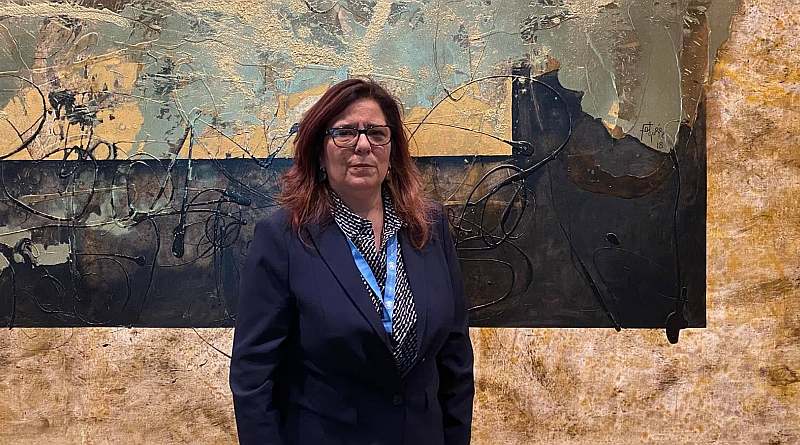
Volodymyr Ilchenko, New York / Ukrinform
In a new report, the UN Special Rapporteur on Human Rights in Russia, Mariana Katzarova, highlights the close link between Russian aggression against Ukraine and the intensification of repression within the Russian Federation. She states that the Kremlin not only suppresses anti-war voices and dismantles civil society but also persecutes critics abroad using international mechanisms. Meanwhile, Russia is militarizing education, forcibly recruiting migrants and indigenous peoples into the military.
Katzarova is a well-known Bulgarian journalist, human rights defender, and international human rights expert. After the Russian invasion of Ukraine in 2014, she led the UN Human Rights Monitoring Mission in Donbas. In May 2023, she became the first UN Special Rapporteur on the human rights situation in Russia. Moscow has banned her from entering the territory of the Russian Federation.
Ukrinform asked her about the scale of Russian crimes and the possibility of holding those responsible accountable.
THE WAR AGAINST UKRAINE AND INTERNAL REPRESSION IN RUSSIA – COMPONENTS OF ONE KREMLIN POLICY
– In your report, you claim that repression within Russia and aggression beyond its borders are components of a single policy. How has the full-scale war against Ukraine changed the situation with repression in Russia?
– Absolutely. This is one of the main conclusions of my latest report “Traitors of the Motherland: Strategy of Fear and Punishment”. Repression within the country and aggression against Ukraine are closely interconnected.
The war gives the authorities a pretext to label people as traitors and enemies of the state.
Anyone who expresses anti-war opinions, likes anti-war posts on social media, or speaks out against the war is considered not just an enemy but a criminal.
At the onset of the full-scale invasion, the authorities in Russia introduced criminal norms aimed at dissent. These include laws that establish military censorship, hold people accountable for “discrediting” the armed forces, and disseminating so-called fake news about the army. All these are components of a strategy to suppress freedom of speech and anti-war voices.
– You also mention that repression in Russia is becoming transnational. How does the Kremlin persecute people who have left the country?
– Russia seeks not only to silence those it declares enemies and traitors within the country but also to punish them abroad, in exile.
The official Russian list of terrorists and extremists currently contains 22,000 names.
A significant part of this list consists of dissenters, human rights defenders, and anti-war activists who disagree with the Kremlin’s official position. They are labeled as terrorists or extremists and face corresponding criminal charges.
The authorities have also declared entire groups extremist organizations. In 2024, the Supreme Court recognized the LGBT movement as such. Or the non-existent “Russian separatists movement.” Following this, 172 non-governmental organizations were added to the list, most representing national minorities and indigenous peoples: Daria Yegereyeva and Natalia Leongardt, for example, face up to 30 years in prison. They are persecuted for allegedly participating in a terrorist organization merely because their public organization, the “Forum of Indigenous Peoples,” was listed as terrorist. They engaged in peaceful activities and cooperated with the UN.
Initially, people or organizations are declared terrorist or extremist, added to the appropriate list, and then criminal cases are opened against them. If these individuals are abroad, Russia can try them in absentia. In August, Russia adopted the corresponding law. They will lose their civil rights. I call this the “law of civil death,” as such people will no longer be able to receive consular services, renew passports, or register the birth of children. Essentially, they can become stateless persons, although they still hold Russian passports.
An example is Sergey Davidis, one of the leaders of the human rights organization “Memorial,” which is a Nobel Peace Prize laureate. Last year, he was sentenced in absentia to six years in prison for publishing a statement by the organization on Facebook, in which members of the “Azov” battalion, imprisoned in Russia, were recognized as political prisoners.
– You highlight that Russia uses mechanisms like Interpol, extradition requests, and other international tools to persecute opponents abroad. How can democratic countries prevent the abuse of these mechanisms?
– My report to the UN Human Rights Council, presented at the end of September, is the first such United Nations document on transnational repression in a specific country. I hope it will contribute to the development of a UN approach on how member states can counter this issue.
I recommend developing a new international human rights convention on transnational repression. This may seem like an overly ambitious goal, as such an initiative will be blocked by states that engage in similar practices, including Russia. But there is currently no agreed-upon definition of transnational repression, and neither the victims nor the obligations of the host states when such repression occurs on their territory are defined.
Transnational repression is a strategy, not a series of isolated incidents. The Russian government employs at least ten different methods of such persecution.
One of them is the abuse of Interpol red notices. The Russian authorities regularly use the mechanism of the International Criminal Police Organization to seek the arrest of dissenters and critics in other member countries.
This abuse affects not only the organization itself but also international institutions designed to protect us from genuine terrorists. As a result, people can be detained abroad due to such notes.
Host countries and Interpol itself must verify each notice before it is entered into the system. A strict verification procedure must be implemented to determine whether a case is politically motivated. This is especially important in the case of Russia, given how widely it uses this mechanism.
Russia also relies on bilateral agreements and mechanisms created within the Commonwealth of Independent States. The CIS lacks a proper system for checking individuals declared wanted. Russia, Belarus, and Central Asian countries submit numerous lists of names without verifying who these people are. This can lead to their arrest in any CIS state.
My working definition of transnational repression does not limit its victims by nationality. They can be individuals of any citizenship considered by the government as real or imagined enemies. For example, in 2019, Zelimkhan Khangoshvili, a Chechen dissident and a Georgian citizen, was shot in Berlin by a Russian special services officer.
– You mentioned that members of the “Azov” battalion and other Ukrainian captives in Russia are being tried on terrorism-related charges instead of being treated as prisoners of war. How widespread is this practice?
– The Russian government has declared the “Azov” battalion a terrorist organization. Its fighters are prisoners of war. However, instead of treating them according to the rules applicable to prisoners of war, and, if brought to trial, judging them by these rules, they are being tried as terrorists.
This applies to most Ukrainian captives in Russia whose cases are reviewed by courts, including military ones. Possibly, 90 percent of them are charged with terrorism-related crimes, rather than participation in hostilities.
Under the Geneva Conventions, prisoners of war are protected and may be convicted for participating in hostilities as military personnel. They cannot be considered civilians and charged with terrorism.
MILITARY TRAINING IN RUSSIAN SCHOOLS REACHES 50% OF THE EDUCATIONAL PROCESS
– Your report also addresses the militarization of education in Russia. How does the Kremlin use schools to prepare children for war?
– The authorities strive to eradicate any anti-war statements and thoughts that contradict the war, call for peace, or demand an end to aggression.
One manifestation of this is the militarization of education. This concerns not only the thousands of Ukrainian children deported to Russia who are subjected to ideological indoctrination through the education system but also Russian children.
Previously, military training made up 30% of school time. This month, this figure increased to 50%. I know that children are even being taught to disassemble, assemble, and launch drones.
The authorities are preparing their children to become future soldiers in an endless expansionist war.
At the same time, 1,100 children and teenagers under the age of 18 have been added to the list of terrorists and extremists, and charges of terrorism-related crimes have been brought against them. They face long prison terms.
Russian security forces also resort to deceiving children. For example, they pose as representatives of a Russian volunteer battalion fighting in Ukraine and ask children if they would agree to join it. Teenagers sometimes answer affirmatively, only to later find that they have been charged with terrorism.
The Russian government does not acknowledge that it is waging a war. It calls it a “special military operation.”
Ukrainian prisoners of war are not afforded the protection provided by the Geneva Conventions because they are not treated as prisoners of war. The same applies to thousands of Ukrainian civilians who are held without contact with the outside world, and their relatives know nothing about their whereabouts.
You are well aware of what happened to your colleague, journalist Victoria Roshchina, whom the Russian authorities abducted in the Zaporizhzhia region while she was there on a journalistic assignment.
– Do you see signs that the Russian authorities systematically prepare society for a protracted war by suppressing dissent?
– First and foremost, they prepare for authoritarian rule. This is how the authorities strengthen their position—by destroying civil society, non-governmental organizations, and independent media.
Without civic organizations, human rights defenders, independent media, and lawyers, people lack an effective system they could rely on to protect their rights, hold offenders accountable, and ensure justice.
The authorities also block communication channels, essentially depriving Russians of access to alternative information and the internet.
Now, for example, searching the internet for so-called extremist materials is considered an offense. The authorities interpret this concept extremely broadly. Such materials may include products of structures declared extremist or terrorist, such as the Navalny organization or “Memorial.” Even reports by the UN Independent International Commission of Inquiry on violations in Ukraine could be deemed such materials. In the Urals, a human rights defender was imprisoned for publishing a UN report on Ukraine.
FORCED MOBILIZATION DESTROYS SMALL INDIGENOUS PEOPLES
– You also describe increasingly harsh methods of recruiting people into the Russian Armed Forces. Who suffers the most from this, and what consequences does it have for the indigenous peoples of Russia?
– I consider this war imperialist by nature because the most vulnerable segments of the population were involved and mobilized by the harshest methods. In particular, indigenous peoples were disproportionately affected. In Moscow and St. Petersburg, mobilization was conducted online and with comparatively milder methods. But in remote villages of Siberia, from the very beginning of the war, representatives of the Ministry of Internal Affairs came by buses, went from house to house, forcibly pulled men out and sent them thousands of kilometers away to fight.
Some indigenous peoples live in the northern part of Siberia, and an entire people may consist of residents of only four villages. The mentioned Daria Yegereva, who faces up to 30 years in prison, belongs to the Selkup people, an indigenous group living near Tomsk, numbering only about 3,000–3,500 people.
Another example is Pavel Sulyandziga, head of the “Batani” foundation based in the USA. The Russian government declared the foundation an undesirable organization due to its active participation in the UN Permanent Forum on Indigenous Issues. Sulyandziga belongs to the Udege people, who live in the Khabarovsk and Primorsky regions.
When such peoples lose even two or three men due to disproportionate mobilization, often conducted against their will, the consequences become catastrophic. Some of these indigenous peoples are already on the brink of extinction.
CANNIBALS, RAPISTS, MIGRANTS…
– You have also documented the recruitment of prisoners into the Russian army and the pardoning of individuals convicted of serious crimes. What happens when these men return from the war?
– I have documented cases related to extremely serious crimes. For example, last year I reported on a cannibal who was pardoned after signing a contract to participate in the war against Ukraine. Before that, he killed 14 people and ate parts of their bodies.
Many Russian veterans of the so-called “Special Military Operation” return to civilian life. Some of them commit violent crimes against women and children, including sexual violence. However, they evade responsibility. Investigations and criminal proceedings against them are suspended if they sign a new contract and go back to fight in Ukraine again. Some have done this multiple times.
– You have also expressed concerns about the recruitment of migrants. What have you found out?
– Migrants, especially from Central Asian countries, as well as asylum seekers from various countries, are often coerced into signing contracts to participate in the war against Ukraine.
This happens as follows: people are stopped on the street, and police say to them, “You know what’s waiting for you if you don’t sign this contract.” Sometimes migrants are also offered Russian citizenship as an incentive.
For instance, I know of five men from Syria who were seeking asylum. They were stopped and beaten to force them to sign contracts to participate in the war against Ukraine.
Moreover, there is increasing talk of human trafficking involving men from Africa, Latin America, and Asia, including Sri Lanka and Nepal. They are promised construction work or other civilian jobs. However, upon arrival in Russia, they face abuse and torture and are then coerced into signing military contracts. Often they are not even provided with a translator. They are simply handed a document in Russian, which they do not understand. Their passports are taken away, and they are sent to war.
– Can it be said that the war has already affected practically all spheres of Russian society?
– I don’t think there is a single sphere in Russian society that the war against Ukraine has not negatively affected.
Cultural figures, journalists, and everyone who expresses an anti-war position are not just dismissed from their jobs or deprived of the opportunity to continue their professional activities. Criminal cases are also brought against them on charges of discrediting the armed forces or spreading fake news about the army.
Every year in my report, I list the names of cultural figures – singers, actors, and writers – who have faced such persecutions.
RUSSIA IS ONE OF THE MAJOR ORGANIZERS OF CONTRACT KILLINGS IN THE WORLD
– Have you documented cases of direct involvement of Russian intelligence services in physical attacks abroad?
– Physical attacks are the most severe form of transnational repression as they directly threaten people’s lives. The Russian Federation ranks third among the ten states responsible for 70 percent of all documented attacks over the past decade.
Russia is one of the main organizers of assassination attempts. In many cases, this has been established in court.
Remember the case in Germany involving Vadim Krasikov, an FSB operative sentenced to imprisonment for the murder of Zelimkhan Khangoshvili. Later, two years ago, he was released as part of a prisoner exchange and is now back in Moscow.
Recall the poisoning of Alexander Litvinenko in London in 2006.
In 2022 and 2023, there were attempts to poison three women—two journalists and one human rights activist—after their trips to Germany and the Czech Republic. These incidents involved Novaya Gazeta journalist Elena Kostyuchenko, former Echo of Moscow journalist Irina Babloyan, and Free Russia Foundation founder Natalia Arno.
At a military hospital in the US, Natalia Arno was informed that a new type of “Novichok” substance was used against her, possibly sprayed on her pillow. However, no additional information was provided.
Another incident occurred in Sweden with Chechen blogger Tumso Abdurakhmanov. A man broke into his home with a hammer and attempted to kill him. Abdurakhmanov survived. A Swedish court found two people guilty—FSB operatives.
– Based on your report, 438 Ukrainians have died in Russian captivity. What international mechanisms should ensure independent investigations of these cases, hold those responsible accountable, and bring them to justice?
– We have the International Criminal Court. Each state can also initiate proceedings based on the principle of universal jurisdiction and pursue accountability for specific perpetrators of crimes. This requires funding, political will, and resources.
I don’t believe the Russian authorities will investigate these deaths in places of detention. The torture machine is running at full capacity, and Ukrainian captives are treated especially harshly due to a high level of impunity.
Sometimes the torture of Ukrainian prisoners can even serve as a basis for promotion.
The case of Ukrainian civilian prisoner Natalia Vlasova horrifies me. She was gang-raped by 15 members of the so-called ‘Donetsk People’s Republic’ armed formations. She was then raped with a bottle, tortured with electric shocks, and had her teeth filed down with a metal file.
She recounted these crimes during a court hearing in a military court in Rostov. Instead of ordering an investigation, the judge ignored her testimony and sentenced Natalia to 18 years and two months in prison. She is currently in a Russian colony.
I have a list of two dozen women, but there are actually many more.
In September, the case of Irina Levchenko from Melitopol also became known. She is 64 years old, a retired journalist. In 2023, she and her husband were abducted right on the streets of Melitopol. On September 3, 2026, a Russian court sentenced her to 15 years in prison on charges of espionage.
During a court session in September, where she testified in another case regarding Ukrainian captives, Levchenko described how she was tied to an office chair, had a bag placed over her head, and was tortured with electric shocks.
She also testified that she saw other Ukrainian women being forced to strip naked. Drunk FSB officers attached electric wires to the women’s genitals and tortured them while beating them on the head with shovels.
This is happening even today. It is crucial to document these crimes for future court proceedings and to hold those responsible accountable.
FOR THE FIRST TIME, THE UN MONITORS HUMAN RIGHTS VIOLATIONS IN A COUNTRY THAT IS A PERMANENT MEMBER OF THE SECURITY COUNCIL
– What practical result of your work do you consider the most important? Can the evidence you have gathered serve as the basis for future criminal proceedings?
– The most important result is the very existence of a mandate to monitor and report on the human rights situation regarding one of the five permanent members of the UN Security Council, which are the most untouchable states. This is the first time in the 80-year history of the UN.
This is an extremely important signal: no one is above the law and the rules of the UN.
This is just the first step. The mandate concerning Russia is renewed annually through voting, and each time there is the question of whether it will be extended.
The reports document the truth about what is happening in Russia during its aggressive war, and this already has great significance. My work, along with the examples and documented cases presented in the reports, can and should serve as the basis for further investigations.
I am also a strong advocate for the imposition of targeted sanctions for human rights violations against specific perpetrators of crimes – torturers, judges, prosecutors – and all those involved.
In my reports, I also pointed out the involvement of doctors and other medical staff in the torture of prisoners, especially Ukrainians. Their activities must also be subject to scrutiny.
It is crucial to impose targeted sanctions against specific individuals by naming them. This signals that the international community is watching them until justice is served in the courts.
Photo: Volodymyr Ilchenko/Ukrinform
