
Olha Petrenko-Tseunova / Tyzhden
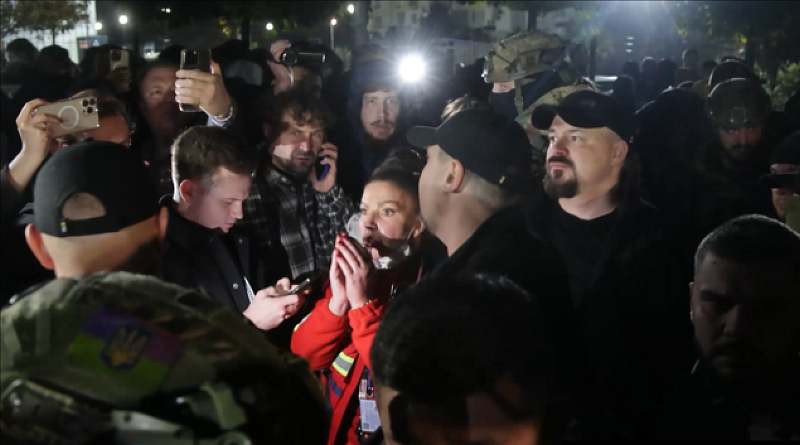
Much has already been said about the disgraceful night events in Petropavlivska Borshchahivka. If you think it was another planned Russian provocation, you’re not mistaken.
Sergiy Hnezdylov reported that the information attack began even the day before when an anonymous source distributed fake information to bloggers about a “torture chamber in Borshchahivka”. The mechanism of such “infodermy” — when disinformation virally and uncontrollably covers the network — was convincingly analyzed by Oleksandr Solonko using the example of Novi Sanzhary in his book “Infodermy: The Weapon of Disinformation in the Viral Age”. At that time, the hostile intervention started four days before the plane with evacuated Ukrainians arrived from China: bots with non-local profiles filled city chats with calls for violence. The Kremlin’s IPSO aimed to stir up protests, undermine trust in state institutions, blacken Ukraine in the eyes of the world, and turn the February Days of Dignity into a discrediting narrative about “savages”.
This refined mechanism has been used more than once. And the place of action often plays a significant role in the plots of Moscow’s “screenwriters”. In the summer of 2026, Sykhiv was chosen as the setting. The mass brawl with the MTC was deliberately planned in this particular district of Lviv, which in the first decade and a half of independence had a negative reputation as a dangerous area for hooligans and street brawls.
A similar reputation in Kyiv in the nineties and early 2000s was held by Borshchahivka (in fact, there are five Borshchahivkas, and the urbanized Southern one, not the rustic Petropavlivska Borshchahivka, was “hooliganish”, but Russian special services don’t dig that deep). There was even a persistent phrase “Borshchahivka hooligans”. In the public imagination, Sykhiv and Borshchahivka were equivalent as criminalized areas where everyone is with “seeds”, “on cards”, and “out of control”.
But this stereotype got stuck in the 2000s when the Russian crime series “Brigada” was shown on TV. Since then, much has changed in Ukraine at the horizontal level of communities. Only the Russian organizers of such provocations, of course, do not know about this. The Russian “IPSO headquarters” still operates with mental maps from twenty years ago, marking areas where marginalized youth can be hired for little money to create a picture for propaganda about a “popular uprising against the military”.
Meanwhile, Sykhiv, Borshchahivkas, and other Ukrainian communities have decolonized and dynamically developed around the ideas of civil society, respect for human dignity, and volunteerism.
Today’s Sykhiv is about active urban and environmental initiatives like the “Better Sykhiv” association. It’s a cultural hub around the Dovzhenko Center and a spiritual one around the Church of the Nativity of the Blessed Virgin Mary, near which Pope John Paul II once spoke. It’s the Heroes’ Square of the Russo-Ukrainian Wars.
Borshchahivka is a space of developed self-reliant condominiums, responsible small businesses, and a conscious middle class. In 2022, a street in Borshchahivka was named after the deceased military journalist Oleksandr Makhov. The local volunteer community “Borshchahivka is Europe” has been conducting cleaning activities and greening projects for years. A number of volunteer centers weave camouflage nets and “chugaisters”, collect Russian books for recycling, and use the funds raised to buy drones for the military.
Post-Soviet stereotypes about “depressive outskirts” remain only in Russian manuals. Trying to find points of social division in Ukrainian society, hostile special services repeatedly run into their own optical blindness.
However, incidents in Sykhiv and Borshchahivka expose a broader issue — the vulnerability of Ukrainian society to media provocations, where any local conflict instantly becomes sensational content for social networks and enemy propaganda. The unprecedented level of trust in Ukraine’s Defense Forces, recorded at the beginning of the full-scale invasion, is now being tested by a prolonged war and fatigue. Investigations of possible misconduct by individual servicemen are often mixed in the information field with undermining trust in the military overall.
Protecting the army’s authority remains a fundamental condition for preserving our statehood. This is precisely the line of connection between society and the army that Russia systematically targets to undermine the country from within, hoping that outdated sociocultural stereotypes will help shake the country from within where weapons have not worked.
On the cover: A woman arriving at a house in a vehicle that looked like an “ambulance”. Petropavlivska Borshchahivka, Kyiv region, November 2, 2026. Photo: Maryan Kushnir/Radio Liberty
Copyright © 2021 RFE/RL, Inc. Reprinted with permission from Radio Free Europe/Radio Liberty
