
The territories of Ukraine occupied by Russia have been recognized as the least free place in the world for the second year in a row, according to a ranking by the American organization Freedom House.
The occupied areas of eastern and southern Ukraine ranked lower than South Sudan, North Korea, and Gaza.
This is not just about the absence of political rights or freedom of speech.
Residents of the occupied territories, according to Freedom House and the UN Human Rights Monitoring Mission in Ukraine, face forced passportization, persecution for pro-Ukrainian positions, secret detentions, deportations, and property confiscations.
At the same time, the Russian authorities are trying to change the demographic and cultural composition of the regions.
“This occupation is one of the most documented systems of repression, oppression, and human rights violations,” says Daniel Bell, head of the UN Monitoring Mission in Ukraine, quoted by Politico.
According to her, it is a “systematic approach to restricting the rights and fundamental freedoms of people.”
According to the mission, since 2022, Russia has implemented at least 16 laws and decrees restricting the rights of Ukrainian citizens in the occupied territories. Schools teach the Russian version of history, and the use of the Ukrainian language or showing sympathy for Ukraine can be considered “extremism.”
At the same time, Russia encourages the relocation of its citizens to the occupied territories.
Journalist Andriy Dikhtyarenko, originally from the currently occupied east of Ukraine, believes that such a policy has “all the signs of cultural genocide.”
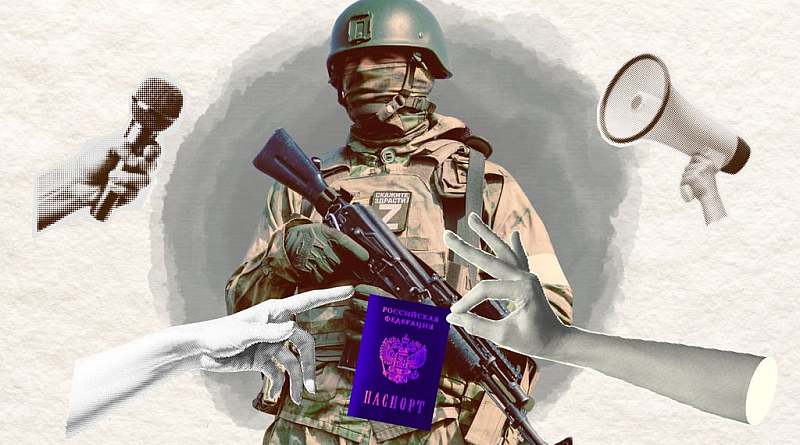
One of the main tools of Russification, according to Politico, is forced passportization. The occupation authorities declare Ukrainians “foreigners” and effectively force them to obtain Russian passports if they want access to medicine, social services, jobs, or property ownership.
One such story was told by Lyudmila Chub from Melitopol. In 2023, her employer informed her that she must obtain a Russian passport or he himself would be fined. At the passport office, Chub recorded a video expressing her outrage at the forced passportization, calling the Russian document a “chicken passport” because of the image of the double-headed eagle.
After that, a guard handed her over to the occupation police. Chub spent eight months in detention in Kherson, after which she was deported to the Russian border with Georgia.
“They attach this passport to you, and then, along with it, make you a traitor to their country,” she told Politico.
According to Chub, other people she met in prison initially received Russian citizenship and later became involved in cases of espionage or treason.
The UN Monitoring Mission documented more than 400 detentions in the occupied territories on charges of espionage and treason. However, it is impossible to determine the exact number of people held without contact with the outside world.
Politico also tells the story of 59-year-old IT specialist Serhiy Hryshchenkov from Sevastopol. According to his daughter Daryna, Russian security forces took the man from his home in May 2025. For a year, the family did not know where he was. The daughter claims that her father was held incommunicado and tortured, and in June 2026, he was charged with treason.
When Hryshchenkov reappeared in the detention center, he told his daughter about other prisoners who had been secretly held for years. “Their relatives don’t even know if they are alive,” Politico reports his words.
Another tool for changing demographics, the authors mention, is the seizure of property from Ukrainians who left the occupied territories.
Russian laws allow abandoned housing to be declared “ownerless,” after which it can be confiscated. The owner may attempt to retain the property only by personally reregistering, and they must be a Russian citizen.
This makes returning home risky for many Ukrainians. Those who try to come to the occupied territories to re-register property may undergo Russian “filtration,” be detained, or banned from entry.
The practice of confiscating housing from Ukrainians in the occupied territories was covered in an investigation by the BBC.
BBC Verify journalists analyzed hundreds of documents and data from the occupied parts of Donetsk, Luhansk, Zaporizhzhia, and Kherson regions and established that at least 34,002 housing objects of Ukrainian citizens have been confiscated or marked for confiscation since 2024.
Where Russia Seizes Ukrainian Housing
(Map with confiscated property. Four occupied regions)

This involves apartments, houses, and summer homes of people forced to leave due to the war. The occupation authorities declare such housing “ownerless” if the owner has not personally re-registered according to Russian rules.
After that, the property can be transferred to people with Russian passports. Thus, for many Ukrainians, the loss of a home becomes twofold: initially, they leave because of the war, only to find later that there is nowhere to return.
The BBC also spoke with Ukrainians who tried to keep their homes or return to the occupied territories. For them, it’s not just the loss of property: with the apartment or house, they lose family memories, a sense of security, and the perspective of returning.
The investigation showed that the seizure of property is not isolated but a systematic policy of the Russian occupation authorities, which simultaneously alters the population composition of the seized territories.
Journalist Olena, who left occupied Donetsk in 2014, told Politico that for 12 years she continued to pay utilities for her apartment and her parents’, hoping to return. Later, she learned that the occupation authorities had placed her on a public list of “enemies.”
“With this new law, nothing can help us anymore,” she said.
According to the UN Monitoring Mission, as of July, more than 60,000 private real estate properties in the occupied territories of Ukraine have already been recognized as “ownerless.” At least 6,500 of them have been confiscated. Some have been transferred to veterans of the Russian army or sold to Russian citizens on preferential terms.
Politico pays particular attention to education. In the occupied territories, Russian educational programs are being introduced that convey the Kremlin’s version of history to children. Parents are being discouraged from Ukrainian education with fines and threats of parental rights deprivation.
Additionally, the Russian education system may become a path to service in the Russian army. After obtaining a Russian passport, residents of the occupied territories may be drafted into the Russian armed forces and sent to fight against Ukraine.
Journalist Dikhtyarenko believes that the combination of all these measures gradually erases the possibility of openly demonstrating Ukrainian identity.
“People who want to survive are forced to accept the rules of the game,” he says.
At the same time, the journalist emphasizes: even despite forced passportization, many residents of the occupied territories continue to keep their Ukrainian passports. They hide them under the floorboards or bury them in the garden, hoping that one day they will be able to return to the Ukrainian legal framework.
“It’s their little ticket to freedom,” said Dikhtyarenko.
