
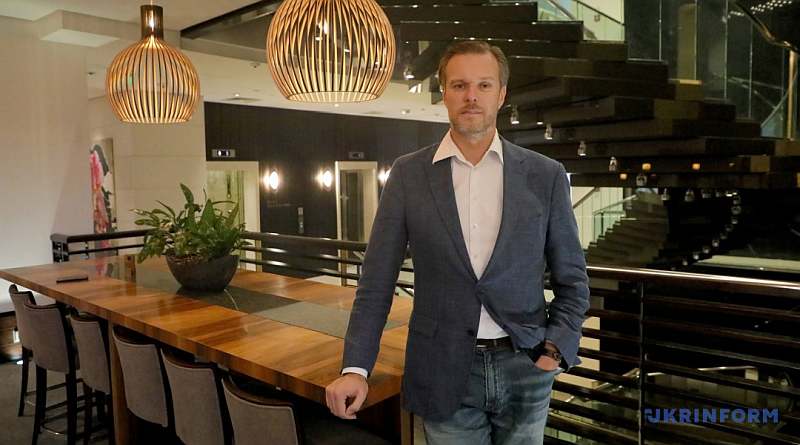
Lithuanian politician, former member of the European Parliament and former Foreign Minister of Lithuania Gabrielius Landsbergis remains one of the prominent European voices supporting Ukraine and countering Russian aggression. He consistently emphasizes that the cessation of hostilities does not mean the end of the Russia-Ukraine war.
This time, Landsbergis came to Kyiv to participate in the Yalta European Strategy (YES) conference, dedicated to Ukraine’s future, European security, and changes in the international order.
In an interview with Ukrinform, he spoke about the prospects of diplomatic resolution of the war, Europe’s readiness to take greater responsibility for its security, and Ukraine’s place within it.
RUSSIAN ESCALATION OF THE WAR ALREADY AFFECTS EUROPE
– Mr. Landsbergis, you have come to Kyiv at a time when diplomatic efforts to end the war are being revitalized. What do you see as the real prospects for negotiations between Ukraine and Russia now? Is there any reason to believe that Moscow is truly ready to end the war?
– There are no signs of Moscow’s readiness. We must understand that one person makes decisions – Putin. And it has always been so.
For him, defeat in this war means a loss, possibly even of his own life.
Therefore, the only path he sees and is shown is escalation.
We in Europe still expect escalation to happen sometime in the future, but I think it is already occurring. Thus, I am not too optimistic about whether Russia is ready to change course at this time.
– President Zelensky stated that after recent contacts with US representatives, new ideas about a possible peace process have emerged. What do you think is currently the biggest problem with the American diplomatic strategy regarding Russia and Ukraine?
– Such a strategy has been repeatedly tested in previous historical moments: large states believed they could pressure a smaller country, the victim, to stop the war. This is called appeasement. That is, similar things have happened and have not produced significant results.
The only way to convince Putin that this war is a dead end for him is to exert maximum pressure. And unfortunately, there are no signs that the United States is ready to do this.
At the same time, we, Europeans and Western representatives, must show, just as Ukraine does, that we will not concede, will not tolerate what Putin began in 2014 and continued with a full-scale invasion.
CHANGING THE DEFENSE CONCEPT BUILT ON TRANSATLANTIC BELONGING IS CHALLENGING
– If the United States indeed insists on a quick ceasefire, is Europe capable of preventing an agreement that would benefit Russia but only provide Ukraine with a pause before a new war?
– I was pleasantly surprised when the European Union stated: if it comes to an imposed agreement regarding Ukraine – for example, pressure from the USA to officially recognize the occupied territories – Europe will not do it.
This was a good signal.
But unfortunately, the very fact that we see European security differently today indicates a split in the transatlantic alliance.
Europe views Ukraine as a significant part of its own security and is sending Putin a signal: look, even if you can make a deal with Washington in the “spirit of Anchorage,” it doesn’t mean the Europeans will agree to it. At least in words, it looks good.
I am quite critical of Europe. And not without reason. But when it comes to helping Ukraine, I can assume that many – both in Moscow and possibly in Washington – believed that the cessation of American aid would make Europe reconsider its position. But this did not happen. So we are still looking for a way to continue supporting Ukraine.
– Earlier you mentioned that Europe needs to learn to act as if the USA might be absent. How far has Europe progressed in this over the past year?
– It’s very complicated. Currently, Europe is dealing with a huge number of problems. On one hand, we have the issue of Russia, which Europeans handled at a distance but together with the Americans – starting from 2008 in Georgia, 2014 in Crimea and eastern Ukraine, and so on.
And now suddenly, we are most likely going to have to acknowledge that we are at war ourselves.
Add to this the Chinese shock for Germany and other countries.
That is, Europe is under attack from all sides. And it was completely unprepared for this.
In Europe, of course, a certain strategic awakening has occurred – we see its elements here and there. But the problem is that Europe needs to rethink itself: what it is and how it functions. Using a well-known phrase, it can be said that Europe is now “building a plane during flight.”
– Do you see real signs today of forming European strategic autonomy in the field of defense?
– Yes, to some extent. I would say there are individual elements. But if we talk about Europe as a whole, then probably not.
At the European level, nothing truly strategic is happening. If you take, for example, Spain – there, they don’t even discuss defense spending over 2% of GDP. Instead, the situation is completely different in the Northern countries, the Baltics, or Poland.
We are even thinking about how to defend against Russian threats without the United States. But this is an incredibly complex discussion in our countries because the entire concept of defense in Northern and Eastern Europe was based on our transatlantic affiliation.
– You mean Article 5 of NATO?
– Exactly. We didn’t have to think about all the things Ukraine does because we have the strongest ally in the world and an agreement that if we are attacked, they will come to our aid.
And it’s not just a cornerstone, but the foundation on which our countries are built. So when you ask a politician, a political scientist, or anyone in our countries – what happens if the Americans are no longer interested in helping us or are busy with some other war – people really don’t have an answer.
Moreover, since the situation is unclear, they’re not even ready to discuss it publicly due to fear that the very discussion might hasten the Americans’ departure.
Usually, when I communicate with representatives of my country and others, I advise this: it’s not worth discussing it publicly, but it’s essential to prepare. After all, there may be a situation—and the Russians likely already have the appropriate plans—where we find ourselves in a very difficult position.
UKRAINE HAS A DOCTRINAL UNDERSTANDING OF DRONE WARFARE
– In your opinion, what should be Ukraine’s role in the European security system after the active phase of the war ends? Can Ukraine not only be part of it but also one of the key security centers?
– This is a very good question. And my opinion is this: naturally, Ukraine has long aspired to join NATO, to become part of this community of countries that seemed stronger in military, financial, economic, and other aspects. But this is changing.
When I look at European readiness, I believe that Ukraine is the most prepared country for 21st-century warfare.
We may currently have more F-35s, ammunition, and so on, but I don’t think we are ready to acknowledge the fact that warfare has changed.
– Why?..
– Because we mistakenly believe that if the Russians attacked a Baltic state, Poland, or Finland, we would see something similar to the march on Kyiv at the beginning of 2022: columns of tanks moving to the capital of one of the European NATO countries.
– The war of 2022 and the war of 2026 are already two different wars.
– So, most likely, we would have thousands of drones flying over us, cutting off electricity, internet, heating, water, and then simply presenting us with demands to change our position.
Indeed, the appearance of even a single drone now can paralyze life in our countries.
Ukraine has the necessary knowledge, experience, and capability to counter this. Some people come to Ukraine, buy drones, take them home, and say, “We are ready for drone warfare.” However, when it comes to real training or combat application, it turns out they actually have no idea how it works, where to place them, how to plan operations, etc.
Ukraine has a doctrinal understanding of drone warfare. Europe does not. So, in my opinion, your country becomes a central point for European defense, at least for our region.
– In a previous interview with Ukrinform, you spoke about the possibility of a regional security alliance involving Ukraine, the Baltic countries, Poland, and Northern Europe. Do you consider this idea realistic today? Which countries could be the first to join such a format?
– I consider it entirely realistic. Among the countries that could join are the Baltic and Scandinavian states; depending on the format, I think Great Britain and Germany would be interested; of course, Poland and probably Romania.
Currently, in Europe, there is an example—the Joint Expeditionary Force (JEF) led by Great Britain, which to some extent has positioned itself as an immediate crisis response force in the northern part of NATO. This has allowed Great Britain to maintain its presence and a somewhat more active role, despite protection under the “American security umbrella.”
On the other hand, this hasn’t undermined NATO, because essentially, NATO works, Article 5 exists. But it takes time to make decisions, convince everyone, figure out who is coming and how quickly. Thus, a parallel track was agreed upon.
Now imagine a Ukraine-led structure where countries would agree to jointly prepare for 21st-century drone warfare. This is a path parallel to NATO, based on the experience of drone warfare and Ukrainian doctrines. This means that the issue of joining NATO is not as pressing. Instead, it integrates Ukraine into a regional security system.
We need Ukrainian knowledge and experience, as well as an understanding of how to defend against drone invasions and similar threats.
And I am confident that we can offer Ukraine a lot in return. We have industries that can be expanded to supply Ukraine with what it needs. We have training grounds and much more for which our countries could be thankful for the help that Ukraine provides.
So it changes the logic a bit. Instead of waiting, Ukraine can become a leader in this. And I am quite sure that many countries will be ready to follow her.
EUROPEAN COMPANIES HAVE CAPITAL AND ARE LOOKING FOR INVESTMENT OPPORTUNITIES IN DEFENSE
– Ukraine has effectively become one of Europe’s main centers of military innovation – from drones and robotic systems to the combat use of artificial intelligence. From your perspective, what specific technologies or approaches from the Ukrainian experience should Europe adopt most quickly to change and strengthen its own defense capabilities?
– I think the first thing we need is radars and detection systems. I know that Ukraine has not yet perfected this, as it is an active battlefield where new technologies constantly emerge.
For example, reactive drones that are now terrorizing Ukraine. They are much harder to detect and eliminate. So I understand this is a constantly evolving process. But Europe has not yet reached the level of detection that Ukraine currently possesses.
Secondly, perhaps it’s not about technology but about doctrine.
After all, some things Europeans can develop on their own – they successfully develop their technologies, test them in Ukraine, and Ukraine already uses them against Russians.
I am convinced that Europe is an industrial powerhouse, and you have engineers and people capable of designing and building. Currently, half of my country consists of military experts at a certain level. We may have good ideas, but we are nowhere near where Ukrainian specialists are with their daily knowledge of what is relevant now and what no longer works.
Over time, there may be deep integration of the Ukrainian defense industry with European military production. I know that some of this is already being implemented, but it is still at early stages.
European companies have capital and are looking for investment opportunities. This includes, in particular, the merging of Ukrainian and European companies to increase potential and develop existing capacities. That is, combining the experience of our and your engineers using European funds.
Currently, most processes are initiated “from above” and funded by Europe or governments. At the same time, there is significant interest from the private sector. The question is how to carry out this integration not only at the company level but also at the level of understanding the defense sector itself.
RUSSIANS ARE EVIL, BUT THEY ARE NOT FOOLS
– Lithuania is significantly increasing its defense spending and strengthening its own armed forces today. What specific threat from Russia do you consider most underestimated by the Baltic countries and Europe?
– It’s what we call hybrid threats. I don’t like this term. Honestly, it is essentially just a cover for our inability to respond.
Whatever happens, we call it a hybrid threat. The Russians escalate. It used to be very simple things – like spray-painting Russian slogans on some wall – and we called it a hybrid threat. Now they launch a drone at a German airport, and on our side, nothing changes.
I’m worried that we don’t know where this will end. Next time, people will die, a power plant will explode, and we will continue to call it a hybrid threat. And this can go on until we lose the war. So, this is one of the biggest problems.
The thing is, the Kremlin has learned quite well to come up with new scenarios while we prepare for what the Russians have already done and expect them to do it again.
– What exactly do you mean by new Russian threats?
– Russia has already accused the Baltic states of allowing Ukraine to carry out attacks on St. Petersburg and other cities. Obviously, this is disinformation, but it’s a good excuse for Moscow to take some active measures.
One of the scenarios: using this as an information pretext, Russia declares a certain territory of Lithuania and Poland a “quarantine zone” because the Russians are allegedly concerned that Ukrainians are building something there and threatening Russia, Kaliningrad, and so on. This means we can’t use this territory, NATO can’t use it, we can’t fly there, train – as if we lost it.
The Russians don’t even need to threaten us with weapons – they can just declare it, say through Peskov.
We need to expose this bluff. We need to take the best tanks we have and just drive through this so-called quarantine zone because it’s our territory. But they will hope that we get scared, that we’ll call our American friends and say: please, bring your Bradleys and Abrams and just drive there. And the Americans will say: well, we’re unfortunately busy in Iran. Then we call the Germans and say: can you do this? And the Germans say: well, it sounds like a good idea, but we’re not sure if now is the best time for this.
And we can’t ask you, Ukrainians, for help because then the Russians will say: well, see, we thought so.
This is just one of the scenarios, Russians can come up with thousands. They will test us, pressure us, break alliances, and force us not to ask for help from others. And this is very alarming.
I heard a phrase at a conference: “Russians are evil, but they are not fools.” Actually, I’ve heard similar thoughts in different forms throughout my trip to Kyiv: people hate Russians, but they should not be underestimated.
EUROPE STILL LACKS A CONCEPT TO WITHSTAND RUSSIAN POLITICAL BLACKMAIL
– Russia is increasingly using historical narratives and propaganda, trying to influence the societies of European countries. Do you see a dangerous change in attitudes towards Russia in certain EU countries, and how successful is Moscow in creating fatigue from Ukraine?
– One of the attempts we are currently seeing is related to this shadow war. It works like this: you put pressure on a European state – it could be a large country like Germany – you increase the pressure. Your train derails, drones appear at airports, cyberattacks happen. Of course, it’s not like in Ukraine, but people start to worry and get outraged: what’s going on? And then a populist party appears and says: well, we can explain why you’re in this situation…
– Let me guess: Ukraine is to blame for everything?..
– You’re right. Populists build their logic like this: the only thing needed for all this to stop is to stop helping Ukraine. And then Peskov comes out again and says: this is a very good idea, we in Moscow completely support this message.
And then you see that in one of the regions, 44% vote for this populist party, and you think: are we sure this isn’t resonating? And, again, as I said before, are we considering the level of escalation this might reach?
Imagine not one drone at one airport, but a hundred drones at hundreds of airports. Imagine a country like mine under a massive attack when it’s very difficult for us to cope. And then a phone call from Moscow: listen, do you want this to end – we can offer you a way to stop it.
I think the concept of how to deal with this hasn’t been thought out. I don’t have the feeling that we have what it takes at this stage to resist and say: we will fight, we will inflict losses on you.
– Europe continues to discuss new sanctions against Russia, but you previously noted that actual sanctions measures are much weaker than political rhetoric. Does the EU need a fundamentally new sanctions strategy, and what should be its toughest component?
– I am very pessimistic about this issue. Honestly, I don’t think that Europe is capable of mustering the strength to further adopt significant sanction packages, because the interests are now very divergent.
Almost all countries, except certain groups – like the Scandinavian and Baltic states – have different views on how to act on this issue in the future. This means that even if something is brought forward for discussion, it will most likely mean having to give up something else. We have probably reached the limits of what was possible.
But if we talk about another strategy… Ukraine has well demonstrated its so-called long-range kinetic sanctions. I’m not saying that Europe should start striking deep into Russia, but there are things we can do, right? For example, closing the Baltic Sea to the shadow fleet, informing Russia that this is the end and it will no longer be used for oil exports. That’s also sanctions. And when Italy, France, or Germany stop Russia’s shadow fleet ships, it’s good. But let’s not forget that a thousand other ships are waiting their turn.
THE GREATEST SECURITY GUARANTEE FOR UKRAINE IS AND WILL BE LONG-RANGE WEAPONS
– If the war ends with an agreement that doesn’t include Ukraine’s NATO membership in the near future, what security guarantees could realistically deter Russia from a repeat attack? And are European states ready to take on such commitments?
– I believe that the greatest security guarantee Ukraine has today and will have in the future is long-range drones, equipment, and ballistic missiles that are currently being developed.
Ukraine has increased its production from several thousand drones per year to almost 10 million. So imagine 100 million drones and ten times the ability to strike.
Add to this ballistics. Also needed are good guidance systems, satellites, and the like—to reach a point where, with or without allies, Ukraine can tell Putin: look, even if you try next time, you’ll have no industry left. Everything will disappear on the first day.
Honestly, it’s not very pleasant for me to admit, but there is no other country that could do this—only Ukraine. And we, the West, are capable of helping Ukraine achieve this.
We can adopt the Ukrainian experience and create a similar system for ourselves, so that Lithuania, although not as large as Ukraine, has its own version of this system, and Estonia and all other Russian neighbors have theirs. That is, we are armed to the teeth, with a finger on the button. And then we can also tell Putin: if you try to attack us, we won’t ask for help from Washington, we’ll just press the button—and you’ll be in trouble.
This is deterrence—a sovereign power.
– You often talk about historical lessons for Europe. In your opinion, what is the main lesson of this war for the European Union itself? What should the EU change right now in its foreign and security policy to prevent the next war in Europe?
– I don’t think Europe is preventing the next war. It is heading for the next war.
And unfortunately, I believe that Europe will be reformed by what comes next—simply because reality will force us to change.
Right now, we are trying to avoid this, essentially postpone it, hoping we have time to build enough. But when I look at the past, I see how people already tried to appease Nazi Germany. And what came of it?
The same with Stalin, right? How to appease him, how to make him happy when in 1939 he had 1.2 million troops in Poland? We couldn’t do anything about it. So aren’t we in the same situation?
Now we believe that we can somehow deal with Putin, mistakenly thinking he will stop at Ukraine. And then he mobilizes two or three million people and throws them at Europe. And we’ll say: “Well, that’s… unexpected.” And there will be nothing we can do. Although we had plenty of years to stop him, to help Ukraine.
I am somewhat pessimistic. But in general, I am convinced that Russia will lose this war. The only question is when and where exactly they will be forced to admit defeat. Can they be forced to lose where they are now—near Kharkiv? That would be the best option. Or could they lose near Vilnius, Warsaw? Or even Berlin? The answer to this question is still unknown.
Photo: Yuliia Ovsiannikova / Ukrinform
