
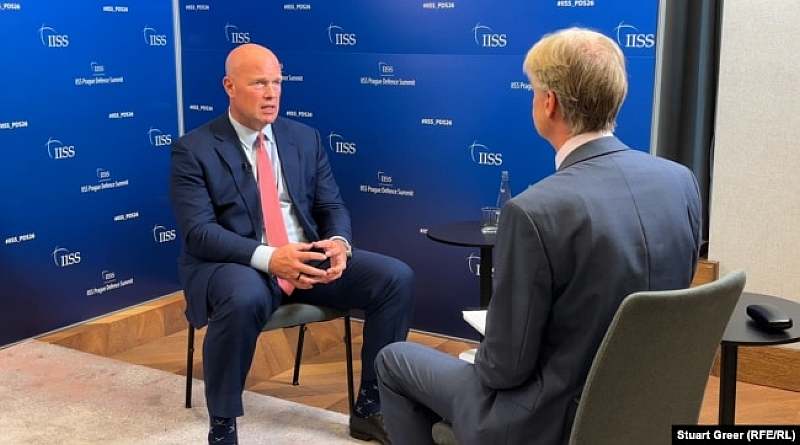
The shortage of missiles for Patriot, prospects for their production in Ukraine, Russian hybrid attacks on NATO countries, and a possible American military base in Poland – Radio Liberty discussed this on September 18 with the permanent representative of the United States to NATO, Matthew Whitaker.
In the interview, Whitaker explained what most limits the supply of interceptors to Ukraine, the current stage of negotiations on licensed production of Patriot missiles, and under what circumstances a hybrid attack could raise the issue of invoking Article 5 of NATO.
– President Zelensky stated that Ukraine needs about 300 PAC-3 interceptors to get through the winter. What do you think, how many can Kyiv realistically expect by the end of the year?
– I am working with all our allies to find available Patriot missiles that could be transferred or sold to the Ukrainians.
We are very actively working through the PURL initiative, which also provides Ukraine with Patriot missiles – PAC-3 interceptors.
Ultimately, the solution involves a combination of several things: increasing production capacity both in the United States and in Europe. I am also working on joint production opportunities – with Ukrainians and with our NATO allies.
At the same time, we are looking more broadly at integrated air and missile defense. I think there needs to be a certain combination of all this.
Obviously, Ukrainians are also working very actively – in addition to everything we are doing regarding Patriot – to create their own capabilities, their own interceptors. Based on what I saw six weeks ago when I was in Ukraine, I think there are certain possibilities there.
The demand exceeds supply, and we will really need to dig deeper – as the United States, but more importantly, allies – and find a way for Ukraine to protect itself in the winter.
– But where do you think the main limitation is? In insufficient contributions to PURL?
– No.
– … In depleted reserves? Or is the problem something else?
– In production capacity. Obviously, this leads to available reserves being insufficient for the current world situation.
I think even more important is the global security environment we are in: the world has become more dangerous. We have been telling our allies this essentially since President Trump was re-elected.
That is why we agreed on the Hague Commitment to Defense Spending at 5% (at the NATO summit in the Netherlands in 2025 – ed.). That is why I am trying to stimulate transatlantic cooperation in the defense industry and increasing production capacities.
In two years, we will be in a much better position when all these initiatives start to yield results: the important work being done by the Pentagon, our work with Ukraine, and work with our NATO allies.
Today, I met here with the Prime Minister, and one of the topics we discussed was the idea of joint production of Patriot missiles in the Czech Republic.
That is, everyone is ready to invest, ready to make deals. However, such things are not created overnight. It’s not like cutting down a tree and shipping it off.
– Regarding Ukrainian-American cooperation that you talked about today: at what stage is the issue of licensing Ukraine to produce Patriot interceptors?
– We are currently working out all the complex details regarding export licenses, companies holding intellectual property rights, and how exactly this might look in practice.
But this will not solve the problem this winter. It will solve it in the long term. And again: I think in a few years, we will be in a much better position.
These missiles are very specialized, their production takes time – homing heads and all other components. But missile defense is important. It is important for every ally, and I think the competition that this stimulates is good.
– We heard the statement by Polish Prime Minister Donald Tusk that Russia is preparing drone and missile strikes on European countries that support Ukraine. Does this correspond to the intelligence information you have?
– I cannot disclose intelligence information. But I know for sure that we are seeing an increasingly aggressive Russia, taking more and more risks on the battlefield in Ukraine.
We are also in conditions of increasingly intense electronic warfare, which, among other things, causes drones to go off course and need to be intercepted by NATO air patrols. Recently, this has worked quite effectively in Romania, the Baltic countries, and Poland.
What exactly Russia intends to do is, of course, somewhat subjective. And again, I cannot speak about U.S. or allied intelligence information.
But we need to be more vigilant, we need to be better prepared. I think we have been doing quite well so far, but as such activity intensifies, we need more capable allies.
And one of the things I am urging our allies to do is invest more in counter-drone capabilities. Such systems are available. This is not the same as PAC-3 MSE missiles.
Counter-drone systems can be purchased in the United States, Ukraine, and many other suppliers in Europe.
So, I believe that in the short term, our allies need to think not only about acquiring and deploying such systems but also about how to apply them in non-warfare situations, in a civilian environment – because these are the situations we often face.
– Do you consider NATO’s response to Russia’s hybrid warfare in Alliance countries decisive enough?
– Yes, because first and foremost, it is a response on a national level.
Did you see what happened in Leipzig with the drones at the airport, responsibility for which the German side placed on Russia? The investigation was undoubtedly aided and supported by allies with the relevant capabilities, knowledge, or experience. But we also saw Germany’s national response.
I was just talking about this today at the conference.
NATO has its role – especially in information sharing, as a platform that helps ensure we all understand the situation the same way. And this is one of the things I work on daily as the United States representative to NATO.
But ultimately, especially when it comes to hybrid activity below the Article 5 threshold, that is, not requiring a NATO response, the response will primarily be national.
– What if a hybrid attack leads to the application of Article 5?
– We’ll cross that bridge when we come to it. I do not consider hypothetical scenarios, so we’ll see what the specific situation will be.
I assume that if we get close to invoking Article 5 at all, it would involve a catastrophic hybrid attack, which would essentially constitute an act of war. But we are not there yet.
– US President Trump indicated that there is progress on the matter of establishing a permanent American military base in Poland. Can you elaborate?
– I saw President Trump’s post on Truth Social. Clearly, the Poles are very interested in hosting American troops.
Traveling to Alliance countries, I often hear how important the presence of American troops is for deterrence and defense throughout the Alliance – American flags on soldiers’ shoulders.
But at the same time, we are working to make our allies stronger and more capable, so that their soldiers with their flags can also ensure deterrence. I consider achieving such a balance important.
The United States is undoubtedly working very closely with our allies, and we appreciate everything Poland is doing to invest in its own defense. I think this makes the entire Alliance stronger.
They are clearly aware and take seriously the challenges and threats they face on the eastern flank. And we expect the same seriousness and clear focus on building up one’s capabilities from all NATO allies.
– Okay, so there are no concrete details about the base. But how does this accord with the overall review of the US military presence in Europe?
– Everything is interconnected. Ultimately, the force and basing review currently underway is directly related to this.
The main question now is how we are deployed in Europe: are our bases sufficient, access to them, basing capabilities, and overflight rights. And we are having such negotiations with our allies bilaterally.
I think we are in a good position, but I have nothing specific to report at this time.
On the cover: U.S. Permanent Representative to NATO Matthew Whitaker gives an interview to Radio Free Europe’s correspondent Ray Furlong in Prague, Czech Republic, September 18, 2026. Photo: Radio Free Europe
Copyright © 2021 RFE/RL, Inc. Reprinted with permission from Radio Free Europe / Radio Liberty
