
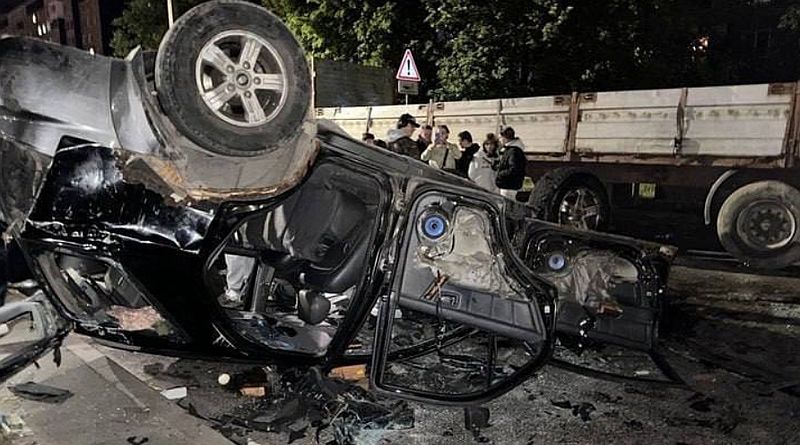
The authorities have managed this task. It was a difficult task: with such an initial level of trust, such solidarity, such involvement in the war by practically every family, to contrive to undermine the nationwide support for the military—it took some effort. The recent attack on the military in Lviv is not the first manifestation of the crisis, but it is overly obvious, the clearest it can be.
At all times, in every state, war is the highest priority, especially when it comes to a fight for life or death. There can be no other tasks for a nation if it faces annihilation. And that this is not an exaggeration, we have had the chance to confirm almost daily. If someone still (!) does not believe it, let them take a trip to Bucha or talk with our people who managed to miraculously break free from the “liberators.”
All words have been said, all thoughts expressed, it remains to repeat them concisely.
In four years and four and a half months, the defense of Ukraine has not become the number one issue for all citizens. Essentially, we live in two countries at once:
- in one, there is war;
- the other pretends it does not concern them.
Country-2 looks good: glamorous cafes, packed fitness centers, motorcycles with loud mufflers, and a full house in Bukovel. Country-2 is not overly concerned with the trials of Country-1: at best, it buys its way out with donations, at worst, it engages in sabotage. What unites these countries are the shellings: rockets do not distinguish between patriots and evaders.
- Both active military personnel and veterans face disdain and powerlessness despite the loud emotional statements from the authorities and command. A soldier’s life hasn’t become, and won’t soon become, the highest value—forget about “Saving Private Ryan.” Essentially, their fate depends not on clearly established rules, but on how adequate their commander is or how humane the official they encounter is. A recent scandal in the renowned assault regiment effectively showed that instances of abuse of power and violence towards the personnel—whether isolated exceptions or hidden routine—are still not the focus of army command. The overdue and half-hearted reform, particularly regarding pay and infantry service terms announced from July 1, has not yet reached the “front line.” For now, a soldier remains an expendable resource.
- Certain officials and businesses affiliated with them view war as a favorable circumstance for further enrichment. Monumental manifestations of corruption are frightening not in themselves—corruption exists in most countries. However, recent revelations suggest that the system continues to engage people with skewed motivations by inertia, and correcting these practices requires not only specialized bodies but also the political will of leaders. The state’s leadership, known for its charisma, could announce a reset but prefers to ignore the problem altogether and focus on what it believes it does best.
- The state engages in activities at various levels and branches that, in ordinary times, would deserve all respect and support, but here and now, it sends citizens a clear signal: we are in Country-2, where one can abandon everything to undertake a major repair of a city park sidewalk or adopt a civil code while the war is somewhere far away. There is no sense that planting junipers of the “Prince of Wales” variety and Chinese miscanthus at 600 hryvnias per plant today, as well as introducing the legal category of “decency,” is immoral. And the permissibility of this is broadcasted to the broad masses.
- Against the backdrop of noticeable activities by Moscow agents and remnants of the “fifth column,” the authorities allow themselves to settle scores with the opposition, doing so demonstratively with violations of existing legislation. The search for internal enemies occurs clearly not in the right place and has a questionable educational effect.
- The delay in organizing mobilization is the most vulnerable point of the authorities’ activities during the entire great war, to say nothing of the carelessness beforehand. Why the state’s top leadership dragged its feet for so long—whether due to neglecting threats, ineptitude, indecisiveness, or unwillingness to scare off the electorate ahead of hypothetical elections—will be analyzed later. Strange steps like allowing young people under 24 to travel abroad have not added any gratitude to the Verkhovna Rada or the government from the citizens. They only reinforced the notion of Country-2.
- There is a demand in society for extraordinary stringent measures from the state. If they were implemented timely and comprehensively, it would only strengthen the authorities’ authority (as a conditional mood). Were there not enough powers? You have a whole parliament at your disposal. Passivity where decisiveness was required reinforces among the masses a conscious or subconscious feeling that the authorities, pardon me, lack courage.
- The state’s information policy leaves much to be desired. Amidst the sluggish, smooth “marathon,” almost daily video addresses by the Supreme Commander are exactly what’s needed, something he is remarkably adept at. However, in the general context…
they paradoxically undermine the prestige of authority: at this stage, society would prefer not a skilled diplomat and talented publicist, but a strict and effective administrator who would not comment on problems but solve them as they arise.
Country-2 was allowed to live as it pleased, ignoring Country-1 entirely. Each real reminder of the mortal danger only intensifies the rejection. The army and police are perceived as real enemies not only because of the direct threat of ending up in Country-1 but also due to the uncomfortable reminder that Country-1 exists. This is not a crisis; the crisis was yesterday; this is a catastrophe. It’s worse than betrayal; it’s irresponsibility.
From history, we know that instances where an entire country united “as one” in the face of aggression were rare and atypical. During World War II, warlike France surrendered to the mercy of a temporary victor and continued to exist as directly occupied territories and the puppet regime of Vichy. The number of French people involved in the resistance movement, at its peak, did not exceed 2% of the entire population. Britain demonstrated grand examples of societal mobilization. However, we know that just before the war, tens of thousands of local fascists were urging to make peace with Hitler. They were dealt with radically, but the suspicion remains that in case of occupation, there would be no shortage of “waiters” among the British.
Collaborators and the passive “masses” were everywhere and always. The idealization of national unity by the victors, in hindsight, is left to the conscience of propaganda. Compared to historical precedents, the current Ukrainian solidarity is extremely high and would be even higher if it weren’t undermined by the clumsy actions of its own authorities. Those Ukrainians who define the face of the country today genuinely demonstrate exemplars of bravery to the world, and this is not just an impressive phrase, but a consummate fact. Hoping that the government—central, regional, local, executive, legislative, judicial—will recognize the societal catastrophe and propose effective measures for rectification is naïve.
Are there ways to unite a Country-1, already exhausted and traumatized in every sense, or is it possible to give it a reserve of vigor, to make it dictate the agenda? This question is too abstract under the current conditions. I would not dare to speculate on ways to preserve societal health, let alone treat the state mechanism. However, a sober, ruthless awareness of the point we have all reached should be the first step in such treatment.
But if we are to appeal to historical experience, I would hint that in all the countries involved in World War II, both totalitarian and democratic, even the smallest manifestations of desertion and sabotage were punished with full severity. I do not call for lawlessness, God forbid, I merely remind of the once-current standards of behavior at the brink of death.
On the cover: On July 8 in Lviv, civilians attacked servicemen of the TCC. Photo: Suspilne Lviv
