

Glory to Ukraine!
Glory to the defenders of Ukraine and the entire modern civilization!
- The president caused a scandal with a journalist during an interview
- Another defeat for the 47th president in court
- War with Iran: can an agreement be reached?
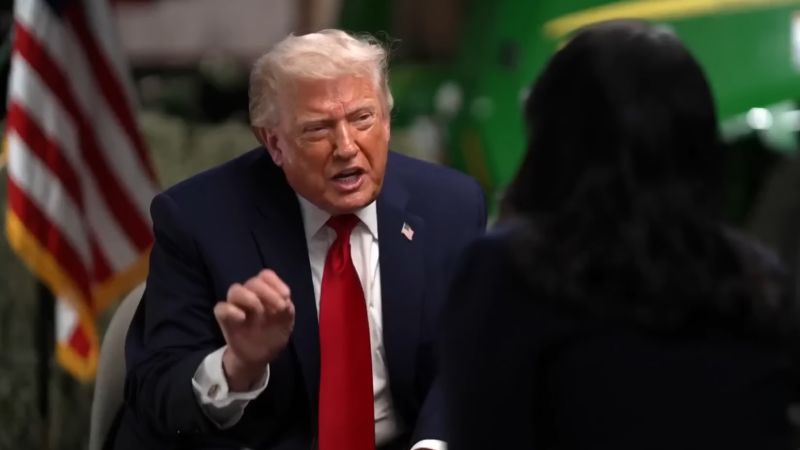
▶ Last Friday, the 47th president was in Wisconsin, where he spoke to farmers. Kristen Welker, host of the author’s Sunday program “Meet the Press” on NBC, arranged to record an interview with the president for her program during his stay in Wisconsin. The program airs on Sunday. This past Sunday, it aired as usual. Viewers saw a very angry, furious person pouring out a stream of consciousness. The president’s irritation and fury grew with each question and literally every word spoken by Kristen Welker. Because Trump was annoyed by questions about any of his actions, their compliance with the law, why his actions were contrary to his campaign promises, any polite but clearly formulated remark by the highly professional journalist that any statement by the president was not supported by facts.
Trump defended his fund for compensations to “victims of Sleepy Joe’s repressions” and did not hide that the idea of the fund was payments to participants in the storming of the Capitol on January 6, 2021. He claimed that participants in this rebellion were directed to attack police officers by FBI agents. He repeatedly called the police officers and prosecutors and investigators who investigated the attempted coup “dirty cops.” He claimed that the idea of his fund “is supported by many Republicans” (this is not true – many Republican members of Congress have condemned the very idea of creating such a fund, and none of them have supported it). He said he would be upset if the fund did not operate (any further actions to create it have been blocked by the court, and Acting Attorney General Todd Blanche, officially nominated by Trump on Monday for Senate confirmation on a permanent basis, stated that the fund would not exist, that it is closed).
The president was angry, his face, thickly covered with makeup, increasingly distorted by a malicious grimace. His irritation reached its peak when he talked about the elections in California being falsified because there couldn’t be such a situation where it takes five days to count votes, and that all elections in California are rigged.
In fact, in California, a significant majority of voters vote by mail. Election commissions accept ballots sent by mail before the elections. The opening of envelopes with mail-in ballots begins after polling stations close on election day. Since California is the most populous state in the country (with about 40 million people), election commissions need to open 10-15 million envelopes with ballots, verify the authenticity of all ballots, and only after this verification, scan them. This process always takes several days. This has been the case in California for many years. Neither Republicans nor Democrats have ever complained about this system. There has never been a single such case. Nor have there been any challenges to election results in court.
However, the 47th president declared that elections in California are “always rigged.” Kirsten Welker objected, saying there was no evidence to support the president’s words. To which Trump responded that her channel NBC, as well as CNN, ABC, and CBS, are “fake news,” and that she is either a fraudster or foolish. After repeating his tirades several times, the president said he was ending the interview, dropped the microphone on the floor, said a few more words to the journalist, then stood up, stomped on the microphone, and left.
In principle, it’s clear that by making such statements, the 47th president is preparing for the Congressional elections, which will take place on November 3. Any election that he and the Republicans lose is “stolen” and “rigged” for him. And these are exactly the kinds of statements we’ll hear from him after the elections in the event of a Republican defeat. If he limits himself to just statements, then, as they say, let him amuse himself…
▶ On Monday, the 47th president suffered another painful defeat in court. A federal judge in Boston, on the lawsuit filed by the Massachusetts Attorney General, joined by attorneys general from other “blue,” Democratic states (the lawsuit was filed in December 2025), ruled that the $100,000 fee for an H1B visa established by the 47th president, granting the right to work in the USA, is illegal. The judge ruled that this fee is essentially a tax, and taxes can only be established by Congress. Furthermore, such a fee contradicts immigration law, which also can only be changed by Congress.
▶ On Monday, speaking to reporters at the airplane’s stairs, Trump announced that an agreement with Iran would be reached in 2-3 days (once again!), and “if you want the truth, it might even be reached in an hour.”
On Tuesday, Iran shot down an American Apache attack helicopter over the Strait of Hormuz. The helicopter was either deliberately shot down by an Iranian drone or collided with an Iranian drone. Two pilots survived and were evacuated using a marine drone. On Tuesday, the US launched retaliatory strikes against Iran.
Vice President Vance, in an interview with CBS, said that an agreement with Iran could be reached in a week, or it could be in a month. In other words, he hinted that whether it will be reached and, if it will be, when, is unknown.
And this corresponds to reality.
The real state of the US-Iran negotiations is detailed in a major article published on Tuesday in the New York Times by the newspaper’s journalist David Sanger, who cites his sources in the White House and the State Department (which he undoubtedly has).
US negotiators are focused on four specific nuclear issues in ceasefire talks with Iran: a lengthy freeze on enrichment, diluting the existing stockpile, dismantling nuclear sites and snap inspections. @SangerNYT https://t.co/dy57cQhGNi
— Peter Baker (@peterbakernyt) June 9, 2026
Here are some important excerpts from the article, which make it clear that no one really knows the answer to the question of whether an agreement with Iran will be reached and, if it will be, when exactly.
“Even before the recent outbreak of violence in the Middle East, President Trump’s aides were negotiating with Tehran on four key points of the nuclear agreement, which, according to US officials, would allow freezing Iran’s nuclear program for about 15 years.
According to American officials and diplomats knowledgeable about the course of these confidential discussions, the negotiations went far beyond the issue of unblocking the Strait of Hormuz, which the Iranians had effectively blocked for 101 days.
As a result, only vague outlines of a future agreement have emerged — and this is provided that the Islamic Revolutionary Guard Corps and radical Iranian politicians do not overturn the decision of Iran’s chief negotiator, Foreign Minister Abbas Araqchi, and disrupt more detailed talks that the US proposed to hold in Switzerland this summer.
It is unclear how recent events will affect the negotiation process.”
“According to officials and diplomats, four key points can be identified in the nuclear agreement negotiations between the US and Iran:
1. A lengthy suspension of uranium enrichment
The United States has been demanding for several months that Iran agree not to engage in uranium enrichment for at least 20 years. In response, the Iranian side proposed a 10-year suspension, but American officials believe they will eventually agree on a 15-year term.
Earlier in this standoff, Mr. Trump stated that a 20-year ban would not be sufficient, but on May 15, returning from China aboard the presidential plane, he told reporters that he would accept such an option if it meant “a real 20 years.” However, it is unclear if a 15-year term would satisfy him.
2. Dilution (reduction of enrichment level) of Iran’s stockpiles of enriched uranium
According to two American officials familiar with the negotiations, the U.S. intends to work with the International Atomic Energy Agency (IAEA) — the UN’s inspection body — to dilute (reduce the enrichment level) of Iran’s uranium stockpiles. The American side plans to play an active role in handling nuclear materials, but Iran has always categorically opposed this. Iranian officials assert that the U.S. should only serve as an observer.
Secretary of State Marco Rubio has repeatedly stated in recent weeks that any agreement must cover all 11 tons of enriched uranium in Iran’s possession, not just the half-ton of fuel enriched to near-weapons-grade levels.
The Iranian side has not publicly commented on whether it is willing to dispose of all existing stockpiles. However, if the uranium were diluted (instead of being removed from the country), Iran’s leadership could claim that the fuel remains in their possession.
“3. The U.S. has demanded that Iran dismantle three key nuclear sites: Natanz, Fordow, and Isfahan. Almost a year ago, the United States struck all three sites during Operation “Midnight Hammer,” causing significant damage. Iran is discussing the possibility of dismantling two sites but insists on retaining one — partly to demonstrate that it hasn’t abandoned what it considers its “right to enrich.”
This could become a sticking point: critics of the agreement reached during the Obama administration criticized it for failing to close the Fordow facility — a deeply buried underground complex that the Iranians later resumed using to produce fuel enriched nearly to weapons-grade levels. Retaining one operational site would create a similar issue, unless it were located on the surface, where it could be easily destroyed in case Iran started working on nuclear weapons. Iran’s reaction is currently unclear.”
«4. Iran agrees to surprise inspections. The US insists that international inspectors must have the ability to conduct surprise inspections at any time and place within Iran. It remains unclear if the Iranian leadership will agree to this. In practice, many suspicious nuclear sites are located on the military bases of the Islamic Revolutionary Guard Corps, where inspectors have often been denied entry at checkpoints.»
Iran’s agreement to four restrictions regarding its nuclear program would be a significant step forward compared to some of the concessions obtained from Tehran during the 2015 negotiations.
On paper, at least, this would appear to be progress. However, the implementation of such an agreement would depend on Iran’s willingness to cooperate at every stage: whether it is ensuring access for international inspectors and delivering Western equipment to the nuclear facility in Isfahan (where, it is suspected, the main part of Iran’s uranium reserves enriched up to 60% is stored deep underground) or allowing inspectors access to all sites in the country suspected in connection with the nuclear program.
The situation with the negotiations remains extremely unstable. On Sunday and Monday, there was an exchange of strikes between Iran and Israel, and Donald Trump reported that on Monday an Apache attack helicopter of the US Army was shot down off the coast of Oman (the crew was rescued).
Nevertheless, last week’s trip by the president’s special representative Steve Witkoff and his negotiation partner Jared Kushner to the top-secret American nuclear laboratory in Oak Ridge, Tennessee, indicates that the US is already preparing to address the issue of Iran’s 11-ton stockpile of enriched uranium in case a final agreement is reached.»
«Like Obama’s plan proposed 11 years ago, Trump’s initiatives are based on the calculation that Iran’s economic interests will prevail in internal discussions – specifically the desire to end the American blockade of Iranian shipments, achieve the unfreezing of assets worth $25 billion, and gain the ability to sell oil worldwide. However, historical experience shows that many Iranian generals and politicians consider opposition to the United States to be the essence of the Iranian Revolution – regardless of the economic costs it entails.
Now the question arises: will recent negotiations withstand the recent, albeit short-lived, but fierce flare-up of hostilities – which was the most serious violation of the two-month ceasefire – and the threat of new clashes?»
“This is only possible if the US and Iran resolve their prolonged disagreements over when Iran can receive the first installments from the frozen Iranian assets totaling $25 billion. Just recently, a high-ranking officer of the Islamic Revolutionary Guard Corps told CNN that a significant portion of these funds should be unfrozen immediately. ‘If he wants to reach an agreement with Iran, these $25 billion will be a test of trust,’ noted General Mohsen Rezaei, a military advisor to Iran’s Supreme Leader.”
“This is our own money, not America’s money.”
The American side insists that these funds be released in stages — as Iran fulfills individual provisions of the agreement, starting with the opening of the Strait of Hormuz for free passage of ships.”
David Sanger’s article is the most comprehensive analysis of the real state of negotiations between the US and Iran, showing that reaching an agreement — or something better than the 2015 JCPOA deal, terminated by Trump in 2018, or a similar agreement to the JCPOA — is very difficult.
There are 956 days left until the end of the story titled “Fear: Trump in the White House” © (the title of Bob Woodward’s book, published in 2018).
Thank you to everyone who read. Take care of yourself and your loved ones. Take care of each other, help each other. Wishing everyone health.
Ultimately, what happens in the world depends on us. Whether we fight evil, do good, remain mere observers, wait passively and believe that someone somewhere will decide for us, or fight against evil and do everything possible for good to prevail.
We must not let evil win. The victory of evil would mean the end of the world we live in. We cannot allow this. Especially now.
Ukrainian Friends, I hug and love you all. Please take care of each other.
Ukraine is and will always be.
And evil will be defeated and punished. And this is certain.
