
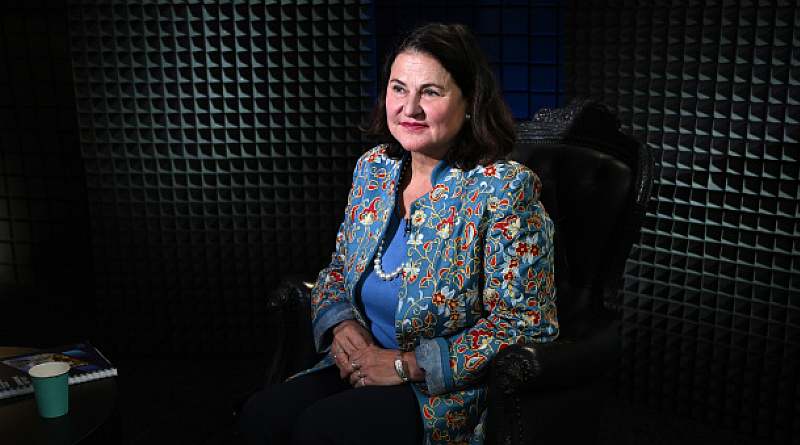
Yevhen Matyushenko, Brussels-Kyiv / Ukrinform
After Ukraine was congratulated on the opening of the first negotiation cluster during the second Conference on Accession between the EU and Ukraine on June 15 in Luxembourg, it is finally time for productive work from Kyiv, not just on a technical level, but officially, in fulfilling necessary requirements to close the cluster covering “fundamental issues”, the so-called “Foundations”. Next in line is the opening of five other clusters. Both the Ukrainian authorities and the European Commission, represented by Enlargement Commissioner Marta Kos, expressed hope that this step would be taken by July, before the summer break in the work of EU institutions.
One of the main drivers of the European integration process in Ukraine from the European Union side and a promoter of European values is the EU Ambassador to Ukraine Katarína Mathernová, who, by the way, is celebrating her birthday today. And today, following the “mega day” in the EU enlargement process, as it was dubbed in Brussels, Ms. Mathernová spoke with Ukrinform to summarize the current stage of Ukraine’s European integration and outline further steps critically necessary for realizing Ukrainians’ long-standing aspiration for EU membership.
I COULD NOT IMAGINE A BETTER BIRTHDAY GIFT
– Madame Ambassador, now Cluster 1 is officially open, and this has probably become one of the pleasant early gifts for your birthday today. Congratulations! We heard that the European Commission expressed the desire to open the remaining five clusters before the summer holidays. Considering the need for large-scale alignment of Ukrainian legislation with EU law, is it realistic to aim for full EU membership by 2030?
– Thank you. Indeed, I couldn’t imagine a better gift. Firstly, I believe that 2030 is a very viable term. Of course, the negotiation clusters will require many changes, but now we are talking about their opening, meaning official technical negotiations in specific areas. And I think Ukraine is ready for this.
Furthermore, the question of how quickly we can complete the negotiations will often depend on significant legislative and other work.
Regarding the opening of clusters, I think it would be wonderful if the idea to achieve this by this summer comes to fruition, and for that, sufficient political will is necessary.
– The unblocking of the first cluster occurred after agreements with the new Prime Minister of Hungary, Péter Magyar, regarding the rights of the Hungarian minority in Ukraine. From the EU’s perspective, does the current legislative framework of Kyiv fully meet the requirements of Cluster 1 regarding fundamental rights, or does Brussels expect further changes in domestic policy?
– The whole idea of opening clusters is that after opening, there will still be many alignments that must necessarily occur, and there will be many more requirements we have outlined in our position.
There are intermediate benchmarks that need to be met, but as the European Commission stated over a year ago, Kyiv had to meet the requirements specifically for opening the clusters. We are not yet talking about completing the discussions. So, the current alignment with EU legislation is now quite sufficient to start actual accession negotiations. That’s what the opening of the cluster means.
UKRAINE DOES NOT USE MARTIAL LAW AS AN EXCUSE FOR EXCESSIVE RESTRICTION OF RIGHTS
– Cluster 1 covers the judiciary, anti-corruption efforts, and internal security. How will the EU continue to monitor the independence of our anti-corruption bodies during active negotiations, and crossing which specific “red lines” could freeze progress?
– We will monitor the progress and independence of anti-corruption bodies in the same way we do now. I mean, issues of anti-corruption and the rule of law are, of course, an integral part of the first cluster.
But it’s not just about anti-corruption and the rule of law. It also includes the foundations of the market, economy, statistics, financial control, and the functioning of democratic institutions. So the “Foundations” cluster is quite large and covers all aspects of the functioning of a modern democratic state based on a market economy.
Therefore, it will obviously be closely monitored, but this also applies to the rest of the negotiations. Everything will be constantly monitored and evaluated.
– The first cluster significantly focuses on democratic institutions and fundamental rights. However, Ukraine operates under prolonged martial law, which naturally restricts certain peacetime civil liberties. How will the EU balance the strict requirements of the cluster with the practical realities of a country engaged in a full-scale war?
– First of all, I must note the remarkable fact that a country at war, fighting for its national survival, is actually reforming its state, its institutions, and its legal order. So this should not be taken for granted. Ukraine is truly unique in this regard. I don’t know of any other country that is engaged in an existential war and is simultaneously reforming. Martial law, as you mentioned, obviously imposes some restrictions on fundamental rights.
For example, there is a curfew at night. This is not normal, but I believe that Ukraine is currently balancing the restriction of freedoms to the extent necessary for waging war, but does not use this as an excuse for unnecessary restrictions.
NEW IMPETUS OBSERVED IN THE VERKHOVNA RADA
– Since the first cluster sets the overall pace of the entire accession process, any lag could suspend all other processes. What do you see as the greatest administrative or legislative obstacle that could delay Ukraine in meeting the interim benchmarks outlined in Luxembourg?
– Before I answer the question about obstacles, I don’t believe it’s correct to state that the first cluster sets the pace for overall progress. It is true that no negotiation chapters can be closed until the interim benchmarks are met. So yes, measures within Cluster 1 need to be carefully evaluated, but it is still about interim benchmarks.
Regarding your specific question, we very much hope that the legislative work will look like what we saw last week, rather than somewhat earlier.
I am very pleased that there seems to be a new impetus in the Rada for voting on EU-related legislation, and we welcome the adoption of the resolution on this issue last week. I think the interim benchmarks can technically be met. I also believe that this will require political decisions, political will, and a quick response from colleagues in Brussels.
THERE ARE WAYS TO CALM ECONOMIC CONCERNS OF SOME MEMBER STATES ABOUT UKRAINE’S ACCESSION
– Hungary is no longer the main obstacle in the enlargement process, but some other member states are now expressing cautious concerns about, for example, the capacity of our agriculture and market competition ahead of opening other clusters. How do you plan to help Ukraine overcome these evolving economic concerns among EU member states?
– Economic concerns have accompanied every stage of EU enlargement. There is nothing extraordinary about this. I believe I mentioned earlier that when Spain and Portugal joined the EU, wine producers in Italy and France were concerned. During the big expansion in 2004, “Polish plumbers” and “Czech truck drivers” caused great anxiety. So, when big changes occur, economic concerns always arise. By the way, we haven’t had a new EU enlargement since 2013, when Croatia joined. So everything is quite normal.
It would be good if all parties understood and addressed the existing issues. Ukraine is very competitive, which causes significant nervousness among European agricultural producers. We will simply have to work on this issue.
And the European Commission will be there to help and sort out where each specific concern originates.
I also expect certain temporary provisions will be implemented, related to specific sectors. But this will not devalue EU enlargement as a value for both sides if you look at the overall issue, even if temporary provisions are introduced in some areas.
For example, in 2004, 10 countries joined us, and most EU member states introduced a seven-year temporary provision that prohibited free movement of workers. Citizens of the new EU member states could travel but were not allowed to work in most EU member states. Seven years passed, the adaptation period ended, and now it is a matter of history, and no one even mentions it anymore.
