
Olesya Zhihalyuk, BBC News Ukraine
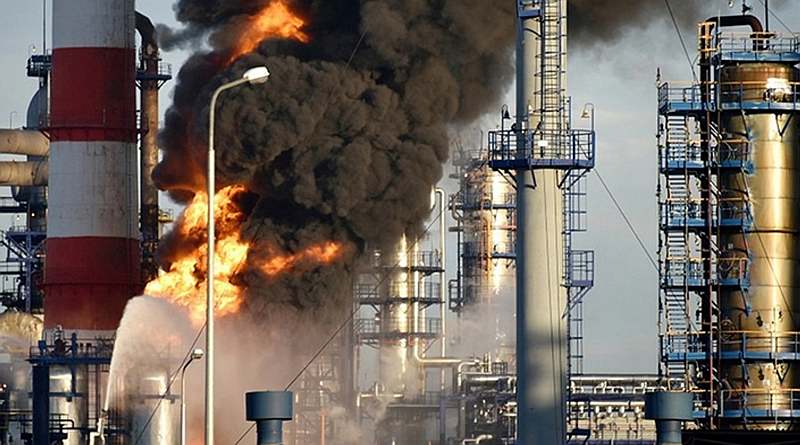
Almost a third of Russian oil refining capacities are currently non-operational due to strikes by Ukrainian drones. This assessment is provided by Energy Intelligence. Analysts warn: if the attacks continue, Russia may face the deepest fuel crisis in its history.
According to the publication, systems capable of processing 2.14 million barrels of oil per day are halted due to damage. This is almost a third of the country’s total refining capacity. In the first week of June, processing volumes fell below 4 million barrels per day – to the lowest level since 2005.
Particularly painful for the industry is the fact that Ukrainian drones are increasingly attacking not just individual facilities but the largest enterprises.
In May alone, Ukrainian drones successfully attacked Russian refineries 16 times, according to the publication. Eight out of the 10 largest refineries in the country were targeted.
“It seems that this summer Russia is moving towards what could become the worst fuel crisis in its history,” state Energy Intelligence analysts.
There’s oil. Nothing to process with
Bloomberg also reports that the consequences of the attacks have long gone beyond individual incidents.
The publication indicates that refining volumes in Russia have fallen to their lowest level in two decades.
Citing analysts from EA Analytics, Bloomberg notes that in May, Ukrainian forces focused on refining infrastructure. A total of 31 attacks on refineries, export terminals, and pipelines were recorded in one month. This is the highest monthly figure since the start of the full-scale invasion of Ukraine by Russia.
Despite Russia remaining one of the world’s largest oil producers and continuing to export raw materials, the problem is increasingly shifting from extraction to processing.
There’s enough oil, but turning it into gasoline, diesel, and aviation fuel is becoming increasingly difficult.
Signs of these problems are noticeable in the domestic market.
According to Energy Intelligence, restrictions on gasoline sales are in place in more than 25 regions of Russia.
Disruptions are noted in Moscow, St. Petersburg, Tatarstan, Kuzbass, Nizhny Novgorod, and Ulyanovsk regions. Some gas station networks are already selling no more than 20 liters of fuel per person.
The deficit is beginning to affect other sectors of the economy as well.
Russian farmers report issues with diesel fuel supplies in several agricultural regions.
Several airports in the country also report a shortage of aviation fuel.
Crimea shows how a fuel crisis might look
The most noticeable consequences of the deficit have been observed in annexed Crimea.
As BBC wrote, local authorities were forced to impose limits on gasoline sales, and some stations switched to a QR-code system for obtaining fuel. Residents report long queues and difficulties finding gasoline.
“I discovered a new type of happiness – a full tank of gasoline,” a resident of Bakhchisaray, Sergey, told the BBC.
According to the BBC, in some cases, sales were limited to 20 liters per person, and the right to refuel can only be obtained after registering in a special system.
Moscow tries to contain the consequences
The Russian authorities have already begun to take emergency measures.
According to Energy Intelligence, in April and May, oil companies received about 700 billion rubles in budget subsidies. Additionally, the government temporarily allowed the supply of lower ecological standard gasoline to the market.
Previously, Moscow Times also reported that some refineries were allowed to sell fuel with deviations from current environmental standards to compensate for the deficit.
However, many experts believe that the toughest period is yet to come.
“The most troubling thing is that the crisis is just beginning. The peak of seasonal demand comes in August-September, and signs of a deficit and accelerating price increases have already appeared in June,” says Yaroslav Kabakov, an analyst at one of the largest Russian investment companies “Finam”.
According to him, if the damaged refineries cannot be quickly restored, the fuel shortage may accelerate inflation and create additional problems for the Russian economy.
For now, high world oil prices help Moscow maintain export revenues.
However, analysts at Energy Intelligence and Bloomberg believe that a serious threat to the Russian oil industry today is already not associated with extraction but with the ability to refine oil.
This problem, according to analysts, may become one of the most painful consequences of the Ukrainian campaign of strikes on Russia’s energy infrastructure.
