

Glory to Ukraine!
Glory to the defenders of Ukraine and the entire modern civilization!
- Lindsey Graham and the evolution of the Republican Party.
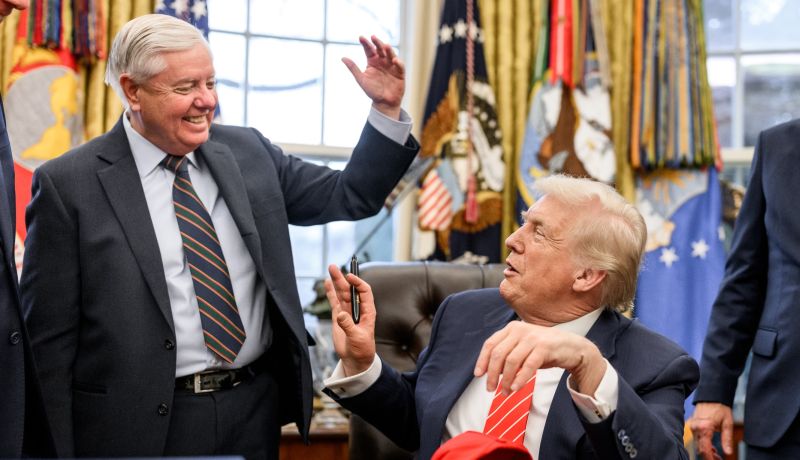
▶ On Saturday evening, Republican Senator Lindsey Graham passed away. This happened after his return from Ukraine. The last person he spoke to (by phone) was Donald Trump.
Obviously, this will greatly disappoint conspiracy lovers. For some reason, there are a lot of them among post-Soviet people. Why exactly there are so many among this category of people could be the subject of sociological research.
Conspiracists – from the far-right American influencer Laura Loomer to post-Soviet people – have unanimously decided to spread theories that Graham was poisoned, that Putin did it, that it’s a “special poison” from the KGB, and so on.
Conspiracy is a very great evil. It not only leads away from the truth but creates a virtual world that does not intersect with the real one and blocks the perception of the real world, destroying people’s ability to build cause-and-effect relationships.
The reality is that, as testified by the results of the autopsy and forensic medical examination, Senator Lindsey Graham died from an aortic rupture caused by thinning and dissection of its walls. This is a fatal complication of atherosclerosis of the coronary arteries feeding the heart.
Lindsey Graham was a very prominent political figure in Congress – both in the House of Representatives, where he served from 1995 to 2003, and in the Senate, where he was elected four times starting in 2002 and was to be re-elected for a fifth term in the November 3 elections.
If we trace his political career, the path he took in politics, we will, in fact, trace what has happened to the Republican Party over the past thirty years.
Graham was elected to the House of Representatives in November 1994, on the wave of what was later called the “Gingrich Revolution.” He was 39 years old and had two years of experience working in the South Carolina legislature. Graham became known nationwide during the impeachment of President Clinton in late 1998 – early 1999 – he was one of the official prosecutors (impeachment managers) representing the House of Representatives during the trial in the Senate, where Clinton was acquitted on all charges.
In 2002, Graham was elected to the Senate from the state of South Carolina.
For the next 14 years, until Trump was elected president in 2016, Senator Lindsey Graham was actively engaged in foreign policy issues. He became close to Senator John McCain. Graham’s views on foreign policy and the role of the US in the world matched the definition Graham gave himself — a Reagan-style Republican.
He never shared the desire of various American presidents to build relations with Putin’s Russia, considering Russia a hostile state. He voted in 2010 against the ratification of the US-Russia START-3 treaty on the limitation of strategic weapons and sharply condemned Russia’s 2008 aggression against Georgia.
He visited Ukraine with John McCain back in the summer of 2004, meeting with President Kuchma at that time.
Supported the war aimed at overthrowing Saddam Hussein and his regime in Iraq, supported the war against Al-Qaeda and the Taliban in Afghanistan.
Supported the Revolution of Dignity in Ukraine and from the first day of Russian aggression against Ukraine in 2014 supported Ukraine. Called for a boycott of the 2014 Winter Olympics held in Sochi.
Always actively supported Israel.
His foreign policy stance for many years was truly classic for American politics — spreading US influence in the world, expanding the free world, and strengthening the role of the US as its leader.
Throughout his years in the Senate, Graham showed his interest in foreign policy issues, frequently traveling to other countries as part of Senate delegations and also going on individual trips. He participated in various international forums.
In domestic politics, Graham was a fairly classic conservative. Here, with more or less some nuances, he rarely differed from the vast majority of Republicans.
But there is an entirely different aspect of Lindsey Graham’s political path. And this aspect shows what has happened and is happening with the Republican Party, where classic, “Reagan-style” Republicans are going.
In 2015, Graham announced that he was going to run for president from the Republican Party. Trump announced the same. Graham literally lashed out at Trump with devastating criticism, stating that Trump was a fanatic, that he did not share the country’s and the Republican Party’s values, and that to make America great again, Trump must be sent to hell.
But Graham’s electoral campaign did not go well. He had to drop out of the race almost before entering it—there was no money for the campaign, and polls showed he had no chance in the Republican primaries. Meanwhile, Trump won both the 2016 Republican primaries and the presidential election. From that moment, Graham’s path to Trump began. Lindsey Graham was an experienced politician, and his political instincts did not deceive him—if you want to be at the top of Republican politics, you need to be close to Trump. Otherwise, you’d be out of Republican politics and out of politics altogether. Graham gradually distanced himself from Senator McCain. This was especially evident during the Senate vote in the summer of 2017 on the bill to repeal the Affordable Care Act (Obamacare), which Trump advocated for. Three Republican senators—McCain, Collins, and Murkowski—voted against, preventing the repeal of Obamacare. For the first time on a fundamental issue, Graham openly parted ways with McCain. Increasingly, Graham stated in interviews that Trump was the acknowledged leader of the Republican Party, that he would remain the leader for a long time, and that those who did not recognize this had no place in Republican politics.
Step by step, Graham managed to gain Trump’s favor, including invitations to play golf. Although Trump told Graham in 2017 (as Graham himself recounted to Bob Woodward) that Graham was not yet a sufficient, fully sincere Trumpist. Graham had to strive to become sufficient and appear fully sincere. Graham actively defended Trump during his first impeachment.
On the night of January 7, 2021, after Trump’s attempted coup, Graham spoke in the Senate, saying “enough” and that the election results should be certified, and it seemed he was breaking with Trump. But no. A month later, Graham, like all Republicans in the Senate, had the opportunity to send Trump into political retirement by voting to convict him in the second impeachment. However, Graham voted against convicting Trump for inciting an attempted coup, along with 42 other Republican senators, allowing Trump to remain in politics and at the helm of the Republican Party.
In 2024, Graham supported Trump in the presidential election. It should be noted that at the time of the 2024 election, Trump was a convicted criminal, having been found guilty by a court of falsifying 34 financial documents, was involved in three other ongoing criminal cases, was found guilty by another court of sexually assaulting a woman, and yet another court found his business guilty of systematic long-term financial fraud, prohibiting him from managing businesses in the state of New York. But it was this candidate that Graham supported in the 2024 election.
In supporting Trump in the 2024 elections, Graham actively participated in blocking, under Trump’s directive, the allocation of funds for military aid to Ukraine. From October 2023 to the end of April 2024, Republicans blocked the consideration of a bill to aid Ukraine. Initially, they put forward a contrived pretext linking military aid to Ukraine with funding for strengthening the southern border. When Democrats agreed to this and an appropriate bill was developed, in February 2024, Graham voted against it in the Senate.
When Trump became president, Graham voted in the Senate to confirm a slew of the most incompetent people in history—Director of National Intelligence (Gabbard), Secretary of Defense (Hegset), FBI Director (Patel), Secretary of Health (Robert F. Kennedy Jr.).
However, Trump apparently no longer considered Graham lacking or insincere as a Trump supporter. Graham became the closest to the president among all Republican senators, becoming a frequent weekend guest and regular golf partner.
This whole story is about how the Republican Party changed. How “Reaganite” Republicans became Trumpists. Or exited politics.
From February 24, 2022, to today, 24 American senators visited Ukraine: 14 Democrats and 10 Republicans.
Of these ten Republicans:
✓ Lisa Murkowski often shows independence from Trump, as she doesn’t depend on him due to her popularity in Alaska—Trump tried to run his candidate against her in the primaries, but that candidate lost.
✓ Susan Collins, less frequently than Murkowski, but still sometimes shows independence from Trump, and Trump knows he won’t find another Republican in Maine capable of winning Senate elections.
✓ Mitch McConnell declined to run for re-election. Currently, he’s been in the hospital for three weeks. No more initiatives supporting Ukraine are expected from him due to his health condition. It’s unknown if he’ll be able to return to work in the Senate at all.
✓ Thom Tillis declined to run for re-election due to his disapproval of Trump.
✓ Rob Portman declined to run for re-election back in 2022 due to his disapproval of Trump.
✓ Joni Ernst declined to run for re-election due to her disapproval of Trump.
✓ John Cornyn was ousted from Republican politics by Trump (lost the primaries to a Trump-supported candidate).
✓ Lindsey Graham died last Saturday.
✓ John Barrasso and Stephen Daniels continue to work in the Senate and are absolutely in sync with the president during Trump’s second term. They visited Ukraine during Biden’s presidency.
Graham appeared to be the last of the Republicans who became fully Trumpian in domestic politics, publicly supporting Trump while trying to remain a “Reagan Republican” in foreign policy views (except for the time when he participated in blocking aid to Ukraine for six months – from October 2023 to April 2024).
He attempted to combine things that are difficult or even impossible to reconcile. It was on his advice that Ukraine signed the “mineral agreement” with Trump, hoping that Trump would have a better attitude toward Ukraine because of it. He gave Zelensky advice on how to deal with Trump. He initiated a sanctions bill that he never saw considered, as Trump still didn’t want to review it, and Republican Senate Leader John Thune refuses to put anything on the Senate’s agenda that isn’t Trump-approved. The idea of the sanctions bill was designed to appeal to Trump – sanctions in the form of 500% customs tariffs on imports from Russia (a purely symbolic gesture, as the US buys virtually nothing from Russia) and on imports from countries buying Russian oil, i.e., imports from China and India. It’s impossible to expect Trump to impose such tariffs after his defeats in the trade wars he began. But if the law had been passed, it would have had political significance from different perspectives – both to pressure China and India and their companies buying Russian oil, and to prevent Trump from aligning with Putin (remember, the bill was proposed during Trump’s enthusiastic tweets after each conversation with Putin), and to provide a platform on which another bill introducing real sanctions against Russia could later be adopted.
Can traditional American foreign policy of spreading American influence, supporting democracy worldwide, fighting authoritarianism – can this be combined with Trump’s approaches to politics?
Graham tried to do this. Although how to reconcile morality with immorality, perhaps only he understood.
There are 921 days left until the end of the story called “Fear: Trump in the White House” © (title of Bob Woodward’s book published in 2018).
Thank you to everyone who read this. Take care of yourself and your loved ones. Take care of each other, help each other. Health to all.
Ultimately, what happens in the world depends on us. Whether we fight evil, do good, remain just observers, wait passively and hope someone somewhere will decide something for us, or fight evil and do everything possible for good to triumph.
We must not allow evil to win. The victory of evil would mean the end of the world we live in. We cannot allow this. Especially now.
Ukrainian friends, I embrace and love you all. Please take care of each other, I beg you.
Ukraine is and always will be.
And evil will be defeated and punished. And it certainly will be.
