
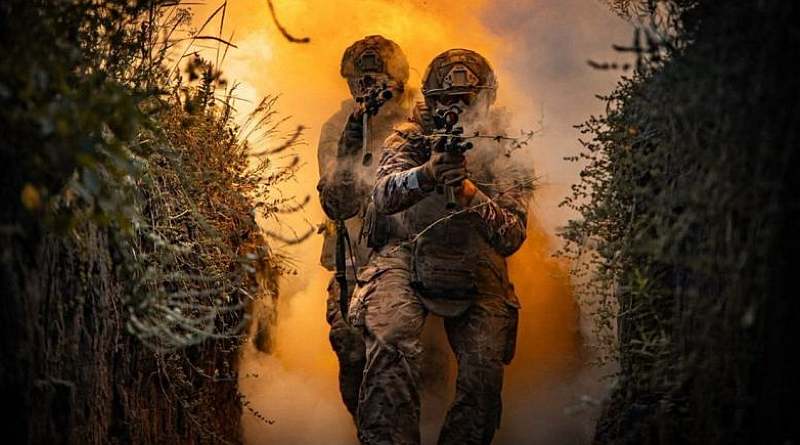

Today – Lyman direction.
We will examine it according to the old familiar scheme:
– Composition of forces and means of the enemy forces operating in this direction.
– Current situation.
– Prospects for its further development.
1. In this direction, the forces and means of the Russian troop grouping (TG) “Zapad” (also known as the Moscow Military District MMD) operate, specifically the troops of its left flank. Their foundation comprises the forces and means of two combined arms armies (CAA) — the 20th and 25th CAA. For the offensive in the direction of Lyman earlier, they were additionally reinforced by part of the forces of the 1st Tank Army (TA) of the same TG “Zapad” — several units of the 1st and 15th motorized rifle regiments (mrr) of the 2nd motorized rifle division (mrd).
Currently, the composition of enemy troops operating in the direction of Lyman is approximately as follows:
20th CAA:
– 3rd mrd – 252nd, 362nd, and 752nd mrr, 237th tank regiment (tr), 99th self-propelled artillery regiment (sar);
– 144th mrd – 254th, 283rd, and 488th mrr, 59th tr, 856th sar;
– its reinforcement – units of the 1st and 15th mrr of the 2nd mrd 1st TA.
25th CAA:
– 67th mrd – 31st, 36th, and 37th mrr, 19th tr;
– 164th separate motorized rifle brigade (smrb);
– 169th smrb;
– 11th separate tank brigade (stbr).
Besides the above-mentioned enemy forces and means, parts and units from the “territorial troops” (TT) and “mobilization reserve” (MR), at the level of “separate motorized rifle/rifle regiment” (smrr/sr) and “separate motorized rifle/rifle battalion” (smrb/srb), are also recorded in the bands of both armies. Likely, within the bands of both armies, there are up to 2-3 regiment-level formations and up to 4 (possibly up to 5-6) battalion-level formations.
In almost all forward parts and units of both armies, composite “assault groups/units” at the level of “assault company/platoon” were formed in most cases. It is with their forces that the enemy command conducts direct assault actions in the tactical zone, using forces of forward parts and units not engaged in them mainly for consolidating and holding captured positions and lines. In some cases, for building up efforts when advancing in the tactical zone.
For these purposes, the Russian command uses not only infantry groups and units but also specialized tactical UAV units with sufficiently powerful artillery and aviation support. Armored vehicles are used relatively rarely, usually in a “scatter” method (no more than 2-3 units, less often up to 4-5, and even less often the number of armored vehicles involved in attacking/assault actions can reach 8-10 units). Mainly for delivering assault groups to the line of transition to attack/assault and, accordingly, their fire support.
To increase the mobility of its assault infantry and to advance deeper and faster in the so-called “kill zone” and in the battle formations of the forward Ukrainian units, the Russian command in some cases equips the personnel of its assault groups and units with light motorization means (motorcycles, buggies, etc.).
2. The current situation in the Lyman direction is characterized by a number of significant tactical changes that have occurred during the reporting period. In particular:
– It is evident that in the strip of its 20th CAA, the enemy was forced to switch from offense to active defense. This primarily concerns its bridgehead on the Chorny Zherebets River, where Ukrainian forces managed through active counterattacks not only to stop the enemy’s offensive actions but also to advance in several directions and on specific areas.
– In turn, in the strip of its 25th CAA, the enemy was forced to significantly reduce the intensity of its offensive actions and also to retreat from some of its forward positions.
Specifically:
– The Armed Forces of Ukraine (AFU) have evidently “returned” to the territory of the Luhansk region, liberating the village of Hrekivka and advancing southeast from it towards the village of Makiyivka by 1.5 km.
– Additionally, Ukrainian forces have likely advanced in the direction of Novy Myr – Novomykhailivka, driving the enemy out of the latter.
– Furthermore, they have likely reached the Ridkodub – Katerynivka line and advanced from it to the northern outskirts of the village of Nove (forward Ukrainian positions are already approximately 500-600 meters from them), although, likely, fights for the Katerynivka area continue. AFU also advanced in the direction of Karpivka – Nove by approximately 3.2-3.4 km and reached Nove from the west at a distance of less than 2 km.
– At the “top” of the enemy’s bridgehead, the AFU seem to have been able to completely eliminate a small tactical bridgehead of the 20th Russian CAA on the Nitrius River, forcing the enemy to withdraw from the village of Serednye and also from areas north and south of it on the western bank of the river. However, the enemy continues to hold the village of Shandryholove on the opposite bank.
– It is apparent that Ukrainian units also completely “cleared” small enemy infantry groups previously recorded in Novoselivka and Drobysheve. However, the enemy evidently still holds Derylove.
– Ukrainian forces likely also managed to advance in the directions of Stavky – Kolodiazy, Stavky – Bilohorivka, reaching directly to the outskirts of both Kolodiazy and Bilohorivka. Although in the Stavky – Kolodiazy – Myrne – Zarichne area, numerous “residual” small enemy infantry groups are still recorded, which previously tried to penetrate from this direction into the northeastern part of Lyman.
– But the enemy continues to hold several of its forward positions west of Zarichne and Torske (approximately 2-2.2 km from them, mainly on both sides of the Zarichne-Lyman road).
– In the zone of the Russian 25th GTA, Ukrainian forces have evidently managed to completely drive the enemy out of the southeastern part of the city of Lyman. In this regard, it is worth noting that the enemy continues to hold several of their small infantry groups only in a few blocks on the outskirts of Partizans’kaya and Vyshneva streets. However, they are likely absent from the rest of the city.
– To the southeast of the city, in the Lyman — Yampil — Ozerne — Dibrova area, intense battles continue. Ukrainian forces have evidently expelled the enemy from Dibrova and forced them to withdraw the main forces of their advanced units to the Lyman — Zakytne road, as well as in some sections beyond it. Currently, only one “very small” enemy infantry group is reported in the Dibrova area.
However, fighting for Ozerne still continues. The enemy likely continues to control the northeastern part of the village and the section located east of the Kryva Luka-Yampil road. The same situation is also in the Yampil area.
– It is likely that a “stabilizing” effect on the situation in the zone of the Russian 25th GTA is exerted by the fact that its command is firmly holding a significant forest area between Yampil and Lyman, which they can successfully use as a platform for active offensive actions, and if necessary, for counterattacks both towards Lyman and to the southwest, through the Lyman — Zakytne road.
3. Thus, regarding the overall (operational) situation on the Lyman front, it can be noted that Ukrainian forces, as a result of active counterattacks in the tactical zone, have managed to completely stop the advance of the Russian 20th GTA from its bridgehead on the Chornyi Zherebets river north of the city of Lyman. However, I emphasize that at the moment, it is premature to speak of the complete elimination of the bridgehead itself (Russian forces continue to hold positions on the eastern bank of the Nitreus river, in the Katerynivka area, and along the Kolozy — Bilohorivka line). Thus, the flanks of this bridgehead of the Russian 20th GTA remain more or less stable, although they are under considerable pressure from Ukrainian forces.
Overall, from an operational standpoint, there are several factors indicating that the situation for Russian forces on the Lyman front continues to develop unfavorably for them, including:
– It is evident that the transition of the Russian 20th GTA to active defense on their bridgehead north of Lyman, in the context of the current Sloviansk-Kramatorsk offensive operation, where the elimination of the Lyman bridgehead by the Ukrainian Armed Forces is evidently one of its key elements, has quite a negative impact.
Although, of course, as long as the Russian 3rd GTA from the “Yug” group continues to advance south from the Siverskyi Donets towards Sloviansk, this effect is somewhat mitigated.
– It is evident that, in due time, the command of the Ukrainian forces operating in this direction adequately assessed the most vulnerable areas and directions of Russian actions, which attempted to “isolate” the Lyman defense area of the Ukrainian Armed Forces from the northwestern direction and for this purpose penetrated tactically deep into the defense system of the Ukrainian Armed Forces north of the city. Specifically – their flanks.
Throughout the spring, I wrote in my reviews about this direction, stating that the Yarova — Novoselivka — Drobysheve — Pryshyb area in the “battle” for Lyman would be one of the key points. Indeed, that’s exactly what happened. The command of the Russian 20th Guards Army concentrated its main forces (almost the entire 144th Motorized Rifle Division and a significant portion of the 3rd Motorized Rifle Division), including reinforcements from the 1st Tank Army (i.e., units of the 2nd Motorized Rifle Division), on the bridgehead towards Svyatohirsk (i.e., in the direction of this area).
At the same time, it essentially limited itself to “private” defense in the area of its 3rd Motorized Rifle Division. Meanwhile, the Russian 25th Guards Army could not fully “push” the AFU away from the Black Stallion in the area of Zarychne and Myrne, thus maintaining the possibility for the AFU to counterattack the 20th Guards Army on its southern, left flank. The Ukrainian command immediately took advantage of this, with their active actions towards Ridkodub — Nove, as well as towards Bilohorivka and Kolodyazi being a vivid example of this.
The distance between the northern outskirts of the village of Nove and the southern outskirts of the village of Kolodyazi, where forward infantry groups of the AFU have already been recorded, is less than 10 km.
If the AFU liberate the village of Nove and continue the offensive from south to north along the Stavy — Nove road, the fate of the Russian bridgehead will be predetermined. Especially if the strike tactical groups of the AFU, operating in these directions, simultaneously advance from the north and south and subsequently unite, for example, in the area of the village of Zelena Dolyna.
– The Russian 25th Guards Army, which previously had the obvious order to “storm” Lyman, naturally “in coordination” with the 20th Guards Army, whose main task was to break through to Svyatohirsk and “isolate” Lyman itself from the north and northwest, still holds quite convenient “starting” positions and areas for this, but cannot proceed directly to the assault.
In reality, this army is bogged down in battles in the wooded area southeast of Lyman. Several semi-successful “forays” by its “stormtroopers” into Lyman from the Yampil Forest have not affected the overall situation in this regard. Since its forward parts and units still do not confidently control Dibrova, Ozerne, or even Yampil itself, though they are present in all these settlements.
Yes, on one hand, it is convenient to accumulate assault infantry in the forest, which approaches close to the city, for its further penetration into the city. But, on the other hand, this is exactly what the enemy expects from you, and naturally, they are preparing for such actions.
Moreover, this process becomes even more complex and prolonged if it is necessary to constantly repel enemy counterattacks on the flanks of this forest, and in addition, the enemy continues to hold several positions in its rear.
Some time ago, the command of the Russian 25th Guards Army tried to resolve this “problem” decisively and immediately by breaking through to Brusivka and Staryi Karavan, thereby completely bypassing the AFU’s Lyman defense area from the south. However, the opposite happened, and ultimately they were forced to “move” in the area of Dibrova.
– And the most important factor, which is quite possible at the moment, is the impact on the situation in other areas due to the complete elimination of the bridgehead of the Russian 20th Combined Arms Army (or at least most of it) on the Chornyi Zherebets River north of Lyman in the event of further successful advances by the Ukrainian Armed Forces on its northern and southern flanks. After all, in such a case, it becomes quite obvious that such further developments could, to some extent, “free up” the Ukrainian command to reinforce their defense not only in the sector adjacent to the Russian 20th Combined Arms Army of the Russian 25th Combined Arms Army but also generally south of the Siverskyi Donets in the Slovyansk direction.
Photo: General Staff of the Ukrainian Armed Forces
