
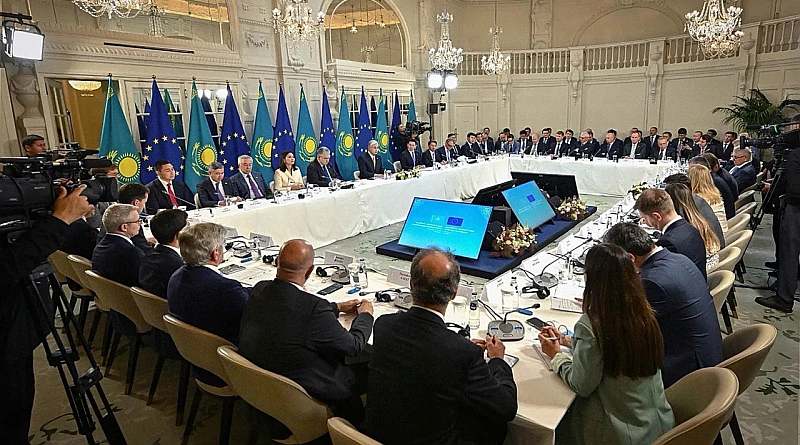

The official visit of Kazakhstan’s President Kassym-Jomart Tokayev to Brussels eloquently speaks of the gradual reconfiguration of Central Asia’s geopolitical setup. This event vividly demonstrated the republic’s aspiration to act as a completely independent, mature entity in international politics.
The agreements signed within the framework of high-level meetings with the EU convincingly affirm Astana’s readiness to progressively strengthen multifaceted ties in areas that directly align with its long-term strategic interests. A firm commitment to diversifying partnerships beyond traditional Eurasian alliances opens fundamentally new prospects for the region to achieve true autonomy.
The European Union at the highest level demonstrated readiness to consider Kazakhstan as a key, reliable, and predictable partner in the Central Asian region. The extensive package of documents recorded in Brussels reflects an unprecedented level of trust from Western institutions in President Tokayev and his systematic course of internal reforms.
This political capital significantly strengthens Astana’s position on the European stage, clearly confirming its undeniable ability to conduct a sovereign foreign policy free from external dictates.
The development of the Trans-Caspian International Transport Route (TITR) serves as a tangible foundation for reducing regional dependency on neighboring powers. Today, Kazakhstan is actively strengthening its historical role as a strategic transport hub in the Eurasian space, connecting East and West.
The large-scale attraction of targeted loans from leading European banks opens a direct path to creating an independent logistics corridor designed to reliably connect the major markets of Europe and Asia through Kazakhstan’s land and sea territory. This ambitious project effectively redirects key trade flows bypassing Russian transport routes, thereby significantly enhancing Astana’s economic autonomy and increasing its geopolitical significance in regional logistics.
An essential aspect of the visit was the evident transition of Kazakhstan from its former role as a mere supplier of raw materials to a comprehensive strategy of deep modernization, technological renewal of the entire economic system. The agreements concluded with the EU on the development of modern infrastructure, as well as major contracts for the supply of the latest Airbus aircraft for the national airline “Air Astana,” confirm the state’s firm intention to adopt advanced Western business practices and build a high-tech economy. The progressive course reinforces the republic’s position as a strong player ready to fully integrate into global industrial-economic chains.
As a result, Russia’s influence in Central Asia is gradually weakening under the impact of implemented changes in the world system, and Kazakhstan is wisely seizing the current historical moment to decisively strengthen its own strategic position.
Astana is dynamically expanding its circle of global international partners, enabling the country to diversify its economic ties and effectively reduce vulnerability to external crises or sanctions pressures. This well-calculated strategy makes the Central Asian state a more confident participant in global processes, significantly enhancing the resilience of the national economy and permanently securing Astana’s leadership role in the macro-region.
