
Brian Schwartz, Robbie Gramer and Daniel Michaels, Wall Street Journal / Translation by iPress
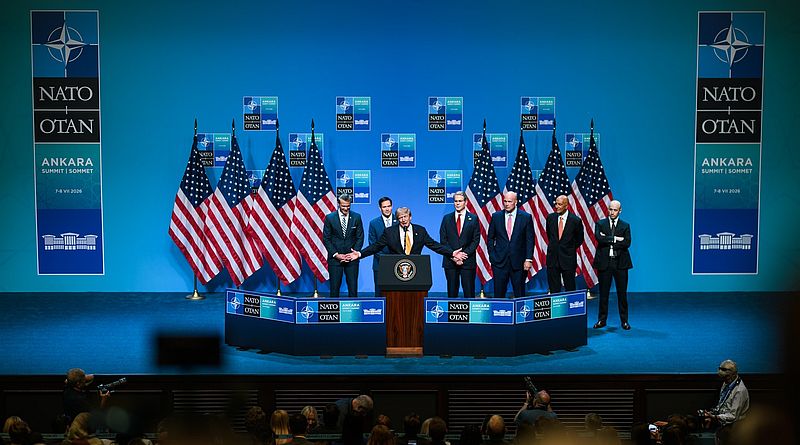
The American Wall Street Journal explains how NATO leaders adapted to the unpredictability of Donald Trump by significantly lowering their own criteria for success at the Turkey summit. The main goal now is not to solve alliance issues but to keep the US president in a good mood. The publication highlights the contrast between an irritable Trump, who publicly criticized allies and revisited the Greenland topic, and a much more amicable version of the president at closed meetings and a private dinner with Erdogan. It also discusses the flattery and public praise strategy employed by European leaders and NATO Secretary-General Mark Rutte to maintain Trump’s engagement, as well as skepticism among some European officials about the longevity of this approach.
US allies managed to avoid a loud confrontation at this year’s NATO summit in Turkey, writes the American Wall Street Journal. According to the publication, when President Trump arrived at the annual NATO leaders summit this week, US allies weren’t sure whether he would appear as a friend or a foe. In the end, they saw both, which was entirely acceptable to NATO leaders since they considered it a victory that Trump didn’t threaten to completely withdraw from the alliance.
According to WSJ, the general relief among US allies regarding Trump’s current, albeit tentative, restraint from undermining NATO reflects a new reality faced by the alliance. Instead of seeking breakthroughs in resolving numerous organizational issues, its members now view keeping Trump in a good mood as the main measure of success.
Trump arrived at the summit on Wednesday in a bad mood. He stated that he might not have attended at all if the event wasn’t hosted by his friend, Turkish President Recep Tayyip Erdogan.
He expressed dissatisfaction with Europeans who did not support the US war against Iran and specifically criticized Spain for insufficient defense spending. Trump also again raised the issue of gaining control over Greenland, reiterating territorial claims he made against NATO ally Denmark earlier in January, which at the time caused the deepest internal crisis the alliance had seen in decades.
However, WSJ notes that at the closed meeting of state leaders that followed, Trump, according to attendees, behaved much more amicably. He did not mention Greenland, praised countries with high defense spending for their efforts, and barely touched on the Iran issue.
At a private dinner hosted by Erdogan at his residence on Tuesday, world leaders generously showered Trump with compliments, an American official familiar with the event reported. Two other officials familiar with the details of the dinner noted that the atmosphere was very warm, and their leaders were relieved when it became clear that the evening would not escalate into a conflict.
After dinner, a high-ranking European official sent colleagues a text message with a single word-summary: “Phew.”
According to WSJ, Erdogan greeted Trump with all due honors, arranging a ceremonial guard at the airport. An official familiar with the situation said he gifted Trump and other world leaders personalized weapons – revolvers with live ammunition and engraved names. Leaders from countries with strict gun laws, according to another official, left the gifts in Turkey and did not take them home.
Summit participants disagreed on whether the compliments showered upon the American president by European leaders were sincere. But Trump made it clear: it had an effect on him.
“There was tremendous love in the room,” Trump said about the leaders’ meeting on Wednesday during a lengthy press conference, where he touched on topics from communism to the automotive industry, occasionally speaking favorably of the allies who praised him.
“They said: Sir, we love you. And these were grown-up people saying it. Isn’t it nice? – Trump continued. – Or maybe not, I don’t know. Maybe they’re just trying to appease me. And to some extent, they succeeded because there was significant unity in that room.”
Trump also hinted that his disputes with Italian Prime Minister Giorgia Meloni and other European leaders over the lack of support during the war with Iran might be left in the past. “Spain behaved very badly, but Italy did well, and most countries in general did okay. They just had an unfortunate moment. They didn’t help us.”
Several European officials noted that the leaders’ meeting went better than expected. This indicates both relief and lowered expectations after almost a year and a half of pressure from Washington.
NATO Secretary General Mark Rutte is making significant efforts to maintain the appearance of alliance unity and support for Trump: he publicly praises the president and downplays the sharp, often public clashes between Trump and European allies that preceded the summit.
This tactic, WSJ notes, sometimes irritated certain European leaders during crises – for example, when Trump threatened to annex Danish Greenland by force.
“I’ve always believed that families that sometimes have frank heart-to-heart conversations, and sometimes a small quarrel, are stronger than those that say: ‘Let’s just not argue. To maintain external harmony.’ This is a mistaken approach,” Rutte stated at a press conference on Wednesday.
Rutte urged European alliance members and Canada to increase defense spending and accelerate military build-up, noting that progress in defense is being shown by all allies without exception. According to individuals familiar with the negotiations, Rutte also responded to Trump’s criticism in private conversations.
As WSJ notes, this year’s summit in the Turkish capital was intended to demonstrate alliance unity and a readiness to invest in defense, despite the political intrigue behind the scenes. It began with a defense industry forum where allies announced defense contracts worth billions of dollars.
“Obviously, the alliance is in a very different position now than it was a year ago,” noted Torrey Taussig, a former Pentagon official and now a fellow at the Atlantic Council think tank. “Europeans are making significant strides in defense spending, innovations, and military production.”
WSJ emphasizes that alliance members hope by showing a new determination to make NATO more capable and strong, Europe and Canada can appease Trump and keep his interest in alliance matters.
“I think what annoys Donald Trump the most is when there are many words but few real actions,” said the President of the Czech Republic Petr Pavel, a retired army general who previously served as NATO’s top military adviser, in an interview. “When he sees that things are indeed changing, there are concrete results and real commitments, his irritation smooths out a bit.”
Other Europeans are less optimistic, stresses WSJ.
“The bar is currently quite low,” noted former Slovak ambassador to NATO and now a member of parliament, Tomáš Valášek, who was present at the summit. “It’s just about avoiding a serious split and a PR disaster.”
Commenting on the strategy of flattery as a way to keep the summit on track, Valášek added, “It is, of course, a terrible system, but it is better than any other alternative.”
Photo: The White House
