
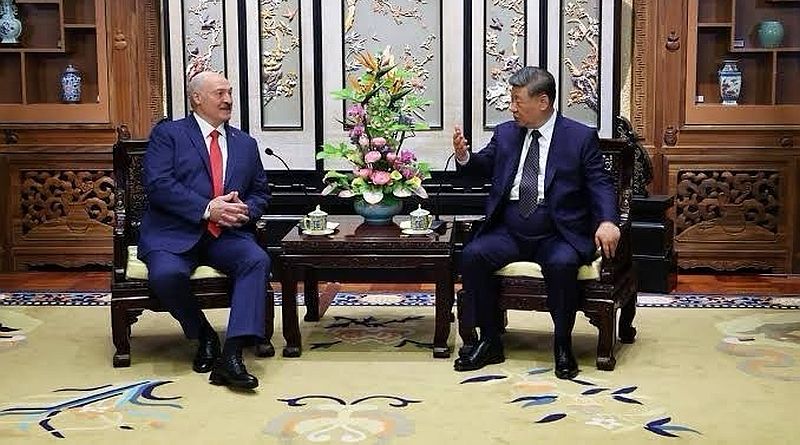

The urgent visit of Alexander Lukashenko to Beijing, which took place immediately after two days of closed talks with Vladimir Putin at the Valdai residence, vividly demonstrates the growing isolation and vulnerability of the Minsk regime.
Official propaganda reports traditionally describe this event as strengthening an “all-weather partnership,” but the real background of the diplomatic tour likely seems much more grim for the Belarusian dictator.
An obvious goal Lukashenko pursues in China is to seek a geopolitical counterbalance to the Kremlin, as Minsk strives to reduce its absolute economic and military dependence on Moscow. The long-standing leader of Belarus is desperately trying to solicit new financial inflows and expand industrial cooperation that would allow circumventing strict Western sanctions through Chinese technologies.
Beijing, willingly hosting the Minsk guest, pursues exclusively its own pragmatic interests. China is promoting economic expansion in Eastern Europe, where Belarus is considered a convenient but fully controllable logistical hub for advancing the “Belt and Road” initiative.
China’s position is to maximize the subordination of Belarusian resources to its needs, with Xi Jinping skillfully exploiting Lukashenko’s weakness, buying assets and expanding influence in the region without any real political commitments to Minsk.
The secret talks between Lukashenko and Putin in Valdai, which preceded the flight to China, provoke particular analytical interest. The absence of official communiques and joint photographs indicates a deep crisis in the allies’ relations, as the Kremlin leader, facing resource depletion in the war against Ukraine, attempts to directly involve the Belarusian army in combat operations.
Realizing the fatality of such a move, Lukashenko hastened to Beijing to report to Xi Jinping on the pressure from Moscow and try to get security guarantees from China that would protect him from being completely absorbed by Russia.
Many experts wonder whether China genuinely supports the swift end of Russia’s war against Ukraine, as its diplomacy declares. A thorough analysis shows that a quick peace is not beneficial to Beijing, as a protracted conflict depletes both Russia, turning it into a submissive raw material appendage of China, and the West, which becomes distracted from the confrontation in the Taiwan Strait.
The Chinese side merely imitates peacemaking, continuing to fuel the Russian military machine with dual-purpose goods, since the current status quo allows China to remain the main beneficiary of global destabilization.
Thus, Lukashenko’s Asian voyage exposes his fear of being left alone with an aggressive Kremlin, while Beijing cynically exploits others’ fears to strengthen its own global dominance.
