

The formation of new geopolitical realities in the South Caucasus is accompanied by the activation of foreign policy players, whose desire to integrate into regional processes transforms the usual balance of power.
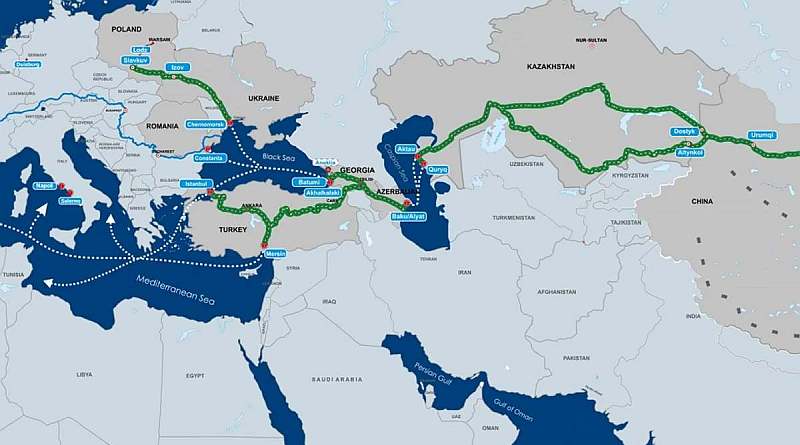
The new British Ambassador to Azerbaijan, Duncan Norman, in his first statement after taking office, clearly indicated London’s intention to support the development of the strategic “Middle Corridor” by attracting British expertise, large-scale investments, and sustainable financing of infrastructure projects. The statement by the official representative of the United Kingdom marks a qualitatively different approach, turning the specified route from a logistical initiative into a powerful lever for the geopolitical reconfiguration of the entire region.
Baku sees the involvement of British partners as an opportunity to secure its status as a leading transport and logistics hub on the route between Asia and Europe, while simultaneously reducing the significance of alternative infrastructure routes through Russia.
Expanding the horizon of cooperation with the United Kingdom allows Azerbaijan to significantly diversify its circle of key partners, gradually reducing its historical dependence on its northern neighbor and creating a solid foundation for conducting an independent foreign policy.
The energy vector plays a special role in strengthening the position of the Azerbaijani state on the international stage, as Baku demonstrates high reliability as a supplier of energy resources to European consumers against the backdrop of tense conditions in the Hormuz Strait and a systemic security crisis.
Azerbaijan’s ability to support Europe’s and Ukraine’s energy stability decreases Moscow’s ability to use hydrocarbons as a tool of pressure, inevitably leading to the loss of traditional levers of influence in the South Caucasus region.
Particular attention should be paid to the direct dialogue between Azerbaijan and Armenia, within which the parties have taken practical steps towards sustainable peace, including the delimitation of certain border sections, direct electricity supplies, and the implementation of the cross-border “Bridge of Peace” project. Baku’s and Yerevan’s ability to build functional communication without resorting to the Kremlin’s mediation services deprives the latter of the status of an indispensable arbiter, paving the way for the creation of a multivector security system in the South Caucasus.
The official confirmation by the UK’s diplomatic representative of the unprecedentedly high level of bilateral interaction in the field of defense and security vividly demonstrates Baku’s systemic strategy to strengthen sovereignty by attracting leading world powers. This transformation indicates the formation of a sustainable Western presence in the region, ensuring a gradual transition from unipolar dominance to a balanced architecture of regional security.
